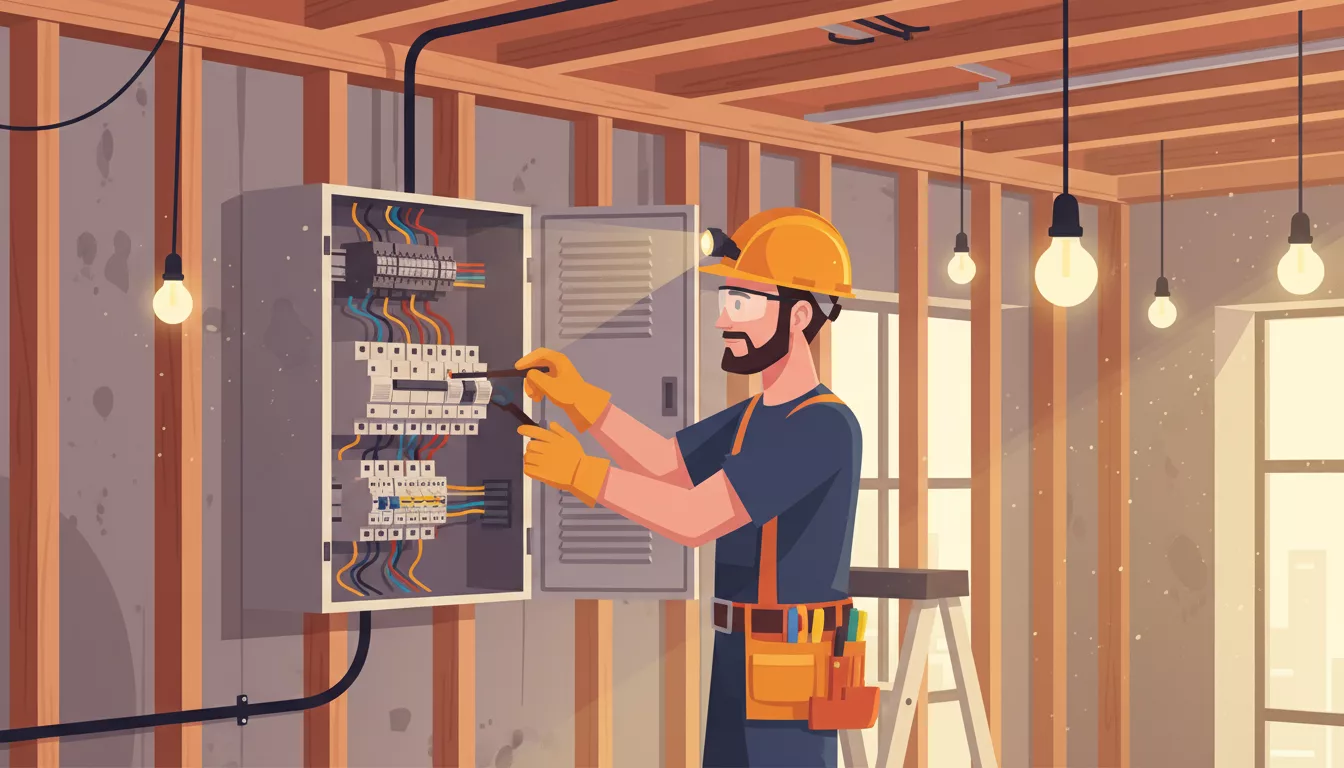
An Honest Look at the Electrician Career Path
Here's what nobody tells you when they say "just go into the trades." Becoming an electrician is one of the best career decisions you can make right now - the pay is solid, the demand is insane, and you won't have $150,000 in student loans following you around for 20 years. But it's not a shortcut. The path from zero experience to licensed electrician takes 4-5 years of apprenticeship, thousands of hours of hands-on work, and passing licensing exams that have a real failure rate.
That said? It's absolutely worth it. Licensed electricians earn $60,000 to $100,000+ depending on where they work and what they specialize in. Master electricians who run their own shops can clear well into six figures. And unlike a lot of white-collar jobs, nobody's going to outsource your work to another country or replace you with ChatGPT. Someone still has to physically wire that building.
This guide walks through exactly how to become an electrician from scratch - what the apprenticeship process actually looks like, how licensing works, what the money progression looks like at each stage, and how to pick the right specialization for your goals.
What Electricians Actually Do (It's Not Just Wiring Houses)
Most people picture an electrician crawling through an attic running Romex wire. And sure, that's part of it. But the electrical trade covers a huge range of work, and your day-to-day can look completely different depending on which direction you go.
Residential Electricians
This is what most people think of. Wiring new homes, upgrading electrical panels, installing outlets and fixtures, troubleshooting circuit problems in existing houses. It's the most common entry point, and apprenticeships in residential work are easy to find. The work is physical but not brutally so - you're usually inside, the scale is manageable, and you get variety from house to house.
Commercial Electricians
Office buildings, retail stores, restaurants, hospitals. Commercial work involves bigger systems - three-phase power, more complex panel configurations, fire alarm systems, emergency lighting. The pay is generally better than residential, and the projects are larger. You'll work with blueprints more and coordinate with other trades on job sites.
Industrial Electricians
Factories, power plants, manufacturing facilities. This is where things get serious. You're working with high-voltage systems, motor controls, PLCs (programmable logic controllers), and equipment that can actually kill you if you make a mistake. Industrial electricians earn the most, but the work is also the most demanding and the environments can be rough - loud, hot, and sometimes hazardous.
Other Specializations
Lineworkers work on the power grid itself - the poles and transmission lines that bring electricity from power plants to buildings. Solar installers focus on photovoltaic systems. Low-voltage technicians handle data cables, security systems, and telecom. Marine electricians work on ships and boats. Each has its own career path and earning potential.
Do You Need a Degree? Education Requirements Explained
Short answer: no, you do not need a college degree to become an electrician. That's one of the biggest draws of this career. But you do need some things.
Minimum Requirements to Start
- High school diploma or GED - This is essentially universal. Every apprenticeship program requires it.
- Basic math skills - You need solid algebra. Not calculus, not statistics, but comfortable working with fractions, decimals, basic geometry, and simple algebra. These are skills worth highlighting on your resume later. You'll be calculating wire sizes, voltage drops, load capacities, and conduit fill every single day.
- Physical ability - You'll be on your feet 8-10 hours, climbing ladders, working in tight spaces, lifting up to 50 pounds regularly. Color vision matters too - you need to tell wire colors apart reliably.
- Clean drug test - Most employers and apprenticeship programs require it. Job sites test randomly too.
- Valid driver's license - You'll be driving to job sites. A clean driving record helps.
- Age 18+ - Some programs accept 17-year-olds, but most require 18 because of OSHA requirements for hazardous work.
Helpful But Not Required
If you took shop classes, physics, or any technical courses in high school, great. But don't worry if you didn't. If you are wondering how to get a job with no experience, trades are one of the best paths. Some people take a pre-apprenticeship course at a community college or trade school (usually 6-12 months) to get a head start. These programs teach basic electrical theory, introduce you to the NEC (National Electrical Code), and give you enough hands-on experience to make you more competitive for apprenticeship spots. They typically cost $1,000-$5,000, which is a lot less than a four-year degree.
The Apprenticeship: Your 4-5 Year Journey
This is the core of becoming an electrician. Unlike most careers where you learn in a classroom and then go find a job, electricians learn primarily on the job. An apprenticeship combines paid work with classroom instruction over 4-5 years.
Two Types of Apprenticeships
| Feature | Union (IBEW/JATC) | Non-Union (ABC, IEC, Independent) |
|---|---|---|
| Duration | 5 years (typically) | 4 years (typically) |
| Classroom hours | ~900 hours total | ~576-720 hours total |
| On-the-job hours | ~8,000-10,000 | ~8,000 |
| Starting pay | 40-50% of journeyman rate | Often lower starting but varies |
| Pay increases | Every 6 months, set by contract | Varies by employer |
| Cost to you | Usually $0 (books/tools only) | Sometimes tuition costs |
| Benefits during training | Health insurance + pension often included | Depends on employer |
| Job placement | Assigned through hiring hall | You stay with your contractor |
| Competitiveness | Very competitive (aptitude test + interview) | Easier to get into |
IBEW/JATC Apprenticeship (Union Route)
The International Brotherhood of Electrical Workers (IBEW) runs Joint Apprenticeship and Training Committees (JATCs) across the country. This is generally considered the gold standard of electrician training. The education is excellent, you earn while you learn, and you get full benefits from day one.
The catch? Getting in is competitive. Most JATCs accept applications once or twice a year and might take 20-40 apprentices out of 200-400 applicants. You'll need to:
- Pass an aptitude test (algebra and reading comprehension)
- Score well in an interview panel
- Have a clean background and drug test
- Some locals give preference to veterans and people with pre-apprenticeship coursework
If you don't get in on your first try, apply again. A lot of people get accepted on their second or third attempt. In the meantime, work as a helper or laborer for an electrical contractor to build experience.
Non-Union Apprenticeship
Organizations like Associated Builders and Contractors (ABC) and the Independent Electrical Contractors (IEC) run their own programs. These are typically 4 years instead of 5, and they're often easier to get into. You apply directly to a participating contractor, and they sponsor your training.
The tradeoff is that your benefits depend entirely on your employer rather than a union contract, starting pay can be lower, and the classroom curriculum may not be as rigorous. But many non-union electricians earn just as much as union ones, especially in areas where unions aren't strong.
What Apprenticeship Actually Looks Like Day to Day
Your first year, you're basically a helper. You'll carry materials, dig trenches, pull wire, and do whatever the journeyman you're paired with needs done. It's not glamorous. You might spend a whole week bending conduit or drilling holes. But you're learning the whole time, even when it doesn't feel like it.
As you progress, you get more responsibility. By year 2-3, you're doing real electrical work under supervision - wiring panels, running circuits, reading blueprints, troubleshooting. By year 4-5, you're essentially working independently with a journeyman checking your work.
Classroom instruction happens in the evenings or on weekends - usually one night a week plus some Saturday sessions. You'll study the NEC (it's a massive book, and you'll know it intimately by the end), electrical theory, motor controls, blueprint reading, and safety practices. There are tests. People do fail.
Pay During Apprenticeship
You earn money from day one. That's the beauty of the apprenticeship model. Starting pay varies enormously by location:
| Apprentice Year | Typical Hourly (Low COL area) | Typical Hourly (High COL area) |
|---|---|---|
| Year 1 | $15-18/hour | $22-28/hour |
| Year 2 | $17-21/hour | $25-32/hour |
| Year 3 | $20-25/hour | $28-36/hour |
| Year 4 | $23-28/hour | $32-42/hour |
| Year 5 (if applicable) | $25-30/hour | $36-46/hour |
In a high-cost area like San Francisco, New York, or Chicago, first-year IBEW apprentices can start above $25/hour with full benefits. In rural Mississippi or Alabama, it might be closer to $14-16. The gap narrows significantly by the time you're a journeyman.
Licensing: Journeyman and Master Electrician
After completing your apprenticeship, you're eligible to become a licensed journeyman electrician. This is the credential that allows you to work independently on electrical systems.
Licensing Varies by State
Here's something that frustrates a lot of people: there's no single national electrician license. Each state (and sometimes cities and counties) has its own licensing requirements. Some states have very strict licensing. Others barely regulate it at all.
| Licensing Level | States with Strong Requirements | States with Minimal Requirements |
|---|---|---|
| Statewide license required | California, Texas, Florida, Oregon, Massachusetts, Georgia, Ohio | - |
| Local licenses only | - | Illinois (Chicago handles its own), New York (NYC separate), Pennsylvania |
| No state license required | - | Kansas, Indiana, Nebraska, Missouri (some local requirements) |
Check your specific state's requirements through the state labor board or licensing authority before you start. The requirements to sit for the exam typically include completing a registered apprenticeship and documenting 8,000+ hours of supervised work.
The Journeyman Exam
Most states use one of two testing providers: PSI (formerly Prometric) or Pearson VUE. The exam typically includes:
- NEC code questions - The bulk of the exam. You need to know the National Electrical Code inside and out. Good news: it's usually an open-book exam, meaning you can bring your NEC codebook. Bad news: if you haven't been using it regularly, you won't be able to find answers fast enough.
- Electrical theory - Ohm's Law, power calculations, circuit analysis, motor calculations
- Installation practices - Proper wiring methods, grounding, overcurrent protection, conduit sizing
- Safety - OSHA regulations, arc flash protection, lockout/tagout procedures
Pass rates vary by state, but expect somewhere around 65-75% on the first attempt. It's not easy. Study seriously for 2-3 months before sitting for it. Popular study resources include Mike Holt's exam prep books and Tom Henry's study guides - electricians swear by these.
The exam fee is usually $75-$150, and the license costs $50-$300 annually to maintain depending on your state. Most states require continuing education hours (12-24 hours per renewal cycle) to keep your license current.
Master Electrician License
After working as a journeyman for 2-4 years (again, varies by state), you're eligible for the master electrician exam. A master license lets you:
- Pull permits (journeymen often can't do this independently)
- Supervise other electricians and apprentices
- Start your own electrical contracting business
- Sign off on inspections
The master exam is harder than the journeyman exam. It covers more advanced code applications, business law, estimating, and project management. But if you've been working steadily as a journeyman, you'll have the practical knowledge. It's the code and business questions that trip people up.
Choosing a Specialization (And How It Affects Your Paycheck)
Once you have your journeyman card, you can stay general or specialize. Specializing almost always means more money, but it also means committing to a niche. Here's how the major specializations compare:
| Specialization | Average Salary Range | Demand Level | Work Environment | Additional Training |
|---|---|---|---|---|
| Residential | $48,000-$72,000 | Steady | Homes, generally comfortable | Minimal beyond license |
| Commercial | $55,000-$85,000 | Strong | Office buildings, retail, hospitals | Some - fire alarm, controls |
| Industrial | $65,000-$100,000 | Very strong | Factories, plants - can be harsh | PLC programming, motor controls |
| Solar/Renewable Energy | $55,000-$90,000 | Booming | Rooftops, solar farms, outdoors | NABCEP certification helps |
| Lineworker | $70,000-$110,000 | Strong | Outdoors, heights, all weather | Separate training program |
| Controls/Automation | $70,000-$105,000 | Growing fast | Industrial facilities | PLC certifications, networking |
| Fire Alarm | $55,000-$80,000 | Steady | All building types | NICET certification |
| EV Charging | $60,000-$90,000 | Exploding | Commercial, residential | EVITP certification |
Growth Areas Worth Watching
Solar and renewable energy is the obvious one. Every state is adding solar capacity, and someone has to wire all those panels and connect them to the grid. The federal government is pouring money into clean energy through the Inflation Reduction Act, which means projects (and jobs) for years to come.
EV charging infrastructure is the other hot area. As more people buy electric vehicles, buildings need charging stations. New commercial construction is increasingly required to include EV charging infrastructure. If you get certified in EV charging installation now, you're positioning yourself for a decade of demand.
Data centers are also exploding. Every major tech company is building massive data centers, and they all need electricians who understand redundant power systems, UPS installations, and generator integration. These projects pay extremely well.
Salary Progression: What You'll Earn at Each Stage
Here's the money picture from start to finish. These are national averages - your actual numbers will depend heavily on where you live, whether you're union or non-union, and what you specialize in.
| Career Stage | Years In | Annual Salary Range | Hourly Range |
|---|---|---|---|
| Pre-apprentice/Helper | 0 | $28,000-$35,000 | $13-17 |
| 1st Year Apprentice | 1 | $32,000-$55,000 | $15-28 |
| 3rd Year Apprentice | 3 | $42,000-$72,000 | $20-36 |
| Journeyman (new) | 4-5 | $55,000-$85,000 | $27-42 |
| Journeyman (experienced) | 8-10 | $65,000-$100,000 | $32-50 |
| Foreman | 8-12 | $75,000-$110,000 | $36-55 |
| Master Electrician | 8-12+ | $75,000-$120,000 | $36-60 |
| Electrical Contractor (own business) | 10+ | $90,000-$200,000+ | Varies widely |
A few things jump out from this table. First, you're earning from day one - no four years of paying tuition before you see a paycheck. Second, the ceiling for electricians who own their own business is genuinely high. I've talked to contractors in major metros who clear $200K+ with a small crew. They're not the norm, but they're not unicorns either.
Overtime also matters more in this career than most. During busy periods or on projects with tight deadlines, electricians regularly work 50-60 hour weeks. At time-and-a-half (or double time on some union contracts), those extra hours add up fast. An experienced journeyman making $45/hour who works consistent overtime can pull in $120,000+ in a year. Learning to negotiate your starting pay can make a meaningful difference even at the apprentice level.
Geographic Salary Differences
Where you work matters enormously. The top-paying states for electricians include:
- Illinois (Chicago area) - Average $82,000+, union scale can exceed $50/hour
- New York - Average $79,000+, NYC union scale is among the highest nationally
- California - Average $76,000+, San Francisco and Bay Area top $55/hour union
- Hawaii - Average $77,000+, but cost of living is brutal
- Oregon - Average $74,000+, Portland area is especially strong
The lowest-paying states (Mississippi, Arkansas, West Virginia) average around $42,000-$48,000, but cost of living is dramatically lower too. A journeyman making $48K in rural Mississippi often has more purchasing power than one making $75K in San Francisco.
A Day in the Life (What They Don't Show You)
Here's what a typical day actually looks like for a commercial journeyman electrician. This isn't glamorous, but it's honest.
5:30 AM - Alarm goes off. Early starts are standard in construction.
6:15 AM - Arrive at the job site. Go through the gang box to get your tools set up. Check in with the foreman about today's tasks.
6:30 AM - Start work. Today you're running EMT conduit on the second floor of a new office building. You spend the morning measuring, bending conduit with a hand bender, and mounting it with straps.
10:00 AM - Break. Coffee. Check the blueprints for the afternoon's work - you'll be pulling wire through the conduit you just ran.
10:15 AM - Back at it. A slight miscalculation means one of your bends doesn't line up with the box. You cut out that section and redo it. This happens. Not often once you're experienced, but it happens.
12:00 PM - Lunch. You eat in the break trailer. Someone brought a space heater because it's February and the building doesn't have HVAC yet.
12:30 PM - Start pulling wire. This is team work - one person feeds the wire at one end while another pulls it through with a fish tape or pulling grip. Some pulls are easy. Some involve a lot of wire lube and swearing.
2:00 PM - The general contractor tells your foreman that the drywall crew needs to close up a wall tomorrow, so you need to get the rough wiring done in that section today. Your afternoon plan just changed. Welcome to construction.
3:00 PM - Clean up your work area. Put tools back. Construction sites that aren't clean get people hurt.
3:30 PM - Head home. You're tired but it's a different kind of tired than sitting at a desk. Your body did things today.
The Physical Reality (Be Honest With Yourself)
This career is physical. Period. You need to be real with yourself about whether you can handle it long-term.
Knees and back. You'll spend time kneeling in crawl spaces, bending over panel boxes, and working in awkward positions. Most experienced electricians have some knee or back issues by their 40s and 50s. Good knee pads and proper lifting technique from day one aren't optional - they're career preservation.
Heights. You'll be on ladders regularly. Sometimes scaffolding. Sometimes lifts. If you have a genuine fear of heights, this might not be your trade. Some electricians work exclusively in trenches and ground-level work, but you'll limit your options.
Weather. New construction sites don't have heating or air conditioning yet. You're working in the heat, the cold, sometimes the rain. Commercial and industrial electricians sometimes work in environments with extreme temperatures, noise, or dust.
The danger. Let's not dance around it. Electricity can kill you. Arc flash can burn you severely. Falls from ladders are the number one cause of electrician injuries. The trade takes safety extremely seriously - OSHA training, lockout/tagout procedures, arc flash protection - but the risk is real. Following safety protocols isn't optional and it isn't annoying bureaucracy. It keeps you alive.
That said, electrical work is far safer than it was even 20 years ago. Modern safety equipment, better training, and stricter enforcement have made a huge difference. The injury rate for electricians is actually lower than for many other construction trades.
How to Get Started: Your Step-by-Step Plan
Enough background. Here's exactly what to do, starting this week.
Step 1: Assess Your Math (This Week)
Can you comfortably do basic algebra? Fractions? If 3x + 7 = 22, can you solve for x? If not, that's fine - but you need to fix it before applying. Khan Academy is free. Spend 2-4 weeks brushing up on algebra and basic geometry.
Step 2: Research Your Local Options (Week 1-2)
Find out what's available in your area:
- IBEW locals: Go to ibew.org and find your local. Call them or send a professional email asking when their apprenticeship applications open. Some locals accept applications year-round. Most have specific windows.
- ABC chapters: Visit abc.org to find your regional chapter. They can connect you with contractors looking for apprentices.
- IEC: Check iec-ok.org for Independent Electrical Contractors programs near you.
- Community college programs: Many offer pre-apprenticeship or electrical technology certificates. These can make you more competitive for IBEW and give you a head start on classroom hours.
Step 3: Get Some Exposure (Month 1-2)
If you've never worked in construction or around electrical systems, get some experience before committing:
- Apply as a helper or laborer at an electrical contractor. This is unskilled work (carrying materials, cleaning up, basic tasks) but it puts you in the environment and lets you see what the work is really like. Networking with the crew can lead to apprenticeship referrals. Pay is low - $13-18/hour - but it's a foot in the door.
- Take a weekend Habitat for Humanity build. You might not do electrical work specifically, but you'll see how construction sites operate.
- Watch videos from actual electricians on YouTube. Channels like Electrician U, sparky channel, and JourneymanPro give realistic views of the work.
Step 4: Apply for Apprenticeships (Month 2-3)
Apply to multiple programs. Don't put all your eggs in the IBEW basket - apply to non-union programs simultaneously. You can always switch later. Have these ready:
- High school transcripts or GED
- Valid driver's license
- Social Security card
- Any relevant training certificates
- References (work references preferred, personal references acceptable). Having a clean resume format helps even for trade applications
Step 5: Prepare for the Aptitude Test (If IBEW)
The IBEW aptitude test covers algebra and reading comprehension. It's not a genius test, but you do need to prepare. Score matters - a higher score gets you a better ranking in the selection process.
- Study algebra: variables, equations, fractions, polynomials, functions
- Practice reading comprehension: main ideas, supporting details, inferences
- Time yourself - the test is timed, and a lot of people don't finish
- Resources: NJATC aptitude test prep book, Khan Academy algebra, practice tests online
Step 6: While You Wait, Build Your Foundation
Apprenticeship programs don't always start immediately. While you're waiting:
- Buy and start reading the NEC (National Electrical Code) - the current edition is 2023. Don't try to memorize it. Just start getting familiar with how it's organized and what it covers.
- Learn to use basic hand tools if you haven't already. Screwdrivers, pliers, wire strippers, a tape measure, a level. Get comfortable with them.
- Work on your physical fitness. You don't need to be an athlete, but being in reasonable shape makes the first year of apprenticeship much easier.
What It Costs (And What You'll Save)
Let's compare the financial picture of becoming an electrician versus going to college for a career with similar earning potential:
| Expense | Electrician (Apprenticeship) | College (4-Year Engineering Degree) |
|---|---|---|
| Tuition | $0 (union) or $2,000-$8,000 (some non-union) | $40,000-$160,000 |
| Tools | $1,500-$3,000 over apprenticeship | N/A (laptop ~$1,500) |
| Books/Materials | $500-$1,000 | $4,000-$8,000 |
| Income during training | $140,000-$250,000 earned over 4-5 years | $0 - $30,000 (part-time jobs) |
| Debt at completion | $0 (typically) | $30,000-$100,000+ |
| Total financial advantage | $170,000 - $400,000+ ahead | Starting from behind |
That "total financial advantage" number is real. By the time a college grad has their first engineering job and starts paying off student loans, the apprentice has been earning for 4-5 years, has zero debt, and is making journeyman wages. Electricians are one of the highest-paying jobs without a degree. It takes the college grad years to catch up, and many never do in terms of net worth.
The Path to Running Your Own Business
A lot of electricians eventually want to be their own boss. It's one of the great things about this trade - the barrier to entry for starting a business is relatively low compared to most industries. But "relatively low" doesn't mean easy.
What You Need
- Master electrician license - Required in most states to operate as a contractor
- Electrical contractor license - Separate from your electrician license. Requires proof of insurance, bonding, and sometimes a business exam
- General liability insurance - $1,500-$5,000/year depending on coverage
- Workers' comp insurance - Required once you hire employees. Electrical work has relatively high premiums
- A van or truck - $25,000-$50,000 for a work-ready vehicle
- Tools and equipment - $10,000-$20,000 to outfit a service van properly
- Working capital - You need money to cover expenses while waiting for customers to pay invoices. $10,000-$30,000 minimum
The Business Learning Curve
Being a great electrician and running a great electrical business are two different skills. Many technically excellent electricians struggle with:
- Estimating jobs - Underpricing is the number one killer of new contractors. You need to account for materials, labor, overhead, insurance, taxes, AND profit. Most beginners forget at least one of those.
- Cash flow management - You pay for materials and labor upfront. Customers (especially commercial ones) might not pay for 30-60 days. That gap destroys businesses that don't plan for it.
- Marketing - Word of mouth takes time to build. You need a website, Google Business listing, and probably some form of advertising to get started.
- Managing employees - Finding good electricians, keeping them happy, handling payroll and benefits. This is where most contractors say the real headaches are.
A common path that works well: start as a one-person operation doing residential service calls (panel upgrades, outlet additions, troubleshooting). Build a reputation, get reviews, grow slowly. Hire your first helper when you're consistently turning away work. Scale from there.
7 Mistakes That Delay Your Career
- Only applying to one apprenticeship program. Apply to everything you can. IBEW, ABC, IEC, individual contractors. Your goal is to get started, and you can always make lateral moves later.
- Skipping the math prep. If you bomb the aptitude test because you forgot how fractions work, that's months wasted waiting to reapply. Spend two weeks on Khan Academy. It's free.
- Not showing up prepared with tools on day one. Ask what tools you need before your first day. Show up with them. First impressions matter, and showing up without basic tools tells your journeyman you're not serious.
- Having a bad attitude about grunt work. Yes, you'll sweep floors and carry heavy boxes as a first-year. Everyone did. The apprentices who complain about it get the worst assignments. The ones who do it cheerfully and ask to learn get pulled into real work faster.
- Not studying for the journeyman exam. "I've been doing this for 4 years, I'll be fine" is what people say right before they fail. The exam tests code knowledge that you might not use day to day. Study for 2-3 months minimum.
- Staying with a bad contractor too long. If your employer isn't giving you diverse experience - if you've been doing the same type of work for two years straight - you're not getting the well-rounded training you need. Talk to your training director or find a new shop.
- Ignoring continuing education. The NEC updates every 3 years. Technology changes. If you stop learning after you get your journeyman card, you'll fall behind. The best electricians are always learning.
Career Outlook: Why Now Is the Time
The Bureau of Labor Statistics projects 6% job growth for electricians through 2032, but that number honestly undersells it. Here's what's really happening:
The retirement wave. A massive number of electricians are hitting retirement age right now. The average electrician is in their mid-40s, and the pipeline of new apprentices hasn't kept up. This means more job openings, better negotiating power, and less competition for the apprentices entering now. It is one of the best entry-level career paths available.
Infrastructure spending. The federal government passed the Infrastructure Investment and Jobs Act, which is putting hundreds of billions into updating the power grid, building EV charging networks, and modernizing buildings. All of that requires electricians.
Clean energy transition. Solar installations, wind farms, battery storage systems, and EV infrastructure are all electrical work. This entire sector barely existed 15 years ago and now it's one of the fastest-growing parts of the trade.
Construction boom (and bust cycles). Construction is cyclical. But even during slowdowns, electricians fare better than most trades because so much of the work is maintenance, renovation, and service calls - not just new construction. Buildings always need electrical work done.
Can't be automated or offshored. Nobody's building a robot that can fish wire through walls in an old building or troubleshoot why a circuit keeps tripping. And you can't outsource the work to another country. The building is here, the wires are here, and the electrician needs to be here.
Is This Career Right for You? An Honest Assessment
This career is a great fit if you:
- Like working with your hands and solving physical problems
- Don't want to sit at a desk all day
- Are comfortable with heights and physical work
- Want to earn while you learn instead of taking on debt
- Like seeing tangible results from your work
- Can handle early mornings and working in various weather conditions
- Are detail-oriented (electrical mistakes can be dangerous)
- Want a career where demand is growing and layoffs are less common
This career might not be right if you:
- Have serious physical limitations (especially back, knees, or shoulders)
- Can't handle working at heights at all
- Want predictable 9-to-5 Monday-through-Friday hours (you'll work overtime and sometimes weekends)
- Prefer working alone most of the time (this is a team trade)
- Are very risk-averse about physical safety
- Need air-conditioned work environments year-round
There's no shame in either list. The point is to be honest with yourself before you invest years in training. If you are coming from another field, our career change guide walks through the full transition process.
Ready to Start? Here's Your First Move
Don't overthink this. The single most important thing you can do right now is pick up the phone and call your local IBEW hall or ABC chapter. Ask when they're accepting apprenticeship applications. That one phone call starts everything.
If applications aren't open right now, use the waiting time productively. Brush up on algebra, get a job as a helper at an electrical contractor, and start reading about the NEC. Every bit of preparation makes the actual apprenticeship easier.
The trades are having a moment right now, and for good reason. The pay is real, the demand is strong, and the path doesn't require going $100K into debt. Four to five years from now, you could be a licensed journeyman electrician earning $60,000-$100,000 with zero student loans and a skillset that will be in demand for the rest of your working life.
That's a pretty solid deal.