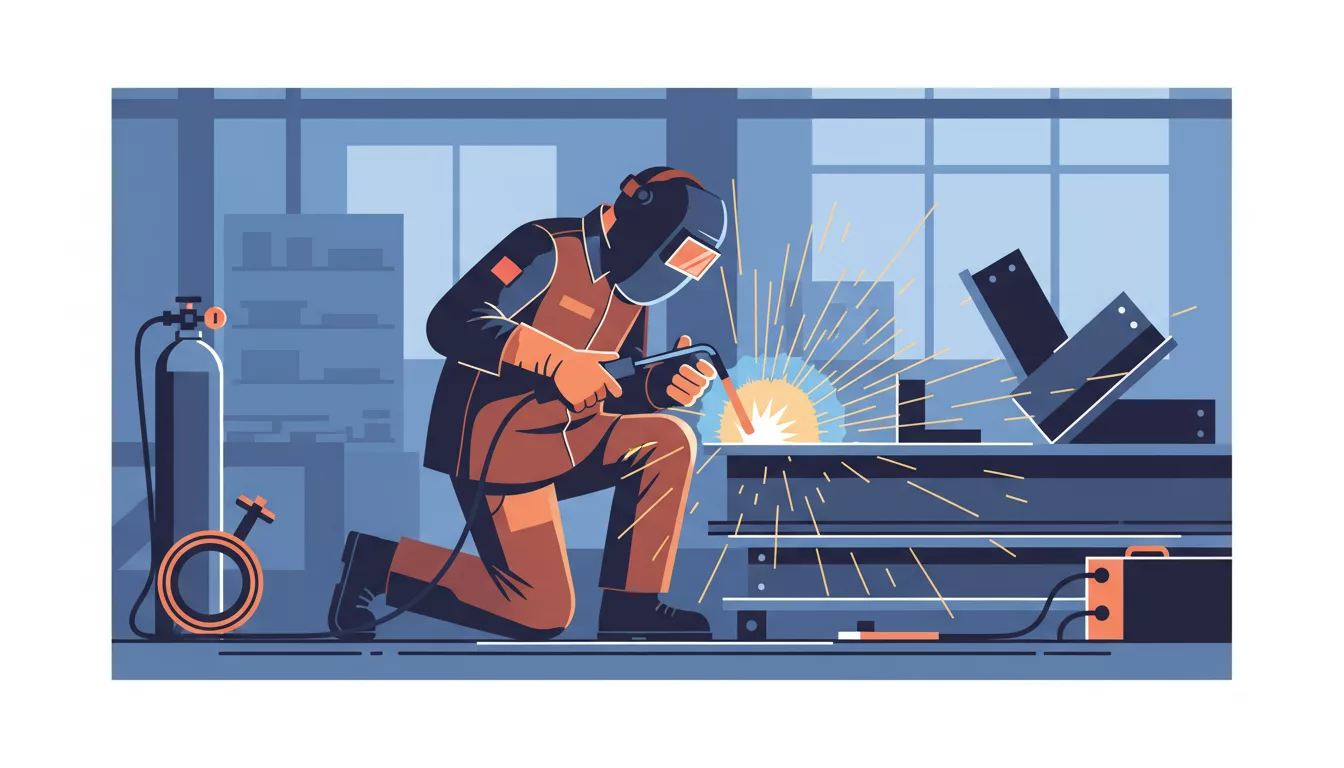
An Honest Look at the Welding Career Path
Welding is one of those careers where the gap between perception and reality is enormous. People either romanticize it - sparks flying, building bridges, underwater welding - or dismiss it as basic grunt work. Neither is accurate.
The truth is somewhere in the middle, and it matters that you understand it before committing. Welders who are good at what they do earn serious money. Experienced welders earn $50,000 to $100,000+ depending on their specialty, location, and certifications. Pipe welders on pipeline projects can clear $150,000 or more in a good year. But the work is physically demanding, environments can be brutal, and the learning curve is real - you can't fake a good weld.
This guide covers everything you actually need to know: how to get trained, which certifications matter, what the different specializations pay, and how to build a career that pays well without destroying your body by 50.
What Welders Actually Do (Beyond the Sparks)
At its core, welding is joining metal together using heat. But that's like saying surgery is "cutting people open." The specifics matter a lot, and they vary enormously depending on what kind of welding you do.
Structural Welding
Buildings, bridges, stadiums, parking garages - anything with steel framing needs structural welders. You're typically working from blueprints, joining steel beams and columns that hold structures up. The welds need to be strong because they're load-bearing. Inspection is strict, and if your welds don't pass, you're cutting them out and redoing them. Most structural welding uses SMAW (stick) or FCAW (flux-core) processes.
Pipe Welding
This is where the big money lives. Pipe welders join pipes that carry oil, gas, water, steam, or chemicals. The welds must be flawless because leaks in pressurized systems are dangerous and expensive. Pipe welders work in refineries, power plants, chemical facilities, and on cross-country pipeline projects. The work often requires SMAW and GTAW (TIG) certifications, and you'll weld in every position - flat, horizontal, vertical, and overhead.
Manufacturing and Production Welding
Factories that make everything from car frames to heavy equipment to metal furniture need production welders. The work is more repetitive than other welding specialties - you might weld the same joint 200 times a day. But the environment is usually indoors, the hours are predictable, and the benefits are often good. GMAW (MIG) is the most common process in manufacturing.
Maintenance and Repair Welding
Every manufacturing plant, every fleet of trucks, every mine needs welders who can repair broken equipment. Maintenance welders are problem-solvers - the work is different every day, you're figuring out how to fix things that weren't designed to be welded, and you need to be versatile across multiple welding processes. The pay is solid and the job security is strong because equipment always breaks.
Specialty Welding
Underwater welding (officially "commercial diving with welding") gets all the attention, but there are other specialties too. Aerospace welding (jet engines, rocket components), nuclear welding, and thin-gauge TIG work (food-grade stainless, pharmaceutical equipment) all pay well and require specific training and certifications. These are niche paths that take years to break into, but the earning potential is exceptional.
Do You Need a Degree? Education Requirements Explained
Short answer: no. You do not need a college degree to become a welder. You need training, practice, and certifications. There are several paths to get there, and none of them require four years of tuition payments.
Minimum Requirements to Start
- High school diploma or GED - Required for most programs and employers.
- Basic math - Fractions, decimals, measurement, basic geometry. You'll read blueprints with dimensions, calculate material needs, and work with angles constantly. These are practical skills worth highlighting on your resume.
- Physical ability - Standing for extended periods, lifting up to 50 pounds, working in confined spaces and awkward positions. Good hand-eye coordination is important - welding is a manual skill that requires steady hands.
- Age 18+ - Most employers and programs require it due to safety regulations. Some high school programs introduce welding earlier, but employment typically starts at 18.
- Vision - You need adequate vision (corrected is fine) to see the weld puddle and read blueprints.
The Three Main Training Paths
There's no single "right way" to learn welding. Each path has trade-offs. Here's how they compare:
| Feature | Trade School / Community College | Union Apprenticeship | On-the-Job Training |
|---|---|---|---|
| Duration | 6-24 months | 3-5 years | Varies widely |
| Cost to you | $5,000-$20,000 | $0 (you earn while learning) | $0 (you earn while learning) |
| Income during training | None (or part-time) | $17-$28/hour starting | $14-$20/hour starting |
| Hands-on time | 200-500 hours | 2,000+ hours | Varies - sometimes extensive |
| Certification prep | Usually included | Built into program | You may need to pursue separately |
| Job placement | Career services, connections | Union hiring hall | Already employed |
| Best for | Getting started quickly | Best overall training + pay | People already in the industry |
Path 1: Trade School or Community College
This is the most common starting point. A welding program at a community college or vocational school gives you structured training in multiple welding processes - typically SMAW (stick), GMAW (MIG), GTAW (TIG), and FCAW (flux-core). Programs range from 6-month certificates to 2-year associate degrees.
The 6-month certificate is usually enough to get hired as an entry-level welder. The 2-year degree adds more theory, blueprint reading, metallurgy, and sometimes CNC or fabrication skills. Whether the extra year is worth it depends on what you want to do - if you're aiming for pipe welding or aerospace, more training helps. If you want to start earning quickly in production welding, the certificate gets you there faster.
Look for programs that are accredited by the American Welding Society (AWS). AWS-accredited programs have standardized curriculum and their certification tests are more widely recognized by employers.
Path 2: Union Apprenticeship
Unions like the Ironworkers (for structural welding), Pipefitters and Plumbers (UA - United Association), and Boilermakers all run apprenticeship programs that include significant welding training. These programs pay you while you learn, provide benefits, and lead to well-paying union careers.
The application process is competitive - similar to the electrician apprenticeship process. You'll need to pass an aptitude test, interview well, and usually have some basic welding experience or trade school background to be competitive. But the investment is worth it: union welders consistently earn more than non-union welders, especially when you factor in benefits and pension.
Path 3: On-the-Job Training
Some employers, especially in manufacturing, will hire people with zero welding experience and train them. This is more common in areas with welder shortages. You start as a helper or "tack welder" doing basic joints while experienced welders handle the critical work. Over time, you learn more processes and take on more complex welds.
The advantage is that you're earning from day one with no tuition costs. The disadvantage is that your training might be narrow - you could spend years doing one type of weld on one type of material and never learn the fundamentals that make you versatile. If you go this route, pursue certifications on your own time to keep your options open.
Certifications That Actually Matter
Welding certifications are different from a license. You don't need a state license to weld (unlike electricians or plumbers). But certifications prove you can produce quality welds to specific standards, and most employers require them.
How Welding Certification Works
A welding certification test is practical, not written. You show up, weld a specific joint using a specific process in a specific position, and an inspector evaluates the weld - usually with a visual inspection and a bend test (they literally bend your welded sample to see if it cracks). If it passes, you're certified for that specific combination of process, position, material, and thickness.
This means welders often hold multiple certifications. A pipe welder might be certified for SMAW on carbon steel pipe in the 6G position (the hardest - pipe is fixed at a 45-degree angle) AND certified for GTAW root with SMAW fill on the same. Each certification opens different doors.
Key Certifications
| Certification | What It Proves | Who Needs It | Cost |
|---|---|---|---|
| AWS D1.1 (Structural Steel) | You can weld structural joints to code | Structural/construction welders | $300-$500 per test |
| ASME Section IX (Pressure Vessels/Pipe) | You can weld pressure-containing joints | Pipe welders, boilermakers | $300-$700 per test |
| API 1104 (Pipeline) | You can weld cross-country pipelines | Pipeline welders | $400-$800 per test |
| AWS Certified Welder (CW) | General AWS certification in your tested processes | Anyone wanting portable credentials | $300-$500 |
| AWS Certified Welding Inspector (CWI) | You can inspect and approve welds | Career advancement to inspection | $1,000-$2,500 (exam + prep) |
| 6G Pipe Certification | You can weld pipe in all positions | Pipe welders seeking top pay | $300-$700 |
The 6G Certification: The Gold Standard
If there's one certification that opens more doors than any other, it's the 6G pipe certification. "6G" means welding a pipe fixed at a 45-degree angle, which forces you to weld in every position (flat, vertical, horizontal, and overhead) in a single test. If you can pass 6G, employers know you can handle anything.
The 6G cert is hard. A lot of welders fail it on the first try. But once you have it, you're in a different pay bracket. Pipe welders with 6G certification are in constant demand and command significantly higher rates than general welders.
Certification Maintenance
Most welding certifications expire - typically every 6 months to 2 years, depending on the code and whether you've been continuously employed in the certified process. Your employer can extend certifications with a letter confirming you've been actively welding. If certifications lapse, you need to retest.
Salary Progression: What You'll Earn at Each Stage
Here's the money picture from start to finish. These are national averages - your actual earnings depend heavily on location, specialization, certifications, and overtime.
| Career Stage | Years In | Annual Salary Range | Hourly Range |
|---|---|---|---|
| Helper/Trainee | 0 | $28,000-$36,000 | $13-$17 |
| Trade School Graduate (Entry Level) | 0-1 | $35,000-$45,000 | $17-$22 |
| Production Welder (MIG) | 1-3 | $38,000-$52,000 | $18-$25 |
| Structural Welder | 2-5 | $45,000-$70,000 | $22-$34 |
| Pipe Welder (Journeyman) | 3-7 | $60,000-$100,000 | $29-$50 |
| Pipeline Welder | 5+ | $70,000-$150,000+ | $35-$75+ |
| Welding Inspector (CWI) | 5-10 | $55,000-$95,000 | $27-$46 |
| Welding Supervisor/Foreman | 7-12 | $65,000-$100,000 | $32-$50 |
| Underwater Welder | 5+ | $50,000-$200,000+ | Varies wildly by project |
| Own Shop/Fabrication Business | 10+ | $80,000-$250,000+ | Varies |
A few things stand out. First, the range is enormous. A production MIG welder in a small-town factory and a pipeline welder in North Dakota are both "welders," but they're in completely different worlds financially. The difference is specialization, certifications, and willingness to travel or work in tough conditions.
Second, overtime matters massively. Industrial and construction welders regularly work 50-60 hour weeks, especially on projects with tight deadlines. At time-and-a-half, those extra hours add up fast. A pipe welder making $45/hour who works consistent 56-hour weeks can pull in $140,000+ in a year.
Third, the ceiling is high for people who go the entrepreneurial route. A fabrication shop owner with a good reputation and a few employees can earn well into six figures. Learning to negotiate your starting pay sets the right tone even early in your career.
Geographic Pay Differences
Where you work changes everything:
- Texas and Louisiana - Petrochemical corridor pays extremely well for pipe welders. Refineries and chemical plants run year-round maintenance.
- Alaska - Pipeline and industrial work pays premium rates plus per diem. Harsh conditions but big paychecks.
- North Dakota/West Texas - Oil field work pays well but involves remote locations and demanding schedules.
- California, New York, Washington - Union structural welding pays high hourly rates, but cost of living eats into it.
- The Southeast - Lower wages but lower cost of living. Manufacturing welding jobs are plentiful.
Choosing a Specialization
Every welder starts as a generalist, but your earning potential and job satisfaction both improve when you specialize. Here's how the major paths compare:
| Specialization | Earning Potential | Work Environment | Travel Required | Physical Demand |
|---|---|---|---|---|
| Production (MIG) | Moderate | Indoor factory | None | Moderate - repetitive |
| Structural (Stick/Flux-core) | Good | Outdoor construction sites | Some | High - heights, weather |
| Pipe (TIG/Stick) | Very high | Refineries, plants, field | Often significant | High - confined spaces |
| Pipeline | Highest (hourly) | Remote field locations | Near-constant | Very high |
| TIG Specialist | Good to very high | Shops, aerospace, food-grade | Minimal | Moderate - precision work |
| Maintenance | Good | Plants, mills, facilities | Minimal | Moderate to high |
| Underwater | Extreme (project-based) | Offshore, harbors, dams | Significant | Extreme |
| Robotic Welding Operator | Good | Indoor manufacturing | None | Low - mostly programming |
The Underwater Welding Reality Check
Everyone asks about underwater welding. Here's the honest picture: commercial divers who also weld earn $50,000 to $200,000+ depending on the project and conditions. The income potential is real. But so is this:
- You need commercial diving certification first (6-12 months, $15,000-$30,000)
- Welding underwater is secondary to diving - most of your time is spent on other underwater tasks
- The work is seasonal and project-based - you're not earning $200K every year
- The injury and fatality rate is significantly higher than any other welding specialty
- Most underwater welders burn out physically by their 40s
If you're drawn to it, great - it's an exciting career. But go in with realistic expectations, not YouTube fantasy.
A Day in the Life: What to Really Expect
Here's what a typical day looks like for a structural welder on a commercial construction project:
5:30 AM - Alarm. Early starts are standard in construction. You're expected on-site before the work bell.
6:00 AM - Arrive at the job site. Get your tools from the gang box, put on your PPE (personal protective equipment) - fire-resistant clothing, welding hood, gloves, steel-toe boots, safety glasses, hard hat. In summer, you're already warm. In winter, you're layering underneath everything.
6:30 AM - Morning safety meeting. The foreman goes over today's tasks and any hazards. Then you head to your work area.
7:00 AM - Start welding. Today you're joining steel beams on the third floor of a new commercial building. You set up your machine, check your leads and ground clamp, grab the right rod, and start laying beads. The position is overhead - you're welding above your head with sparks raining down on your shoulders. This is where fire-resistant clothing earns its keep.
10:00 AM - Break. Water, coffee, get out of the sun (or the cold). Your neck is already sore from looking up at overhead welds for three hours.
10:15 AM - Back at it. An inspector comes by to check your morning work. He runs dye penetrant on two joints. They pass. On a different job last month, one of your welds failed visual inspection and you had to grind it out and redo it. It happens - the important thing is catching problems before the structure goes up.
12:00 PM - Lunch. You eat in the break trailer because there's nowhere else to sit. Someone complains about the general contractor. This is a daily ritual on every job site.
12:30 PM - Afternoon shift. Different task now - you're fitting and tacking beam connections so another welder can complete them. Fitting is a big part of welding that people don't think about. Getting pieces lined up correctly before you start welding is half the battle.
3:00 PM - Clean up your area. Put tools back. Roll up your leads. Construction sites need to be clean for safety.
3:30 PM - Head home. Your arms, neck, and shoulders are tired. You smell like metal and smoke. You take a shower and find a few small burn holes in your shirt where sparks got through. This is why you don't wear expensive clothes to work.
The Physical Reality (Be Honest With Yourself)
Welding is hard on your body. Period. You need to know this going in.
Eyes. "Arc eye" (photokeratitis) happens when UV radiation from the welding arc burns your corneas. It feels like someone poured sand in your eyes and it's excruciating. It's 100% preventable with proper eye protection, but every welder gets flashed at least once in their career - usually from someone else's arc. Always wear safety glasses under your hood, and never watch someone else weld without protection.
Lungs. Welding fume is a real health concern. Different metals produce different fumes, and some (like galvanized steel, stainless steel, and anything with cadmium or hexavalent chromium) are genuinely dangerous with long-term exposure. Good ventilation, proper respirators when needed, and awareness of what you're welding are essential. Don't be the tough guy who doesn't wear respiratory protection - your lungs won't thank you in 20 years.
Burns. You will get burned. Small sparks, hot metal splatter, touching something you didn't realize was still hot. Proper PPE prevents serious burns, but minor burns are just part of the job. Your hands will develop calluses and small scars over time.
Musculoskeletal. Holding awkward positions for extended periods takes a toll on your neck, shoulders, back, and knees. Welders who stay in the trade for 20+ years almost universally have some joint issues. Good ergonomics, stretching, and positioning your work so you're not constantly contorted make a real difference.
Noise. Grinding, chipping, and some welding processes are loud. Wear hearing protection. Tinnitus isn't fun and it's permanent.
All of that sounds grim, but context matters. Modern safety equipment, better ventilation systems, and stricter workplace regulations have made welding dramatically safer than it was 30 years ago. The welders who have problems are mostly the ones who ignore safety practices. Follow the rules, wear your gear, and take care of your body.
How to Get Started: Your Step-by-Step Plan
Step 1: Get Exposure (This Week)
Before spending money on a program, make sure welding is actually something you want to do. Options:
- Community colleges often offer weekend or evening "intro to welding" workshops for $100-$300. You'll strike an arc, run a few beads, and know quickly whether this interests you.
- Makerspaces and vocational centers sometimes have welding equipment you can try.
- Watch realistic welding content online - channels like Weld.com, ChuckE2009, and This Old Tony show what the work actually looks like (not just highlight reels).
Step 2: Choose Your Training Path (Month 1)
Based on your situation:
- Need to start earning quickly? Look for 6-month certificate programs or manufacturing jobs that train on-site.
- Want the best overall training? Apply to union apprenticeships (Ironworkers, Pipefitters, Boilermakers).
- Want maximum flexibility? A 12-month trade school program with AWS certification prep gives you a solid foundation to go any direction.
Step 3: Enroll and Commit (Month 1-2)
Research programs in your area. Look for:
- AWS accreditation (signals quality curriculum)
- Multiple welding processes taught (not just MIG)
- Hands-on booth time - the more hours of actual welding, the better
- Certification testing available on-site or through the program
- Job placement rates and employer relationships
Financial aid is available for most community college programs. Many states also offer workforce development grants for trades training. Don't let the sticker price scare you off before checking what's available. If you're starting with no experience, a structured program gives you the fastest path to employability.
Step 4: Practice Relentlessly (During Training)
Welding is a motor skill. You get better by doing it, not by reading about it. The students who progress fastest are the ones who use every available minute of booth time. If your program offers open lab hours, use them. If you have access to a welder outside of class, practice at home.
Focus on fundamentals first: consistent travel speed, proper arc length, correct angles. Don't jump to fancy joints before your flat-position beads are clean and consistent. It's like learning guitar - you need to master basic chords before attempting solos.
Step 5: Get Your First Certifications (End of Training)
At minimum, aim to leave your program with:
- AWS D1.1 qualification (structural steel) in at least 3G (vertical) and 4G (overhead) positions
- Proficiency in at least two processes (usually SMAW and GMAW)
- OSHA 10 safety certification (most programs include this)
If you're aiming for pipe welding, start working toward a 6G certification as soon as your skills allow. This can happen during a program or shortly after.
Step 6: Land Your First Job (Immediately After Training)
The welding job market is strong. In most areas, competent entry-level welders with certifications don't stay unemployed long. Your approaches:
- Your school's career services and industry connections
- Union halls (even if you didn't apprentice - some unions accept experienced welders)
- Staffing agencies that specialize in trades and industrial work
- Network with classmates and instructors - the welding community is surprisingly tight-knit
- Job search platforms with manufacturing and construction filters
For your first position, prioritize learning over pay. A job where you weld multiple processes and learn from experienced welders is worth more long-term than one that pays $2/hour more but has you doing the same MIG joint 8 hours a day.
Career Advancement: Beyond the Welding Hood
One thing people don't realize about welding is how many directions the career can go. You're not locked into being a production welder for 30 years unless you want to be.
Welding Inspector (CWI)
The AWS Certified Welding Inspector credential lets you move from doing the welding to inspecting it. CWIs work for inspection firms, engineering companies, fabrication shops, and government agencies. The work is less physically demanding than welding, the pay is good ($55,000-$95,000+), and demand is strong. You need welding experience plus passing a three-part exam (written fundamentals, practical, and code book).
Welding Engineer/Technologist
With additional education (associate or bachelor's degree in welding engineering technology), you can move into engineering roles. Welding engineers design welding procedures, solve metallurgical problems, and oversee quality systems. The degree plus hands-on welding experience is a powerful combination that commands high salaries.
Supervision and Management
Experienced welders naturally move into foreman and supervisor roles. You're managing crews, coordinating with other trades, scheduling work, and handling inspections. The pay increase is meaningful, and you're welding less (which your body will appreciate).
Teaching and Training
Welding instructors are in high demand at community colleges, trade schools, and corporate training programs. If you like mentoring and have strong skills across multiple processes, teaching is a genuinely rewarding career path. Pay varies - community college instructors typically earn $45,000-$70,000 with good benefits and summers off.
Starting Your Own Shop
Many experienced welders eventually open fabrication shops, mobile welding services, or specialty repair businesses. The startup costs are lower than many businesses - a good welding machine, a truck, and a reputation can get you started. Mobile welders who serve farms, construction sites, and equipment fleets can earn well into six figures with low overhead.
7 Mistakes That Slow Down New Welders
- Choosing a program based only on cost. A cheap program with minimal booth time produces weak welders. Look at hours of hands-on practice, not just tuition.
- Skipping certification tests. Employers want to see that you've passed tests, not just that you went to school. Budget for and take certification tests as soon as you're ready.
- Only learning MIG. MIG is the easiest process and gets you hired fastest, but it's also the lowest-paying specialty. Learn stick and TIG too. Versatility pays.
- Ignoring safety equipment. Not wearing your hood, respiratory protection, or safety glasses is how careers end early. This isn't optional.
- Not building hand skill on fundamentals. Running beads on flat plate is boring. Do it anyway. Thousands of times. Your consistency on basic welds determines your quality on complex joints.
- Staying too long in one type of welding. If you've been doing production MIG for three years and haven't grown your skills, you're stagnating. Push for new processes, positions, and materials.
- Not pursuing the 6G pipe cert. If you want to maximize your earning potential, the 6G cert is the single biggest lever. Start working toward it within your first 2-3 years.
Career Outlook: Why Demand Is Strong
The Bureau of Labor Statistics projects steady demand for welders through 2032, but that headline number understates the actual situation:
The retirement wave is real. The average welder in America is in their mid-40s. A huge portion of the workforce is approaching retirement age, and not enough young welders are coming up to replace them. This is driving demand and wages up across the trade.
Infrastructure spending. Federal infrastructure bills are putting billions into bridge repairs, highway construction, water system upgrades, and energy infrastructure. All of it needs welders.
Energy sector expansion. LNG (liquefied natural gas) facilities, renewable energy installations, and pipeline maintenance create consistent demand for qualified pipe and structural welders. The skilled trades sector overall is experiencing a renaissance in both demand and public perception.
Manufacturing reshoring. As companies bring manufacturing back to the U.S., they need production welders. Automotive, heavy equipment, defense contracting, and general fabrication are all growing.
Can't be fully automated. Robotic welding handles high-volume repetitive work well, but robots can't do field welding, repair welding, or work in non-standard positions. The human welder isn't going away - the job is just evolving. Welders who can program and operate robotic systems are actually in higher demand, not lower.
Is Welding Right for You? An Honest Assessment
This career is a good fit if you:
- Like working with your hands and creating tangible things
- Can handle heat, sparks, and physically demanding conditions
- Have good hand-eye coordination and can be precise under pressure
- Want to earn good money without a four-year degree - welders are among the highest-paid workers without a college degree
- Are willing to get certifications and keep learning new processes
- Can follow safety protocols consistently (not just when someone's watching)
- Want a skill that's in demand everywhere - every city, every state, multiple industries
This career might not be right if you:
- Have respiratory conditions that would be aggravated by fume exposure
- Can't handle heat and physical discomfort for extended periods
- Need a strictly 9-to-5, climate-controlled work environment
- Have joint problems that would worsen with repetitive positioning
- Are looking for a career with minimal physical risk
If you're coming from a completely different field, our career change guide can help you think through the transition process.
Ready to Start? Here's Your First Move
Call your local community college or trade school this week and ask about welding programs. Many have info sessions or campus tours where you can see the welding lab and talk to instructors. If you're near a union hall for the Ironworkers, Pipefitters, or Boilermakers, call them and ask about apprenticeship applications too.
The worst thing you can do is research forever and never start. Pick a starting point, show up, and start learning. The demand for welders isn't going away, the pay is real, and the barrier to entry is lower than almost any career with comparable earning potential. If you're willing to put in the work, this trade will take care of you.
Keep Reading
- What do welders actually earn?
- Welding interview questions to prepare for
- The state of skilled trades careers
- A day in the life of a welder
- Browse welding jobs
- How to become a plumber: career path and licensing
- How to become a carpenter: training and career path
- How to become an auto mechanic: certifications and career path