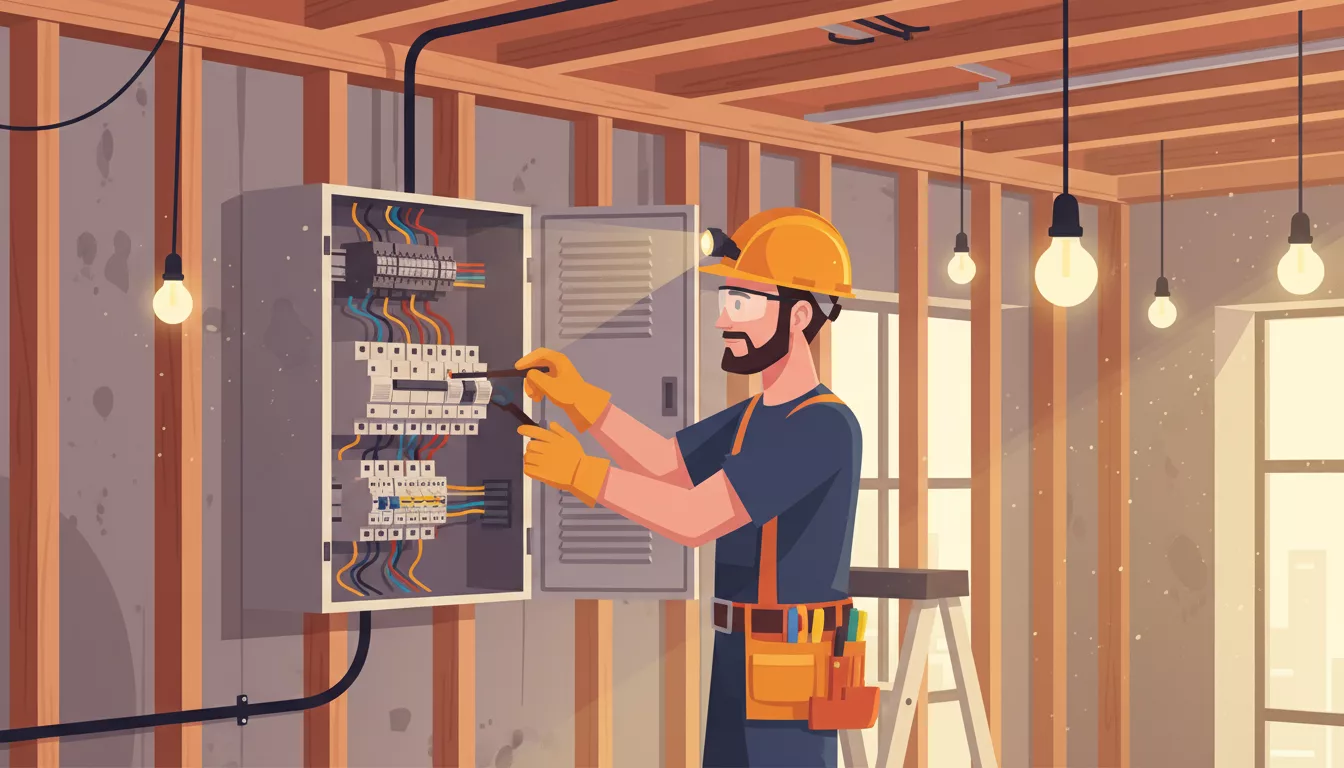
Electrician interviews are different from most job interviews because the hiring manager usually knows the trade inside and out. You're not sitting across from an HR generalist reading questions off a list. You're talking to a foreman, a project manager, or the owner of the company - someone who's bent conduit, pulled wire, and probably gotten shocked at least once. They know when you're bluffing.
That's actually good news if you know your stuff. Electrician interviews reward hands-on knowledge and practical experience over polished corporate answers. Nobody cares if you use the STAR method perfectly. They care whether you can troubleshoot a dead circuit, bend a 3-point saddle without a reference chart, and show up on time every day.
This guide covers what you'll actually get asked - whether you're interviewing for your first apprenticeship, testing for a journeyman position, or moving to a new shop as an experienced electrician.
How Electrician Interviews Work (By Career Stage)
The format changes depending on where you are in your career and what type of work the company does.
Apprenticeship Interviews (IBEW / Non-Union)
If you're applying to a union apprenticeship through the IBEW or a local JATC (Joint Apprenticeship and Training Committee), expect a panel interview. Typically 3-5 people from the committee - a mix of union members and contractor representatives. The interview is usually 15-20 minutes and it's scored numerically. Your score, combined with your aptitude test results, determines your ranking on the acceptance list.
Non-union apprenticeships are less formal. If you're still exploring how to enter the trade, our guide to becoming an electrician covers the full path. You might interview directly with the owner or a lead electrician. They're looking at attitude, reliability, and basic mechanical aptitude more than electrical knowledge. The trades and skilled labor industry is booming right now, so competition for apprentices is lower than you'd think (they know you don't have much yet).
Journeyman Interviews
Journeyman interviews are more technical. The interviewer will ask about specific code knowledge, troubleshooting methods, and your experience with different types of work (residential, commercial, industrial). Many shops also want to know what tools you own - showing up with a fully stocked tool belt signals you're serious and established in the trade.
Foreman and Lead Electrician Interviews
At this level, they're testing leadership and project management on top of technical skills. Can you read prints and run a crew? Can you coordinate with other trades? Can you keep a job on schedule and on budget? The technical stuff is assumed - now they want to know if you can manage people and problems.
Apprentice Interview Questions
If you're just getting into the trade, these are the questions you'll face. The panel or hiring manager knows you're green - they're evaluating your potential, not your expertise.
"Why do you want to become an electrician?"
This is the most important question in an apprenticeship interview. Have a real answer. "Because electricians make good money" is honest but not enough. Talk about what drew you to the trade specifically. Maybe you worked on projects with your dad growing up. Maybe you're making a career change and want something hands-on. Maybe you took a vo-tech class in high school. Maybe you're tired of desk work and want a career where you build something tangible.
What they're really asking: Will you stick with this for 4-5 years of apprenticeship, or will you quit when the work gets hard?
What works: "I've always been the person who takes things apart to see how they work. In high school, I rewired the speakers in my car and helped my uncle add a subpanel in his garage. When I realized electricians do that kind of problem-solving every day and earn a real living doing it, I knew this was the right path. I'm ready to commit to the full apprenticeship."
"What do you know about the electrical trade?"
Be honest about what you know and what you don't. If you've done some reading about the NEC, basic circuit theory, or the apprenticeship program structure, say so. If you've done any hands-on electrical work (even changing outlets at home), mention it. But don't pretend to know more than you do - they'll see through it in about 10 seconds.
"Are you comfortable working at heights? In tight spaces? In extreme weather?"
The honest answer needs to be yes. Electricians work on scaffolding, in attics and crawl spaces, in un-air-conditioned buildings in August, and in below-freezing temperatures in January. If any of these are a dealbreaker for you, this may not be the right trade. If you have some discomfort but are willing to push through, say that directly.
"Tell me about a time you worked on a team."
This is a classic teamwork interview question. Construction is team work. Period. They want to know you can take direction from journeymen, communicate with other trades, and not cause drama on the job site. Use any example - sports, previous jobs, school projects, military service. Show that you listen, do your part, and don't need to be babysat.
"Where do you see yourself in 5 years?"
This is a common interview question across all fields, but for apprenticeship interviews, the right answer involves completing the program. "I want to finish my apprenticeship, get my journeyman license, and continue building my skills" is exactly what they want to hear. Adding a long-term goal - "Eventually I'd like to get my master's license and maybe run my own crew" - shows ambition without sounding like you'll leave the moment you get your card.
"Do you have reliable transportation?"
This matters more than you think. Job sites change. You might be at a hospital renovation in January and a new construction site 40 miles away in February. If you can't get to the job at 6 AM consistently, you're a liability. If you have a valid license and a reliable vehicle, say so. If your transportation situation is less than ideal, be honest about it and explain your plan.
Technical Questions (Journeyman and Beyond)
These questions test whether you actually understand electrical work at a professional level. The depth depends on the position, but expect at least a few of these.
"Explain Ohm's Law and give me a practical application."
V = I x R. Voltage equals current times resistance. A practical example: if you have a 120V circuit with a 12-ohm load, the current draw is 10 amps. You'd use this to calculate wire sizing, breaker capacity, or to diagnose why a circuit is tripping.
They might follow up with: "What's the power formula?" P = V x I. So that same circuit: 120V x 10A = 1,200 watts.
"What's the difference between single-phase and three-phase power?"
Single-phase uses one alternating current waveform. It's standard for residential and light commercial (120V/240V in the US). Three-phase uses three waveforms offset by 120 degrees and delivers power more efficiently. It's used for heavy commercial and industrial loads - think large motors, HVAC systems, and manufacturing equipment.
If they ask why three-phase is more efficient: it delivers constant power (the waveforms overlap, so there's no zero-crossing), uses less conductor material for the same power output, and three-phase motors are simpler and more reliable than single-phase motors.
"How do you size wire for a circuit?"
Start with the load calculation. Determine the amperage, then reference the NEC ampacity tables (Table 310.16 is the one you use most). Factor in conductor type (copper vs. aluminum), insulation rating, ambient temperature, and conduit fill. For continuous loads, multiply by 125% per NEC 210.20. Don't forget voltage drop for long runs - generally you want to keep it under 3% for branch circuits.
A solid answer here tells the interviewer you don't just install what someone tells you to - you understand why specific wire sizes are required.
"Walk me through how you'd troubleshoot a dead outlet."
This is the classic troubleshooting question. A good answer shows a systematic approach:
- Check if other outlets on the same circuit are dead (determines if it's the outlet or the circuit)
- Check the breaker panel for a tripped breaker
- Check for any GFCI outlets upstream that may have tripped (reset and test)
- If the circuit is live at the panel, use a non-contact voltage tester at the outlet to check for voltage
- If no voltage, use a multimeter to test at the connection points
- Check for loose connections, a burned wire, or a failed outlet
- Work upstream toward the panel until you find where voltage is present and where it stops
The key thing they want to hear: you start simple and work systematically. You don't just start pulling wires out of boxes hoping to find the problem.
"What are the NEC requirements for GFCI protection?"
GFCI protection is required for receptacles in bathrooms, kitchens (within 6 feet of a sink), garages, unfinished basements, outdoor locations, crawl spaces, laundry areas, and within 6 feet of any sink in other areas. The NEC has expanded GFCI requirements significantly in recent code cycles - the 2023 NEC now requires GFCI protection for all 150V-or-less, 50-amp-or-less outlets in several additional locations.
Bonus points if you mention that GFCI protection can be provided at the receptacle, the breaker, or at a dead-front device upstream.
"What is lockout/tagout and when do you use it?"
LOTO is a safety procedure that ensures electrical equipment is de-energized and cannot be accidentally re-energized while you're working on it. You lock the disconnect or breaker in the off position with your personal lock, tag it with your name and the date, and verify the circuit is dead with a meter before touching anything. Every worker on the equipment places their own lock. Nobody removes someone else's lock. Ever.
This isn't a trick question - it's a test of whether safety is ingrained in how you work. Giving a casual or incomplete answer signals you might cut corners on the job.
"What's the difference between a fuse and a circuit breaker?"
Both provide overcurrent protection. A fuse is a one-time-use device - the metal link melts when current exceeds the rating, breaking the circuit. You replace it. A circuit breaker is a resettable switch that trips and can be turned back on. Breakers are standard in modern construction. Fuses are still found in older buildings and in some industrial applications where their faster response time is an advantage.
Other Technical Questions You Should Know
| Question | What They're Testing |
|---|---|
| What wire goes to the silver screw on a receptacle? | Basic wiring knowledge (neutral / white wire) |
| What's the minimum burial depth for UF cable? | NEC code knowledge (24 inches for UF) |
| How do you calculate conduit fill? | NEC Chapter 9 tables, 40% fill for 3+ conductors |
| What's the ampacity of #12 AWG copper THHN in a raceway? | NEC Table 310.16 (30 amps) |
| How do you bend an offset? | Practical conduit bending (multiplier method) |
| What's the difference between a grounded conductor and a grounding conductor? | Neutral vs. equipment ground understanding |
| How many receptacles can you put on a 20-amp circuit? | NEC guidelines (typically 10 for commercial) |
Residential vs. Commercial vs. Industrial: How Questions Differ
Residential Electrical
Expect questions about:
- Panel sizing and load calculations for houses
- AFCI and GFCI requirements (residential code is very specific about where these go)
- Rough-in procedures - how you wire a new construction house from scratch
- Service entrance installations and meter bases
- Customer interaction - residential electricians deal directly with homeowners. Can you explain what you're doing in terms they understand? Can you keep a work area clean in someone's home?
Commercial Electrical
Expect questions about:
- Three-phase systems and distribution
- Fire alarm and low-voltage systems
- Blueprint reading (commercial prints are more complex than residential)
- Coordination with general contractors and other trades
- Large-scale conduit installation (EMT, rigid, PVC, MC cable)
Industrial Electrical
Expect questions about:
- Motor controls and variable frequency drives (VFDs)
- PLCs (programmable logic controllers) - at minimum, understand what they do and how they interface with the electrical system
- High-voltage work (480V and above)
- Troubleshooting production equipment under time pressure
- Arc flash safety and NFPA 70E compliance
Safety Questions
Safety isn't a separate category in electrical work - it's woven into everything. But you'll get at least one or two questions focused specifically on safety practices.
"Describe your approach to job site safety."
Don't give a textbook answer. Talk about what you actually do. A strong response touches on: always testing before touching (even if you just watched someone de-energize the circuit), wearing appropriate PPE (safety glasses, gloves, hard hat, steel-toed boots), keeping your work area clean and organized, never working on energized equipment unless absolutely necessary and properly trained, and speaking up when something seems unsafe - even if it means slowing down the job.
That last point matters. Contractors want electricians who will stop and say "this isn't right" rather than take a shortcut that could kill someone.
"Have you ever witnessed or been involved in a safety incident? What happened?"
If you have, be honest and focus on what you learned. If you haven't, say so but talk about near-misses you've seen or specific situations where following safety protocols prevented an incident. Every electrician has a story about a time proper lockout/tagout saved someone. Share yours.
"What PPE do you wear for basic electrical work?"
At minimum: safety glasses, work boots (steel or composite toe), hard hat on construction sites. For working near energized equipment: voltage-rated gloves with leather protectors, arc-rated clothing, and a face shield depending on the arc flash rating. Know your NFPA 70E categories and what each one requires.
Behavioral Questions
Behavioral questions use the "tell me about a time" format to evaluate how you handle real situations. If you want a deeper breakdown of how to structure these answers, check out our behavioral interview guide.
These might feel less important than technical questions, but they carry real weight. A skilled electrician who causes problems on the job site is worse than a slightly less skilled one who's reliable and easy to work with. If you need help articulating your strengths, our guide on answering the greatest strength question has solid examples.
"Tell me about a time you had a conflict with a coworker on a job site."
Construction sites are high-pressure environments with tight deadlines, loud conditions, and strong personalities. Disagreements happen. Show that you can handle conflict without escalation. Maybe a plumber was running pipe where you needed to pull wire. Maybe another electrician was doing something you thought was unsafe. Explain how you communicated, resolved it, and got back to work.
"Describe a time you had to figure something out with limited information."
This is a version of the "describe a challenge you overcame" question. This happens constantly in electrical work. You open a panel and find unlabeled circuits. You're troubleshooting in an old building with no prints. You're doing a service call and the homeowner's description of the problem makes no sense. Show your process: how do you gather information, what resources do you use, and how do you work through it systematically?
"What would you do if your foreman told you to do something that violates code?"
This is a judgment question, and there's only one right answer: you don't do it. But how you handle it matters. You don't grandstand in front of the crew. You pull the foreman aside, explain your concern, and reference the specific code section if you can. If they insist, you involve the project superintendent or your union steward (if applicable). Code violations can result in failed inspections, fines, and, most importantly, someone getting hurt.
What to Bring to the Interview
- Resume - Yes, even for trade positions. Use a clean, proven resume format that highlights your certifications and project experience. If you're writing one from scratch, our guide on writing a resume summary will help you nail the top section. List your certifications, licenses, types of work you've done (residential, commercial, industrial), and major projects. Keep it to one page.
- Copies of certifications and licenses - Journeyman card, state license, OSHA 10 or 30, any specialty certifications (fire alarm, low voltage, etc.)
- Valid driver's license - You'll almost certainly need one. Many companies require a clean driving record because you'll be driving company vehicles.
- Tool list - Some companies ask what tools you own. Having a typed list ready shows you're organized and invested in the trade.
- References - Former foremen, journeymen you worked under, or instructors from your apprenticeship program. People who can speak to your work ethic and skills. Our reference list guide shows how to format these properly.
Questions You Should Ask the Interviewer
When they ask if you have questions, always have a few ready. Good questions tell the interviewer you're serious about finding the right fit - not just any paycheck.
Strong questions:
- "What type of work does the company primarily do?" (Shows you want to know what your days will look like.)
- "How many guys are on a typical crew?" (Shows you understand job site dynamics.)
- "Do you provide ongoing training or support for code updates?" (Shows you care about staying current.)
- "What does the path to foreman look like here?" (Shows ambition and long-term thinking.)
- "What's the work schedule like - standard 40 or regular overtime?" (Legitimate question, not a red flag.)
For more ideas on smart questions, see our guide on questions to ask at the end of an interview.
Questions to avoid:
- "Can I use my phone on the job?" (Instant red flag.)
- "How often do you drug test?" (They'll assume you have a reason for asking.)
- Anything about calling in sick or time off in your first month
Dress Code for Electrician Interviews
This is one of the few fields where you don't need a suit. In fact, wearing a suit to a construction company interview might feel awkward for everyone. The sweet spot is clean work clothes or business casual. If you are unsure what to wear, our guide on interview attire covers every industry - clean jeans or khakis, a collared shirt or clean polo, and closed-toe shoes. No rips, stains, or logos that might offend.
For union apprenticeship interviews or office-based positions (estimator, project manager), business casual is the standard. Dress one level above what you'd wear on the job.
Common Mistakes That Cost Electricians the Job
- Faking technical knowledge - An experienced electrician will catch you in about 30 seconds. Saying "I'm not sure, but here's how I'd find out" is vastly better than making something up.
- Badmouthing your previous shop - The electrical trade is smaller than you think. Contractors know each other. Keep it professional.
- Not being able to name specific projects - "I've done some commercial work" is vague. "I helped wire the electrical for a 200-unit apartment building on Main Street last year" is concrete.
- Showing up late - In the trades, being on time means being 15 minutes early. If you're late to the interview, they'll assume you'll be late to the job site.
- Not asking about safety culture - This signals you're a guy who just does what he's told without thinking about whether it's safe. The best electricians care deeply about safety, and they're not shy about it.
- Being arrogant about your skill level - Even the best electricians learn something new on every job. Overconfidence is a turnoff, especially for apprentices.
The Bottom Line
Electrician interviews reward honesty, practical knowledge, and reliability more than smooth talking. Know your trade fundamentals (or show genuine eagerness to learn them if you're starting as an apprentice). Demonstrate that safety is non-negotiable in how you work. And show that you'll be the kind of person your crew actually wants on the job site at 6 AM.
The electrical trade is one of the highest paying careers you can get without a college degree, and it is in high demand right now. If you're thinking about negotiating your first offer, know that many shops have some flexibility on starting pay - electrician salaries reflect that demand, and contractors need good people and they're hiring. If you prepare for the technical questions, show up on time, and prove you're someone they can count on, you'll have a strong shot.
Ready to find your next opportunity? Browse current electrician jobs on Land A Job and set up alerts to get notified when new positions open in your area.
Keep Reading
- What do electricians actually earn?
- Steps to becoming a licensed electrician
- See what a typical day as an electrician looks like
- Browse electrician jobs
- How to Answer "Where Do You See Yourself in 5 Years?"
- How to Answer "Why Do You Want to Work Here?"
- Welding interview questions guide
- Carpentry interview questions guide
- HVAC interview questions guide
- Plumbing interview questions guide
- Mechanic interview questions guide
- The Complete Interview Preparation Guide
- How to Answer "Tell Me About Yourself"