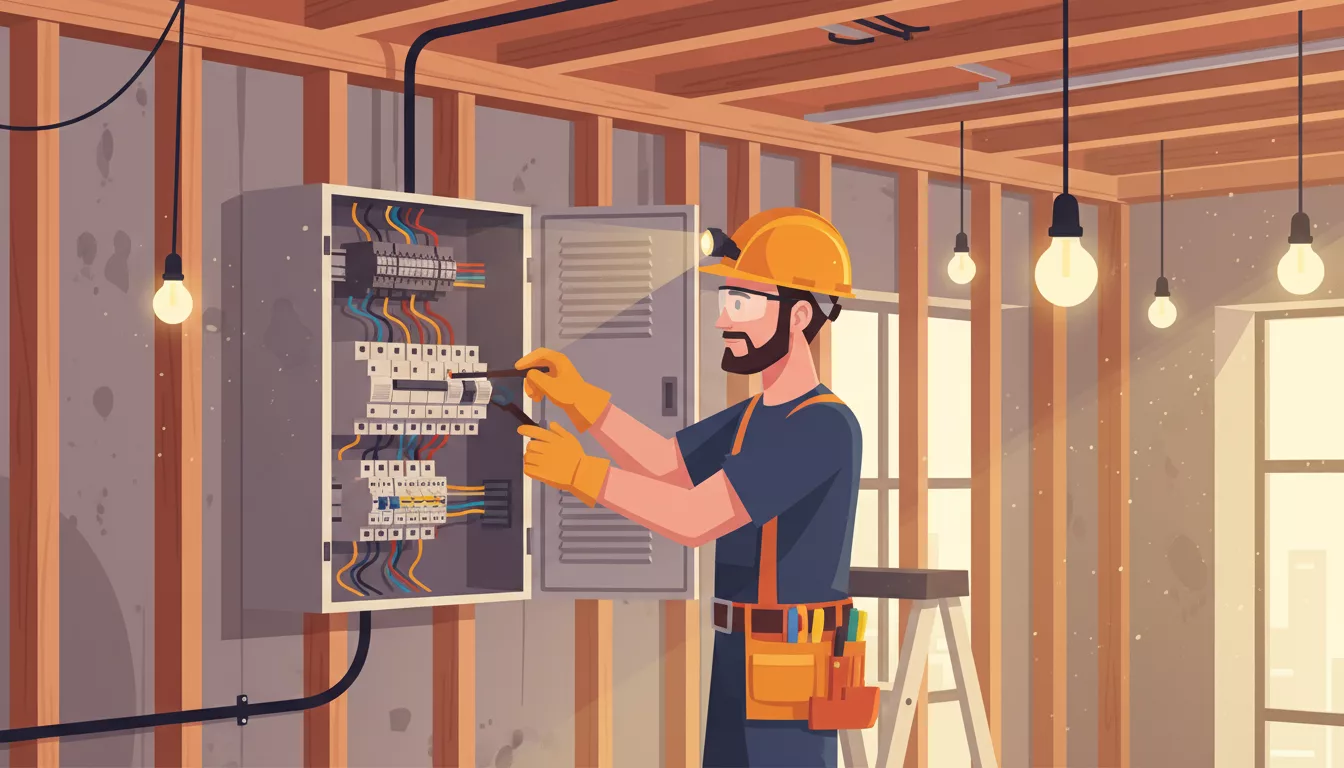
What Do Electricians Actually Make?
Ask ten people what electricians earn and you'll get ten different answers. Your uncle might tell you his buddy clears $120K running cable in Manhattan. A Reddit thread might say apprentices barely make $15 an hour. Both can be true at the same time - and that's exactly what makes electrician salary data so confusing.
So here's the straightforward breakdown. The Bureau of Labor Statistics puts the median electrician salary at $61,590 per year as of their most recent data. That's $29.61 per hour for a standard 2,080-hour work year. But median means half of all electricians earn more, and the top 10% pull in over $99,800 annually.
The gap between the lowest and highest earners is massive. Entry-level apprentices in low-cost states might start around $33,000. A master electrician running their own shop in a major metro? They can clear $150K or more. (See our electrician interview guide to land the job.) once you factor in overtime and side work. Here's how the pay distribution breaks down:
| Percentile | Annual Salary | Hourly Rate |
|---|---|---|
| 10th percentile (entry level) | $37,020 | $17.80 |
| 25th percentile | $46,700 | $22.45 |
| 50th percentile (median) | $61,590 | $29.61 |
| 75th percentile | $78,890 | $37.93 |
| 90th percentile | $99,800 | $47.98 |
A few things worth noting here. These numbers cover W-2 employees only - not independent electrical contractors, who often earn significantly more (but also have higher expenses). And overtime is huge in this trade. Electricians working construction or industrial jobs routinely log 50-60 hour weeks during busy periods, and that time-and-a-half adds up fast.
How Much Do Apprentice Electricians Make?
This is the part nobody loves hearing: the first few years don't pay great. But they pay a lot better than going $80K into debt for a four-year degree (see high-paying jobs without a degree), and your earning potential ramps up much faster than most people realize.
Electrical apprenticeships typically last 4-5 years. You earn while you learn, getting roughly 8,000 hours of on-the-job training plus 576+ hours of classroom instruction. Most apprenticeship programs start you at 40-50% of a journeyman's rate, then bump you up every six months or year as you progress.
| Apprenticeship Year | % of Journeyman Rate | Typical Hourly Range | Approx. Annual |
|---|---|---|---|
| Year 1 | 40-50% | $14-$20/hr | $29,000-$41,600 |
| Year 2 | 50-60% | $17-$24/hr | $35,400-$49,900 |
| Year 3 | 60-70% | $20-$28/hr | $41,600-$58,200 |
| Year 4 | 70-80% | $24-$32/hr | $49,900-$66,600 |
| Year 5 (if applicable) | 80-90% | $27-$36/hr | $56,200-$74,900 |
The range is wide because it depends entirely on where you are. A first-year apprentice in San Francisco working for a union contractor might start at $22/hour. The same apprenticeship in rural Mississippi might pay $14. Your local Joint Apprenticeship and Training Committee (JATC) or the contractor you work for sets your starting rate.
Here's the thing people miss about apprentice pay: you're getting paid to gain a skill that will earn you $60K-$100K+ for the rest of your career. Compare that to spending 4 years paying $20K+ per year in tuition. By the time a college grad starts their first job at 22, a first-year apprentice who started at 18 has already earned $150K-$200K and is now making journeyman wages.
Journeyman vs. Master Electrician Salary
The licensed tiers in electrical work create clear salary jumps. Each level requires specific experience and passing an exam, and each one bumps your earning potential significantly.
Journeyman Electrician: After completing your apprenticeship and passing the journeyman exam, you're fully licensed to work independently (though licensing requirements vary by state). This is where most electricians sit for the bulk of their career. Journeyman electricians earn between $50,000 and $85,000 nationally, with the median around $62,000. In strong union markets and high-cost cities, journeyman rates easily clear $40-$50/hour.
Master Electrician: Requires an additional 2-4 years as a journeyman (varies by state) plus passing the master electrician exam. Master electricians can pull permits, supervise journeymen and apprentices, and run their own contracting businesses. Salary range is typically $70,000 to $110,000 as an employee. But many master electricians go the self-employment route, where income varies wildly - some clear $150K-$200K+, others prefer a manageable workload around $80K.
Electrical Contractor / Business Owner: Not technically a license tier, but the natural next step for master electricians who build their own companies. Income depends entirely on the size of your operation. A solo contractor doing residential work might net $80K-$120K. A contractor with a crew of 10 doing commercial projects could net $200K-$400K+. But you're also taking on business risk, insurance costs, and all the headaches of running a company.
| License Level | Experience Required | Salary Range | Median Salary |
|---|---|---|---|
| Apprentice | 0-5 years (in training) | $29,000-$52,000 | $38,000 |
| Journeyman | 4-5 years + exam | $50,000-$85,000 | $62,000 |
| Master Electrician | 6-10+ years + exam | $70,000-$110,000 | $85,000 |
| Electrical Contractor | Varies + business license | $80,000-$250,000+ | Varies widely |
Electrician Salary by State: Where the Money Is
Geography is probably the single biggest factor in what you'll earn. An electrician in Illinois can make double what the same electrician earns in Mississippi - and it's not just cost of living. Union density, construction activity, licensing requirements, and demand all play a role.
Here are the highest and lowest paying states for electricians:
Top 10 Highest Paying States
| State | Mean Annual Salary | Mean Hourly Wage | Why It Pays Well |
|---|---|---|---|
| Illinois | $84,010 | $40.39 | Strong unions, Chicago construction boom |
| New York | $81,340 | $39.11 | NYC union rates, high cost of living |
| Oregon | $79,570 | $38.26 | Strong labor protections, growing tech sector |
| Hawaii | $78,890 | $37.93 | Island premium, limited labor supply |
| New Jersey | $77,850 | $37.43 | Dense metro area, union presence |
| California | $77,560 | $37.29 | Massive construction, strict licensing |
| Washington | $76,980 | $37.01 | Tech sector growth, prevailing wage laws |
| Minnesota | $76,270 | $36.67 | Strong union market, cold-weather premium |
| Massachusetts | $74,590 | $35.86 | Boston development, strict licensing |
| Connecticut | $73,410 | $35.29 | High cost of living, union density |
10 Lowest Paying States
| State | Mean Annual Salary | Mean Hourly Wage |
|---|---|---|
| Mississippi | $44,850 | $21.56 |
| Arkansas | $46,200 | $22.21 |
| Louisiana | $47,100 | $22.64 |
| West Virginia | $47,530 | $22.85 |
| Alabama | $48,260 | $23.20 |
| South Carolina | $48,710 | $23.42 |
| Kentucky | $49,100 | $23.61 |
| North Carolina | $49,540 | $23.82 |
| Tennessee | $49,870 | $23.98 |
| New Mexico | $50,200 | $24.13 |
But here's the kicker - the highest paying states aren't always the best deal after cost of living. An electrician making $84K in Chicago might have a similar lifestyle to one making $55K in Oklahoma City. States like Minnesota, Texas, and Colorado often offer the best balance of good wages and reasonable living costs.
Electrician Salary by Metro Area
City-level data tells an even clearer story. The top-paying metro areas for electricians tend to be either major union cities or areas with explosive construction growth:
| Metro Area | Mean Annual Salary | Mean Hourly Wage |
|---|---|---|
| San Francisco-Oakland, CA | $96,880 | $46.58 |
| New York-Newark, NY-NJ | $90,430 | $43.48 |
| Chicago-Naperville, IL | $89,750 | $43.15 |
| Seattle-Tacoma, WA | $86,200 | $41.44 |
| Boston-Cambridge, MA | $83,400 | $40.10 |
| Honolulu, HI | $82,570 | $39.70 |
| Portland-Vancouver, OR-WA | $81,900 | $39.38 |
| Minneapolis-St. Paul, MN | $80,750 | $38.82 |
Notice that San Francisco electricians average nearly $97K. Union journeyman scale in the Bay Area is actually over $55/hour, so the average gets pulled up significantly. In cities like New York and Chicago, union electricians regularly clear $100K+ with overtime.
Union vs. Non-Union: The Pay Gap Nobody Talks About
This is one of the most important factors in electrician pay, and it creates more controversy than any other topic in the trade. The numbers are hard to argue with though.
On average, union electricians (IBEW members) earn 20-40% more than their non-union counterparts in the same area. But it's not just about the hourly rate - the total compensation package is where the gap really shows.
| Compensation Factor | Union (IBEW) | Non-Union |
|---|---|---|
| Average hourly wage (journeyman) | $35-$55/hr | $25-$38/hr |
| Health insurance | Fully paid (family coverage typical) | Employee contribution common |
| Pension | Defined benefit pension + annuity | 401(k) if offered, often no match |
| Training | Free through JATC | Varies, sometimes self-funded |
| Overtime enforcement | Strict (time-and-a-half after 8 hrs/day) | Sometimes only after 40 hrs/week |
| Working conditions | Standardized by contract | At employer's discretion |
Let's put real numbers to this. A union journeyman electrician in Chicago (IBEW Local 134) has a total package rate of about $72/hour when you include wages, pension, health, and annuity contributions. Their check rate (what actually hits the bank) is around $50/hour. A non-union electrician in the same market might earn $30-$38/hour with significantly fewer benefits.
The non-union side has its own arguments, though. Non-union shops often give you more varied work experience, faster advancement to supervisory roles, and more flexibility in your schedule. Some non-union electricians say they prefer the meritocracy - if you're good, you advance faster without seniority rules holding you back. And in areas with low union density (most of the South), non-union is the only game in town.
Electrician Pay by Specialization
Not all electrical work pays the same. Your specialty area can shift your earnings by $10,000-$30,000 per year. Here's how the major specializations compare:
Residential Electricians handle wiring in homes - new construction, remodels, panel upgrades, ceiling fans, that kind of thing. It's generally the lowest-paid segment because the work is less complex and the barrier to entry is lower. Expect $45,000-$65,000 for journeyman residential electricians. But if you run your own residential business, income can be much higher since markup on residential work is typically better than commercial.
Commercial Electricians wire office buildings, retail spaces, restaurants, and other commercial structures. The work is more complex (three-phase power, bigger panels, fire alarm systems, conduit runs) and pays accordingly. Commercial journeymen typically earn $55,000-$80,000. This is where the majority of union work falls.
Industrial Electricians work in factories, power plants, refineries, and manufacturing facilities. You're dealing with high-voltage equipment, motor controls, PLCs, and automation systems. This is specialized, sometimes hazardous work, and it pays a premium. Industrial electricians often earn $65,000-$95,000, with some plant maintenance positions paying over $100K especially in petrochemical and power generation.
Lineworkers / Outside Electricians are technically a different trade, but many start as inside wiremen. Lineworkers handle power distribution - the stuff on utility poles and in substations. The work is physically demanding and dangerous, but it pays extremely well: $75,000-$120,000 is common, and storm work overtime can push annual earnings much higher.
| Specialization | Typical Salary Range | Key Skills |
|---|---|---|
| Residential | $45,000-$65,000 | NEC code, panel work, basic troubleshooting |
| Commercial | $55,000-$80,000 | Three-phase, conduit bending, blueprints |
| Industrial | $65,000-$95,000 | Motor controls, PLCs, high voltage, VFDs |
| Linework | $75,000-$120,000 | Pole climbing, high voltage distribution |
| Fire Alarm / Low Voltage | $48,000-$70,000 | Fire alarm codes, networking, security |
| Solar / Renewable Energy | $52,000-$78,000 | PV systems, inverters, NEC 690/705 |
| Controls / Automation | $70,000-$100,000 | PLCs, HMIs, instrumentation, programming |
The controls and automation niche deserves special attention. As manufacturing becomes more automated, electricians who can program PLCs (programmable logic controllers), troubleshoot variable frequency drives, and integrate industrial networks are in extremely high demand. Some controls electricians with strong programming skills are earning $110K-$130K, especially in automotive, food processing, and pharmaceutical manufacturing.
The Overtime Factor: Where Electricians Really Make Money
If you only look at base hourly rates, you're missing a huge piece of the picture. Overtime is where many electricians push their income from "good" to "great."
Construction electricians, especially those on commercial and industrial projects, regularly work overtime during pushes to meet deadlines. Here's what overtime can do to your annual earnings:
| Base Rate | 40 hrs/week (no OT) | 50 hrs/week (10 OT) | 55 hrs/week (15 OT) |
|---|---|---|---|
| $30/hr | $62,400 | $85,800 | $97,500 |
| $35/hr | $72,800 | $100,100 | $113,750 |
| $40/hr | $83,200 | $114,400 | $130,000 |
| $45/hr | $93,600 | $128,700 | $146,250 |
| $50/hr | $104,000 | $143,000 | $162,500 |
An electrician making $40/hour base who works 50-hour weeks for most of the year brings home over $114K. That's not unusual in major metro areas during construction booms. Some electricians strategically work heavy overtime for 2-3 years to pay off a house or build savings, then scale back to 40-hour weeks.
Double-time pay is also common on union jobs for Sundays and holidays. Working a Sunday at double rate means $60-$100/hour for many union electricians. Holiday shutdowns at industrial plants (where all maintenance gets done while production stops) are legendary for overtime - some electricians earn an extra $5K-$10K during a single two-week shutdown.
Benefits and Total Compensation
Salary is just one part of the equation. Electricians, especially union ones, often have benefits packages that add 30-50% on top of their hourly wage.
Health Insurance: Union electricians typically get fully paid family health insurance through their local's health and welfare fund. The monthly premium value is often $1,500-$2,500 per month - that's $18K-$30K per year in value that doesn't show up on your paycheck. Non-union electricians' health coverage varies widely by employer.
Retirement: Union electricians generally receive a defined benefit pension and sometimes an additional annuity fund. Some IBEW locals' pension benefits can reach $4,000-$6,000 per month after 30 years. Non-union electricians more commonly have 401(k) plans, though matching contributions tend to be modest.
Continuing Education: The electrical code changes every three years, and most states require continuing education for license renewal. Union JATCs provide this training free. Non-union electricians often pay out of pocket ($200-$500 per cycle).
Tool Allowance: Some employers provide tool allowances or replace broken tools. Union contracts sometimes include a tool list - the contractor provides power tools and specialty equipment, while you bring basic hand tools.
Vehicle: Service electricians and foremen often get a company truck, which saves $8K-$12K per year in vehicle costs. If you're running service calls, the truck is typically yours to drive home.
How Electrician Pay Compares to Other Trades
The trades and skilled labor industry is booming, and electricians are among the highest-paid tradespeople. Here's how they stack up:
Electricians often debate with plumbers, HVAC techs, and pipefitters about who makes the most. Here's how the trades stack up nationally:
| Trade | Median Salary | Top 10% Earn | Job Growth (2024-2034) |
|---|---|---|---|
| Elevator Installer/Repairer | $102,420 | $130,000+ | 2% |
| Electrician | $61,590 | $99,800+ | 11% |
| Plumber/Pipefitter | $61,550 | $99,200+ | 6% |
| HVAC Technician | $57,300 | $87,000+ | 9% |
| Carpenter | $56,350 | $82,000+ | 2% |
| Welder | $48,000 | $72,000+ | 3% |
| Auto Mechanic | $47,770 | $76,840+ | 4% |
| Painter | $46,080 | $68,000+ | 3% |
Electricians and plumbers are neck and neck nationally (and both outpace truck driving on average), but electricians have better job growth projections. The 11% growth rate through 2034 is much faster than average, driven by EV charging infrastructure, solar installations, data centers, and ongoing construction activity. The skilled trades shortage is real - hundreds of thousands of electricians are expected to retire in the next decade, and not enough apprentices are entering the pipeline to replace them.
The Solar and EV Boom: New Money in Electrical Work
Two trends are reshaping electrician demand and creating entirely new income streams: solar energy and electric vehicles.
Solar installation is creating massive demand for electricians who understand PV systems, inverters, and the relevant NEC articles (690 and 705). Many solar companies are hiring electricians at premium rates because they can't find enough qualified workers. Solar-focused electricians typically earn $55,000-$78,000, with project supervisors and system designers earning more.
EV charger installation is the newest gold rush. Every commercial building, apartment complex, and municipality wants Level 2 and DC fast chargers installed, and it requires a licensed electrician. Some electricians are building entire businesses around EV charger installation alone. Residential EV charger installs typically pay $300-$800 per unit (a few hours of work), and commercial installations run into the thousands.
Battery storage and microgrid work is still emerging but growing fast. Electricians who learn energy storage systems (Tesla Powerwalls, Enphase batteries, commercial battery systems) are positioning themselves for a market that barely existed five years ago.
The Inflation Reduction Act and various state incentives have poured billions into clean energy, and electricians are the ones who actually connect all of it. If you're entering the trade now (our career change guide can help), getting trained on solar and EV systems alongside traditional electrical work is about the smartest career move you can make.
Fastest Ways to Increase Your Electrician Salary
If you're already in the trade and want to earn more, here are the highest-impact moves ranked by effort and payoff:
1. Get your master license. The jump from journeyman to master typically adds $10K-$20K per year, and it lets you pull permits and run jobs. In most states, you need 2-4 years as a journeyman plus passing the master exam. The exam is tough, but study materials are readily available and prep courses run $300-$500. Our certifications guide covers more credentials that boost your earnings.
2. Join the IBEW (if you're non-union). If you're in an area with decent union density, organizing in can immediately boost your compensation by 20-40%. Contact your local IBEW hall about organizing or testing in as a journeyman.
3. Learn a high-value specialization. PLC programming, fire alarm systems, medium-voltage work, or controls and automation can all boost your hourly rate by $5-$15/hour compared to general electrical work. Many of these specializations can be learned through additional training courses rather than full apprenticeships.
4. Move to a higher-paying market. The difference between Mississippi ($44K average) and Illinois ($84K average) is staggering. Even a move from a small town to the nearest major city can bump your pay 20-30%. If you're young and mobile, spend a few years in a high-paying market to build your bankroll.
5. Go into estimating or project management. Electrical estimators and project managers typically earn $75,000-$120,000. These roles combine your field knowledge with office skills. If you're good with computers and numbers, this path can lead to six figures without the physical wear and tear of field work.
6. Start your own electrical business. The ceiling for employee electricians tops out around $100K-$120K in most markets. Business owners can earn much more, but you need your master license, a contractor's license, insurance, bonding, and enough business sense to manage cash flow, employees, and customers. Most successful electrical contractors worked for someone else for 8-15 years before going out on their own.
The Physical Reality of Electrician Pay
Before you look at just the numbers, read what an electrician's day actually looks like to understand what you're earning this money doing.
Here's something salary guides usually skip: being an electrician is physically demanding work, and that affects your long-term earning potential in ways that don't show up in salary tables.
You'll spend time working overhead with your arms above your head, crawling in attics and crawl spaces, climbing ladders, and standing on concrete all day. Repetitive strain injuries, back problems, and knee issues are common in the trade, especially among those who spend decades in the field.
This is why many experienced electricians eventually transition to less physical roles: foreman, superintendent, estimator, inspector, or instructor. These positions typically pay well ($70K-$110K) and let you use your hard-earned knowledge without destroying your body.
Smart electricians think about this career arc from day one. While you're young and your body can handle it, maximize your earnings in the field. Meanwhile, build the skills (leadership, blueprint reading, estimating, code knowledge — see what skills to put on your resume) that will let you transition to higher-paying, less physical roles later.
Career Outlook: Is Becoming an Electrician Worth It in 2026?
Short answer: yes, and it might be the best it's ever been.
The BLS projects 11% job growth for electricians through 2034 - that translates to roughly 80,000 new positions on top of the natural replacement demand from retirements. The average age of an electrician in the US is around 43, meaning a huge wave of retirements is coming over the next 10-15 years.
Multiple factors are driving demand simultaneously:
- Infrastructure spending from the Infrastructure Investment and Jobs Act is funding massive electrical projects across the country
- Data center construction is booming - each data center requires millions of dollars in electrical work
- EV infrastructure needs hundreds of thousands of chargers installed nationwide
- Solar and renewable energy installations are accelerating
- Reshoring of manufacturing is creating new factories that all need electricians
- Aging electrical infrastructure in older buildings needs upgrading
- Not enough young people entering the trades to replace those retiring
The supply-demand imbalance means wages will likely continue to rise. When there aren't enough electricians to go around, contractors have to pay more to attract and retain them. Learn how to ask for a raise when the market favors you. Some markets are already seeing this - apprentice starting rates in 2026 are significantly higher than they were five years ago.
And unlike some careers threatened by automation, electrical work is extremely hard to automate. Robots aren't going to be fishing wire through walls, troubleshooting breaker panels, or installing receptacles in remodels anytime soon. This career has real long-term security.
How to Get Started as an Electrician
If the salary data has you interested, here's the practical path to becoming an electrician:
Step 1: Decide between union and non-union. Union apprenticeships (through IBEW/NECA JATCs) are free, highly structured, and competitive to get into. Applications typically open once a year. A solid resume can set you apart from other applicants. Non-union apprenticeships (through ABC, IEC, or independent contractors) are more widely available but quality varies. Both are valid paths.
Step 2: Apply to apprenticeship programs. For IBEW, find your local at ibew.org and contact their JATC. You'll typically need a high school diploma, algebra proficiency, and a valid driver's license. The aptitude test covers reading comprehension and math. For non-union programs, check with local contractors or organizations like Associated Builders and Contractors (ABC).
Step 3: Prepare for the aptitude test. The IBEW aptitude test isn't easy - brush up on algebra, reading comprehension, and mechanical reasoning. Free study resources are available online, and scoring well makes a significant difference in your ranking.
Step 4: Work hard during your apprenticeship. Show up on time, be eager to learn, ask questions, and don't be afraid of grunt work in the early years. Your reputation in the trade starts building from day one, and this industry is smaller than you think - people talk. Our job search guide has more tips for landing the right position.
Step 5: Get licensed and start building your career. After completing your apprenticeship, pass the journeyman exam and start making real money. From there, the path branches into specializations, supervisory roles, or business ownership.
The entire process from zero to journeyman takes 4-5 years. That's half the time of a bachelor's degree plus the entry-level job search - and you're getting paid the entire time instead of taking on debt.
Keep Reading
- Electrician interview questions to prepare for
- How to start your electrician career
- What does an electrician's day actually look like?
- Browse electrician jobs
- Explore trades and skilled labor careers
- How to ask for a raise as a tradesperson
- Best resume formats for trade jobs
- Highest paying jobs without a degree
- Write a cover letter for your first apprenticeship