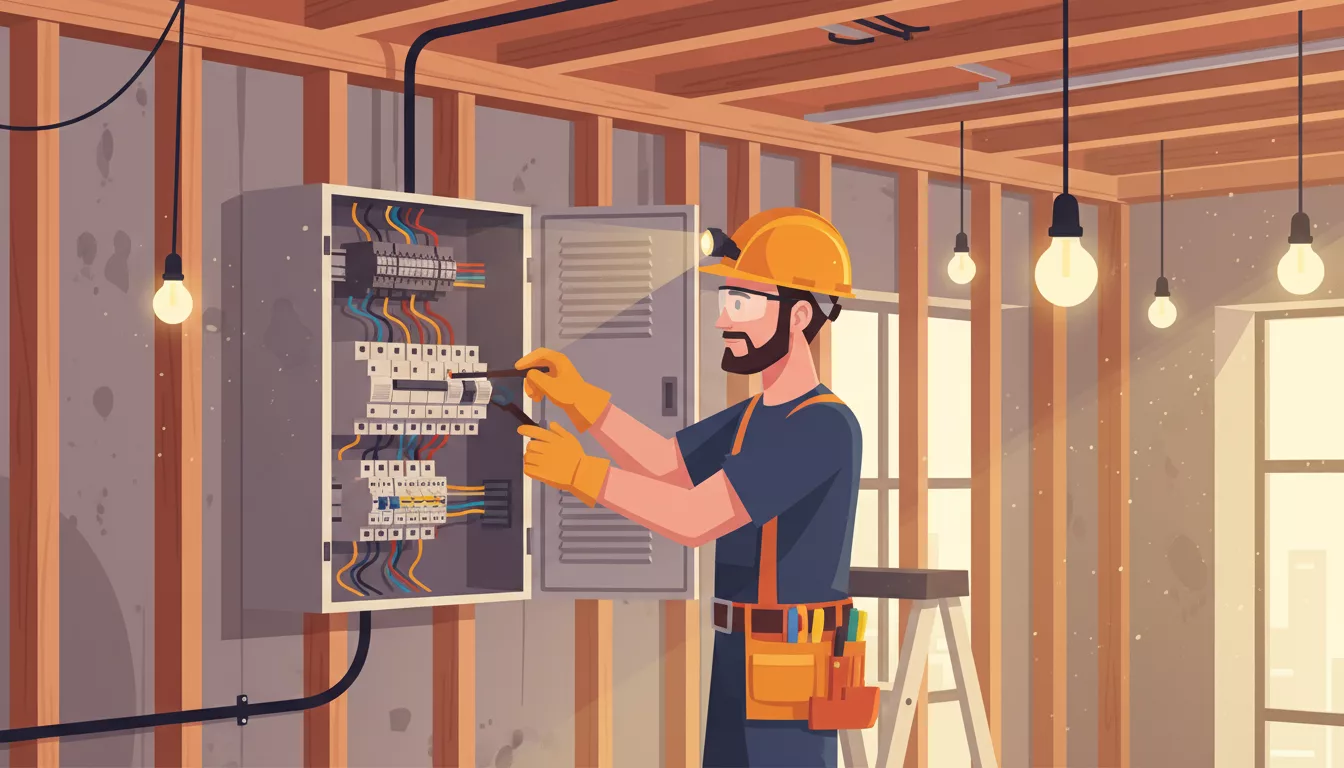
Thinking about becoming an electrician? Good. It pays well, it's in massive demand, and AI can't do it. But before you sign up for an apprenticeship, you should know what the work actually feels like at 7 AM when you're crawling through an attic in August, or at 4 PM when you've been on your feet for nine hours and the inspector just told you to redo a panel.
This isn't the recruiter version. This is what electricians - apprentices, journeymen, and masters - actually told me about their daily lives.
Before Dawn: The Early Start
5:30 AM - Wake Up
Most electricians start their day earlier than they'd like. If you're on a commercial or industrial job, the call time is usually 6:00 or 6:30 AM. If you're running your own residential service calls, you might start at 7:00 or 7:30. Either way, your alarm goes off when it's still dark outside.
You throw on your work clothes - work pants with knee pads built in (if you're smart), a company shirt, and steel-toe boots that you've already broken in. You grab your lunch because eating out every day will eat your paycheck.
6:00 AM - 6:15 AM: Truck and Tool Check
If you're a service electrician or running your own van, you check your truck before you leave. Are your common materials stocked? Do you have enough 12/2 Romex, wire nuts, receptacles, and breakers for today's jobs? Is your meter calibrated and your PPE in the truck?
If you're on a commercial crew, you're driving to the job site. Sometimes it's 15 minutes away. Sometimes it's an hour. That drive time is usually unpaid unless your company is unusually generous or your union contract covers it.
Morning: The Physical Work Begins
6:30 AM - 7:00 AM: Job Site Arrival
On a commercial new construction site, you arrive to organized chaos. There are plumbers, HVAC guys, framers, and drywallers all working in the same building at the same time, often in the same room. Coordination matters. If the HVAC crew runs their ductwork through the spot where your conduit needs to go, you've got a problem that takes time to sort out.
The foreman (or lead journeyman) gives the morning briefing. Today you're roughing in the second floor of a new office building. That means running conduit, pulling wire, and installing boxes before the drywall goes up.
If it's a residential day instead, you might be driving to a customer's house to troubleshoot why their kitchen outlets stopped working, or wiring a new addition, or upgrading a panel from 100 amps to 200 amps.
7:00 AM - 10:00 AM: The First Push
This is when the bulk of physical work happens. On a commercial rough-in, you're:
- Bending and mounting EMT conduit (electrical metallic tubing) with a hand bender
- Running MC cable (metal-clad) through ceiling spaces and wall cavities
- Installing junction boxes, outlet boxes, and switch boxes at the right heights
- Drilling through studs and joists (making sure you don't hit anything structural)
- Pulling wire through conduit runs - sometimes easy, sometimes a two-person job that takes an hour
The physical demands are real. You're on a ladder. You're on your knees. You're reaching overhead for 20 minutes straight and your arms go numb. You're carrying bundles of conduit or spools of wire that weigh 50+ pounds. In summer, the building has no AC yet because - well, you haven't wired it.
If you're an apprentice, you're doing a lot of the grunt work: hauling materials, holding the other end of things, drilling holes, running basic circuits under supervision. But you're also learning constantly. A good journeyman explains what they're doing and why as they work. A great one lets you do it yourself and corrects you when you mess up.
10:00 AM - 10:15 AM: Break
Fifteen minutes. You sit on a bucket or a stack of drywall and drink water. In the trades, hydration isn't a wellness trend - it's the difference between finishing the day and passing out in an attic. Experienced electricians drink water all morning, not just at break.
Late Morning: Problem-Solving Starts
10:15 AM - 12:00 PM: When Plans Meet Reality
The blueprints say one thing. The building says another. This is when you start running into problems that require actual thinking, not just physical work.
The conduit run the plans call for doesn't work because there's a steel beam in the way that wasn't on the drawings. So you figure out a new path - maybe you offset around it, maybe you come from a different direction. You check with the foreman to make sure the new route doesn't violate code or interfere with another trade.
Or maybe it's a residential service call and the homeowner says "the outlet in the bathroom doesn't work." Simple, right? Except when you open the box, you find wiring from 1962 with no ground wire, cloth-wrapped conductors, and a connection that someone clearly DIY'd with electrical tape and a prayer. Now a 30-minute fix is a conversation about upgrading the circuit, whether the panel can handle it, and how much that'll cost.
This problem-solving is honestly the best part of the job for most electricians. Every day is a puzzle. You're not doing the same repetitive task for eight hours. You're figuring things out, adapting, making judgment calls — the kind of skills employers look for on a resume. If you like that kind of work, you'll like being an electrician.
Midday: Lunch and the Second Push
12:00 PM - 12:30 PM: Lunch
Lunch on a construction site is exactly what you'd expect. You sit in your truck, on a tailgate, or in whatever break area exists. You eat the sandwich you packed. You check your phone. You talk to the other guys about the job, about the weekend, about whatever.
On residential service calls, you might eat between jobs in your van. Some days you barely get a real lunch because the schedule is packed.
12:30 PM - 3:00 PM: The Afternoon Grind
Afternoon work depends on what phase the project is in:
Rough-in phase: More of the same from the morning - conduit, wire, boxes. But you're more tired now, so you have to be more careful. This is when mistakes happen. You pull the wrong gauge wire, you miss a box location, you forget to install a nail plate. Experienced electricians slow down slightly in the afternoon rather than trying to maintain morning pace.
Trim-out phase: This is the finish work - installing receptacles, switches, light fixtures, cover plates, and the panel breakers. It's less physically demanding but more detail-oriented. Every device needs to be level, every cover plate needs to sit flush, every wire needs to be properly terminated. This is when your work becomes visible, so it needs to look clean.
Service work: Your afternoon might be a different house entirely. Troubleshooting a tripping breaker. Installing a ceiling fan. Upgrading an outdoor panel that's been rained on for 20 years. Running a new circuit for a hot tub. Each call is its own mini-project with its own set of unknowns.
The Code Factor
Throughout the day, every decision you make is governed by the National Electrical Code (NEC). How many wires can you put in a box? Depends on the box size and wire gauge - there's a calculation for that. How far apart do kitchen outlets need to be? No point along the counter can be more than 24 inches from a receptacle. Does this bathroom need a GFCI? Yes. Always. Does this bedroom need an arc-fault breaker? In most jurisdictions, yes.
Apprentices spend their evenings studying this stuff. Journeymen have it memorized. But even experienced electricians pull out the code book sometimes, because the NEC gets updated every three years and the rules change.
Late Afternoon: Wrapping Up
3:00 PM - 3:30 PM: Cleanup and Organization
On construction sites, you clean your work area every day. Scrap wire goes in the copper bin (that scrap has value - don't throw it away). Tools go back in their pouches. Extension cords get coiled. The area gets swept.
On service calls, you clean up after every job. Vacuum drywall dust if you cut into a wall. Pick up wire clippings. Leave the customer's house cleaner than you found it. This sounds minor but it's actually a big deal - it's how you get callbacks and referrals.
3:30 PM - 4:00 PM: Paperwork
Yes, electricians do paperwork. On commercial jobs, you fill out daily reports: what you installed, how many hours, any delays or issues. For service work, you write up invoices, document what was done (good professional email skills help here too), and sometimes take photos for the file.
If you're an apprentice, you also log your hours by category (rough-in, trim, service, etc.) because you need a specific number of hours in each category to qualify for your journeyman exam.
4:00 PM - 4:30 PM: Drive Home
Pack up. Drive home. Some days you're done by 3:30. Some days you're working until 6:00 because a job ran long or you're on overtime. In the busy season (spring and summer for residential, varies for commercial), 50-hour weeks are normal. Sixty-hour weeks happen. Seventy-hour weeks happen during big project pushes, though they're not sustainable.
What Changes by Specialty
The daily experience shifts depending on what kind of electrical work you do:
| Specialty | Typical Hours | Physical Demand | Variety | Key Difference |
|---|---|---|---|---|
| Residential new construction | 6:30 AM - 3:30 PM | High | Moderate | Same house types, fast pace |
| Residential service | 7:30 AM - 4:30 PM | Moderate | High | Different house and problem every call — great flexibility for working parents |
| Commercial | 6:00 AM - 2:30 PM | High | Moderate | Bigger systems, more teamwork |
| Industrial | Varies (shift work) | Very high | Low-moderate | High voltage, strict safety protocols |
| Solar / renewables | 7:00 AM - 4:00 PM | High (rooftop) | Low-moderate | Outdoor work, growing fast |
| Data centers / low voltage | 7:00 AM - 3:30 PM | Low-moderate | Low | Clean environments, precision work |
| Fire alarm / security | 7:00 AM - 3:30 PM | Low-moderate | Moderate | Specialized code requirements |
The Physical Reality
Let's be honest about what this job does to your body:
- Knees: You're on them constantly. Wear knee pads. Start from day one, not after they already hurt.
- Back: You lift heavy things and work in awkward positions. Learn to lift properly and stretch. Seriously.
- Hands: Cuts, scrapes, and occasional shocks are part of it. You'll develop calluses and permanent little scars. Your hands will never look the same.
- Heat and cold: You work in buildings without climate control, in attics that hit 140°F in summer, in basements that are 40°F in winter. You work outside in rain (but not lightning - that's the one weather that stops electrical work for obvious reasons).
- Fatigue: You're physically tired at the end of most days. Some electricians find balance through side hustles on their off days. Not "I sat in meetings all day" tired. Tired tired. Your body adapts over the first few months, but it never becomes a desk job.
Older electricians will tell you: take care of your body now or the job will take it from you at 55. That means staying in shape, stretching, wearing proper PPE, and learning to handle conflict when safety standards clash with crew pressure, and not trying to be a hero when something is too heavy to lift alone.
Safety Is Not Optional
Electricity kills people. This isn't an exaggeration for dramatic effect. About 160 electrical workers die on the job in the US every year, and thousands more are injured. The danger is especially real because electricity is invisible - you can't see whether a wire is hot.
Every electrician follows lockout/tagout (LOTO) procedures before working on energized equipment. You test circuits with your meter before touching them. You treat every wire as live until you've personally confirmed it's dead. You wear appropriate PPE - insulated gloves, safety glasses, arc flash suits for high-voltage work.
The culture on this is better than it used to be. Old-timers will tell stories about working hot panels with no gloves, and they say it like they're proud of it. Don't be that person. Follow the safety protocols every single time. The one time you skip it is the time that changes your life.
The Money Reality
Here's what electricians actually earn at different career stages:
| Level | Typical Hourly | Annual (40 hrs) | With Overtime |
|---|---|---|---|
| First-year apprentice | $16-20 | $33-42K | $38-50K |
| Third-year apprentice | $22-28 | $46-58K | $55-72K |
| New journeyman | $28-38 | $58-79K | $70-100K |
| Experienced journeyman | $35-50 | $73-104K | $90-135K |
| Foreman / lead | $40-55 | $83-114K | $100-145K |
| Master electrician | $45-65 | $94-135K | $115-170K |
| Business owner | Varies widely | $80-250K+ | N/A |
Union electricians in expensive markets (NYC, San Francisco, Chicago) can earn significantly more. IBEW journeymen in Manhattan make $50+ per hour on the check, plus benefits that add another $30-40 per hour in health insurance, pension, and annuity contributions. Understanding how to negotiate your first salary matters even in union shops.
And remember: no student loans. You're earning from day one of your apprenticeship, and learning how to negotiate a job offer can boost your pay from the start, not spending $80,000 on a degree.
What Nobody Tells You
The first year is humbling
You're the new person. You carry things. You hold things. You clean things. You drill holes. You do work that feels beneath you. This is normal and it's temporary. Every journeyman started the same way. The ones who stayed humble and asked questions became the best electricians. The ones who thought they were too good for grunt work washed out.
You'll work with characters
Construction sites have strong personalities. Some guys are mentors who'll teach you everything. Some are grumpy old-timers who think apprentices should figure it out themselves. Some are genuinely funny. Some are... not. You learn to work with all of them. That social skill is more valuable than you'd think.
Weather doesn't cancel work
Rain? You work. Cold? You work. Hot? You work. The only things that stop construction are lightning, extreme weather events, and frozen ground you can't trench through. You'll be outside in conditions that office workers would call "stay home" days.
The learning never stops
NEC updates every three years. New products come out constantly. Earning the right certifications keeps you competitive. Solar, EV chargers, battery storage, smart home systems - the technology keeps advancing (see the fastest growing jobs in 2026). You're either learning or falling behind. Most electricians enjoy this because it keeps the work interesting, but if you want a job where you can stop learning, this isn't it.
Travel is common
Especially in commercial and industrial work, your job site changes. You might work at one location for six months, then drive 45 minutes the other direction for the next job. Some electricians travel for big projects - power plants, data centers, hospitals - and are away from home for weeks or months.
Who Thrives as an Electrician
You'll probably love this work if you:
- Like solving problems with your hands and your brain simultaneously
- Can handle physical work day after day without it wearing you down mentally
- Pay attention to details - because sloppy electrical work is dangerous electrical work
- Want to earn good money without a four-year degree and student debt (electrician is among the highest-paying jobs without a degree)
- Like seeing tangible results at the end of the day
- Can handle being uncomfortable - hot, cold, cramped, dirty - and not let it ruin your day
- Want a skill that will always be in demand, no matter what the economy does — the trades industry isn't slowing down
You might struggle if you hate early mornings, can't handle physical labor, need a climate-controlled environment, or find repetitive tasks (you'll install thousands of outlets in your career) boring rather than meditative.
Getting Started
If this sounds like your kind of work, the path is straightforward: apply for an apprenticeship. If your resume is thin, our guide to writing a resume with no experience can help. Check with your local IBEW (union) or ABC (non-union) chapter, or look for electrical contractors in your area that hire apprentices directly. Most require a high school diploma, basic math skills, a solid entry-level cover letter, and the willingness to show up on time every day. Plenty of people start electrical apprenticeships as a career change at 40+ — it's never too late.
That last part — showing up reliably — is honestly what separates the apprentices who make it from those who don't. And once you apply, knowing how to follow up on a job application shows you're serious. The skills can be taught. The work ethic can't.