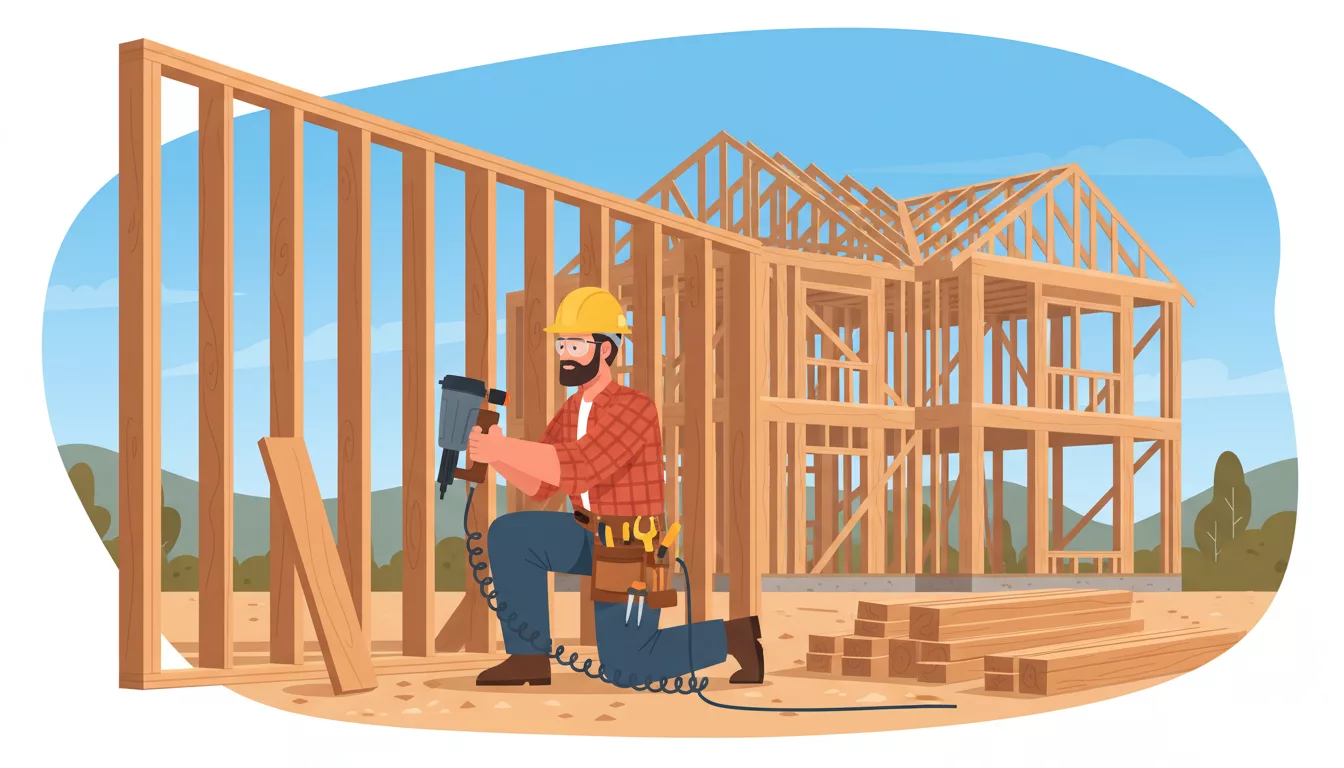
An Honest Look at the Carpentry Career Path
When most people think of carpenters, they picture someone framing a house or building a deck. And sure, that's part of it. But the reality is far more diverse than that simple image suggests. Carpenters work in high-rise commercial buildings, craft custom furniture in climate-controlled shops, restore century-old historic structures, build sets for theater productions, and everything in between. The field is vast, and the career paths available are surprisingly varied.
The money matters, so let's address it up front. According to our detailed carpenter salary analysis, experienced carpenters typically earn between $50,000 and $90,000 annually, with specialists and those running their own operations pushing well past six figures. But you don't start there. Like most skilled trades, carpentry requires you to put in time learning the craft before the real earning potential kicks in.
This is physically demanding work. You'll be on your feet all day, lifting heavy materials, working in uncomfortable positions, and dealing with weather extremes. Your knees will get sore. You'll have sawdust in places you didn't know sawdust could reach. But there's something deeply satisfying about building tangible things that people use every day. You can drive past a neighborhood and point to houses you framed. You can visit someone's home and see the custom cabinets you built. That connection between your work and the physical world is rare in today's economy.
The creative aspect surprises people. Good carpentry requires problem-solving, spatial reasoning, and often a real aesthetic sense. How do you frame a cathedral ceiling? How do you fit crown molding around an out-of-square room in a 100-year-old house? How do you build a curved staircase that's both beautiful and structurally sound? These aren't rote tasks you can learn from a manual.
This guide will walk you through everything you need to know about becoming a carpenter in 2026. We'll cover the different specialties within the field, the various training paths available, realistic salary expectations as you progress, what a typical day actually looks like, and the physical realities you need to prepare for. We'll also give you a concrete action plan to get started, whether you're 18 and fresh out of high school or 35 and looking for a career change. No degree required, but plenty of learning ahead.
What Carpenters Actually Do
Carpentry isn't one job. It's a collection of related specialties, each with different skills, work environments, and earning potential. Understanding these differences is crucial because your choice of specialty will shape your entire career trajectory.
Rough Carpentry and Framing
This is the structural backbone of construction. Framers build the skeleton of buildings - the walls, floors, and roof systems that everything else attaches to. You're working with dimensional lumber (2x4s, 2x6s, engineered beams), reading blueprints, and moving fast. Speed matters in framing because contractors bid these jobs competitively, and the framing crew sets the pace for every trade that follows.
The work is almost entirely outdoors, which means you're dealing with summer heat and winter cold. You're constantly carrying lumber, climbing ladders, working on roofs and upper floors. It's physically demanding and potentially dangerous if you don't respect the heights and power tools involved. But it's also straightforward in many ways. The tolerances are measured in fractions of an inch, not the 64ths required for finish work. And the satisfaction of seeing a building go from a concrete slab to a fully framed structure in a matter of weeks is substantial.
Framers often work in crews with clear hierarchies - laborers, apprentices, journeymen, and a lead carpenter or foreman. The learning curve is steep at first but levels off relatively quickly compared to finish carpentry. Most competent framers can handle standard residential work within two to three years.
Finish Carpentry
If framing is the skeleton, finish carpentry is the skin and details. This is where precision really matters. You're installing trim work - baseboards, crown molding, door and window casings. You're hanging doors and making sure they swing properly without rubbing. You're installing hardwood floors, building built-in shelving, fitting staircases.
The tolerances are tight. Gaps in trim work stand out. Uneven reveals around doors look sloppy. Finish carpenters need steady hands, excellent measurement skills, and an eye for aesthetics. You're often working in occupied homes or nearly completed buildings, which means you need to be cleaner and more professional in your presentation than rough carpenters.
This specialty tends to pay better than rough framing once you develop the skills. Homeowners and general contractors are willing to pay premium rates for finish carpenters who can make their work look effortless. The work is also somewhat less physically brutal - you're not hauling 16-foot 2x10s around - though you'll still spend plenty of time kneeling to install baseboard or stretching to fit crown molding.
Many carpenters eventually gravitate toward finish work as they get older and their bodies become less tolerant of the punishment framing delivers. It's also easier to work independently as a finish carpenter, taking on smaller projects directly with homeowners.
Cabinet Making
This is shop work, not construction site work. Cabinet makers build custom cabinets, vanities, built-ins, and sometimes furniture. You're working with hardwoods and plywood, using table saws, jointers, planers, routers, and increasingly, CNC machines. The precision required is even higher than finish carpentry - cabinet doors need to align perfectly, drawers must slide smoothly, and the finish work needs to be flawless.
The environment is completely different from construction. You're in a shop, usually climate-controlled, working relatively normal hours without the weather delays that plague outdoor trades. The pace is different too. Instead of framing a house in three weeks, you might spend two weeks building a single kitchen's worth of cabinets.
Cabinet making requires a different skill set. You need to understand wood movement, joinery techniques, finishing processes. Many cabinet makers come from carpentry backgrounds but plenty start in cabinet shops directly. The pay can be excellent for skilled craftspeople, especially if you develop a reputation for high-end custom work. But breaking into the field often means starting at lower wages while you learn the craft.
Commercial Carpentry and Concrete Formwork
Commercial carpentry is a different world from residential work. You're working on larger projects - office buildings, schools, hospitals, shopping centers. The scale is bigger, the crews are larger, and the work is often union. Much of commercial carpentry involves building forms for concrete pours, installing metal framing systems, and working with engineered materials rather than traditional lumber.
Formwork carpenters build the temporary structures that hold concrete in place while it cures - forms for walls, columns, elevated slabs, stairs. It's exacting work because if your forms aren't right, thousands of dollars of concrete might need to be jackhammered out and repoured. You're working with heavy materials, often in awkward positions, setting rebar and ensuring everything is level, plumb, and square.
This specialty is heavily unionized in most major markets. The United Brotherhood of Carpenters represents most commercial carpenters, which means better benefits, pension plans, and higher hourly wages than most residential work. But union jobs often require you to go through their apprenticeship program and follow strict work rules.
The job security in commercial work can be better than residential because large projects run for months or years, and commercial construction is somewhat less vulnerable to economic downturns than housing. On the flip side, you might need to travel to project sites or work less desirable schedules.
Renovation and Remodeling
Remodeling carpenters are generalists who need to know a bit of everything. You're working in existing buildings, which means dealing with the surprises that old construction throws at you. Nothing is square. Nothing is level. You open up a wall and find knob-and-tube wiring or evidence of water damage or framing that violates every code ever written.
The work requires problem-solving skills and flexibility. One day you're doing demolition, the next you're framing new walls, then you're installing trim. You need to coordinate with electricians, plumbers, and HVAC techs because everyone is working in the same space. You need to be comfortable working in occupied homes, dealing with homeowners directly, and keeping your work area cleaner than new construction requires.
Remodelers who develop good customer service skills and business sense often end up starting their own companies. The barrier to entry is lower than new construction - you don't need heavy equipment or large crews for most remodeling jobs. Many successful remodeling businesses started as a single carpenter with a truck taking on kitchen and bathroom projects.
The pay varies widely. Small handyman-level repairs don't pay well. But high-end remodeling in affluent areas can be extremely lucrative. The work is steady because people always need repairs and updates, even when new construction slows down.
Specialty Carpentry
Beyond the main categories, there are specialized niches that attract carpenters with particular interests. Timber framers work with massive beams and traditional joinery techniques to create post-and-beam structures and timber frame homes. It's physically demanding work that requires understanding structural engineering principles and often involves custom work on high-end projects.
Stairbuilders are specialists who focus exclusively on constructing stairs, particularly curved or complex staircases. It's mathematical work that requires precise calculations and careful execution. Good stairbuilders are rare and can command premium rates.
Historic restoration carpenters work on preserving and restoring old buildings. You need to understand historical construction techniques, match existing millwork profiles, and often work with preservation regulations and requirements. It's detailed work that appeals to people who love old buildings and craftsmanship.
Set builders work in theater, film, and television, constructing temporary structures and scenery. The pace is often frantic, the hours can be irregular, but the creative variety is unmatched. You might build a Victorian parlor one week and a spacecraft interior the next.
Education Requirements
Here's the good news: you don't need a college degree to become a carpenter. You don't need any degree at all, technically. But before you get too excited, understand that "no degree required" doesn't mean "no education needed." You'll be learning constantly throughout your career, both formally and on the job.
The baseline requirement is a high school diploma or GED. Some apprenticeship programs are flexible even on this, but having at least a GED will open more doors. More important than the diploma itself is what you learned in high school. Can you do basic math? Not calculus - we're talking fractions, decimals, geometry, and basic algebra. Carpentry is mathematical work. You're constantly measuring, calculating cuts, figuring out material quantities, and working with angles.
Fractions are absolutely essential. You need to be comfortable adding, subtracting, multiplying, and dividing fractions in your head or with minimal calculation. If you see 3/4" and need to subtract 5/16", you should be able to figure out that's 7/16" without pulling out a calculator. You'll be doing these calculations dozens of times per day.
Geometry comes up constantly. Understanding right angles, using the Pythagorean theorem to check if something is square (the 3-4-5 triangle method), calculating roof pitches, figuring out compound angles for trim work - all of this requires spatial reasoning and geometric understanding. You don't need to prove theorems, but you need to apply geometric principles to physical problems.
Physical fitness matters more than in most careers. You need to be able to lift 50-80 pounds repeatedly, climb ladders while carrying materials, and stay on your feet for eight-plus hours. You need good hand-eye coordination and decent fine motor skills. If you have serious back, knee, or shoulder problems, carpentry might not be sustainable long-term. But you don't need to be an athlete - average fitness and a willingness to build strength on the job is sufficient for most people.
Beyond the basics, having practical skills worth highlighting on your resume can help you stand out when applying for apprenticeships or entry-level positions. Any hands-on experience - working on cars, building projects at home, welding, mechanical work - demonstrates that you're comfortable with tools and physical work.
Reading comprehension is more important than people realize. You'll be reading blueprints, building codes, safety materials, and technical specifications. These aren't novels, but you need to extract accurate information from technical documents. Misreading a blueprint can result in expensive mistakes.
Training Paths
There are several ways to learn carpentry, each with distinct advantages and drawbacks. Your choice depends on your location, financial situation, career goals, and how quickly you want to start earning.
| Feature | Union Apprenticeship (UBC) | Trade School/Vo-Tech | Non-Union Apprenticeship | Self-Taught/Laborer Path |
|---|---|---|---|---|
| Duration | 4 years (8,000 hours) | 6-24 months | 3-4 years (varies) | Ongoing, no fixed timeline |
| Cost | Free (earn while learning) | $5,000-$20,000 tuition | Free to low cost | No tuition, but lower starting wages |
| Earnings During Training | 50-90% of journeyman wage | None during school, then entry-level | Varies, typically 40-70% of journeyman | Laborer wages ($12-$18/hour typically) |
| Benefits | Full benefits, pension from day one | None until employed | Depends on employer | Depends on employer |
| Job Placement | Excellent through union hall | Job assistance, varies by school | Guaranteed with sponsoring contractor | Already employed |
| Competitiveness | Very competitive in major markets | Open enrollment usually | Moderate - need to find sponsor | Easiest to start |
| Best For | Commercial work, strong benefits, structured learning | Quick start, career change, theoretical foundation | Residential work, flexibility | Immediate employment, learn by doing |
Union Apprenticeship Through the United Brotherhood of Carpenters
The UBC runs what many consider the gold standard of carpentry training. Their apprenticeship programs combine on-the-job training with classroom instruction, typically requiring four years and 8,000 hours of work experience to complete. You're employed from day one, earning a percentage of the journeyman wage that increases as you progress. First-year apprentices might start at 50% of scale, reaching 90% by the fourth year.
The benefits are substantial. You get health insurance, retirement contributions, and union representation from the start. The training is comprehensive, covering everything from basic framing to advanced formwork, safety protocols, and blueprint reading. You're learning from experienced journeymen on real job sites while also attending classes in the evenings or during dedicated training periods.
Getting accepted is the challenge. In major metropolitan areas with strong union presence, hundreds of people might apply for a limited number of apprenticeship slots. You'll typically need to pass an aptitude test covering math and reading comprehension, participate in an interview, and sometimes wait months or even a year for your name to come up on the list.
Once in, you're committed to working union for the duration of your apprenticeship. You go where the union sends you, which might mean traveling to different job sites or even different cities. The work is primarily commercial - high-rise buildings, schools, hospitals, infrastructure projects. If your heart is set on building custom homes or fine furniture, union apprenticeship might not align with your goals.
But for commercial carpentry, it's hard to beat. The wage progression is clear, the training is thorough, and you'll have access to large-scale projects that non-union carpenters rarely see. Plus, union carpenters typically earn 20-40% more than their non-union counterparts over a career, and the pension benefits can make a significant difference in retirement.
Trade School and Vocational-Technical Programs
Community colleges, technical schools, and some for-profit institutions offer carpentry certificate and associate degree programs. These typically run six months to two years, depending on whether you're pursuing a certificate or degree and whether you're attending full-time or part-time.
The curriculum covers fundamentals: tool use, safety, blueprint reading, basic framing, finish work, and sometimes specialized skills like cabinetmaking or green building techniques. You'll get hands-on practice in shop settings and sometimes on actual construction projects. Look for programs accredited by NCCER (National Center for Construction Education and Research), which provides standardized curriculum and credentials recognized across the industry.
The advantage is speed. You can complete a certificate program in less than a year and emerge with foundational knowledge and some hands-on experience. This can make you more attractive to employers than someone with zero training. Some programs have partnerships with local contractors who recruit directly from graduating classes.
The disadvantage is cost. Tuition ranges from $5,000 at community colleges to $20,000 or more at for-profit schools. And you're not earning while you're learning. Financial aid is available for many programs, but you'll need to research your options.
Trade school also doesn't replace on-the-job experience. You'll emerge with book knowledge and some shop practice, but you haven't framed a house in the rain or figured out how to install trim in a room that's three-quarters of an inch out of square. Expect to start at entry-level wages and spend several years learning the practical realities of the trade.
Non-Union Apprenticeships
Many states run registered apprenticeship programs that aren't affiliated with unions. These are typically sponsored by individual contractors or contractor associations. You're hired by a specific company, work for them as an apprentice, and receive structured training both on the job and in classroom settings.
The structure varies widely. Some programs closely mirror union apprenticeships with four-year timelines and comprehensive training. Others are more informal, with less classroom time and more emphasis on learning by doing. Quality depends heavily on the sponsoring contractor.
Finding these opportunities requires research. Contact your state's Department of Labor or apprenticeship council to learn about registered programs in your area. Talk to local contractors about whether they take on apprentices. Some homebuilders have formal apprenticeship programs, especially larger regional companies.
One risk: if the contractor goes out of business or lets you go, your apprenticeship might stall. Union apprentices get placed with different contractors as needed, but non-union apprentices are tied to their sponsoring employer. Make sure you're working for a stable company with a genuine commitment to training.
The Self-Taught Path: Starting as a Laborer
This is how many carpenters still enter the trade, especially in residential construction. You get hired as a general laborer or carpenter's helper with zero experience. Your job is to carry materials, clean up, hold boards while experienced carpenters cut them, and generally make the skilled workers' jobs easier. You're the low person on the crew, but you're getting paid to watch professionals work.
If you pay attention, ask questions, and demonstrate genuine interest, good carpenters will teach you. You'll start with simple tasks - measuring and cutting studs, nailing off walls, installing subfloor. Gradually, you take on more responsibility. After a year or two, you might be doing basic framing independently.
The advantage is accessibility. Small residential framing crews, remodeling contractors, and handyman operations regularly hire people with no experience. You don't need to apply to competitive programs or pay tuition. You just need to find someone willing to hire you and teach you.
The disadvantages are significant. You'll start at laborer wages, which might be $12-$16 per hour in many markets. Your learning is unstructured and dependent entirely on who you're working for. You have no credential at the end, just experience. If you go this route, pursue certifications on your own time to keep your options open.
Certifications and Licensing
Carpentry isn't as heavily licensed as plumbing or electrical work, but various certifications can improve your employability, earning potential, and legal ability to take on certain types of work.
| Certification/License | Purpose | Who Needs It | Cost | Renewal |
|---|---|---|---|---|
| OSHA 10-Hour Construction | Basic construction safety training | All entry-level construction workers | $50-$100 | Recommended every 4-5 years |
| OSHA 30-Hour Construction | Advanced safety training for supervisors | Foremen, leads, supervisors | $150-$250 | Recommended every 4-5 years |
| NCCER Carpentry Level 1-4 | Industry-recognized skill certification | Voluntary, valuable for resume | Varies by training provider | N/A (permanent) |
| EPA Lead-Safe RRP | Required for work on pre-1978 homes | Anyone doing renovation/remodel work | $200-$300 for initial course | Every 5 years |
| First Aid/CPR | Emergency response | Required by some employers, good to have | $50-$100 | Every 2 years |
| Scaffolding Competent Person | Authority to erect and inspect scaffolding | Commercial carpenters working with scaffolding | $200-$400 | Every 3-5 years |
| Forklift/Aerial Lift Certification | Legal operation of powered equipment | Workers using this equipment | $75-$200 | Every 3 years |
| State Contractor License | Legal authority to contract directly with clients | Anyone running their own contracting business | $200-$1,000+ depending on state | Annually or biennially |
OSHA 10 and 30-Hour Certifications
OSHA 10-hour construction safety certification should be among your first priorities. Many job sites won't let you through the gate without it. The course covers fundamental construction hazards - fall protection, electrical safety, struck-by hazards, caught-in or between hazards, and personal protective equipment. It's available online or in-person and takes about ten hours to complete.
OSHA 30 is the advanced version, typically required for supervisory roles. It goes deeper into safety topics and includes sections on managing safety programs. If you're serious about moving into leadership positions, get your OSHA 30 even before you need it.
NCCER Certifications
The National Center for Construction Education and Research provides standardized, industry-recognized credentials. Their carpentry curriculum has four levels, progressing from basic to advanced skills. Each level includes both written assessments and practical performance evaluations. The certifications aren't required for employment, but they provide portable proof of your skills that transfers across employers and states.
EPA Lead Renovation, Repair, and Painting Certification
If you're doing any renovation or remodeling work on homes built before 1978, federal law requires lead-safe work practices. This means either you or your employer needs EPA RRP certification. The course teaches you how to contain dust, handle materials safely, and perform proper cleanup when working with lead-based paint. For anyone planning to work in remodeling, this certification is essentially mandatory.
State Contractor Licenses
Requirements vary dramatically by state. Some states require licensing for any contractor work over a minimal threshold. Others have no statewide licensing and leave regulation to municipalities. If you plan to run your own carpentry or general contracting business, research your state's specific requirements early. Getting licensed typically requires demonstrating several years of experience, passing exams, and obtaining appropriate insurance and bonding.
For a comprehensive look at which certifications provide the best return on investment across various careers, see our guide to the best certifications in 2026.
Specializations Comparison
Different carpentry specialties suit different personalities, physical capabilities, and career goals. Here's how the main specializations compare across key factors.
| Specialization | Earning Potential | Work Environment | Physical Demand | Best For |
|---|---|---|---|---|
| Rough/Framing | $40,000-$70,000 | Outdoor, all weather, new construction | Very High | Young workers who like speed and outdoor work |
| Finish Carpenter | $50,000-$85,000 | Indoor, occupied or near-complete buildings | Moderate | Detail-oriented, patient, aesthetically minded |
| Cabinet Maker | $45,000-$80,000+ | Climate-controlled shop | Moderate | Creative types, precision-focused, shop work |
| Commercial/Formwork | $55,000-$90,000 | Large construction sites, often urban | Very High | Union benefits, large-scale projects, job security |
| Remodeling | $45,000-$90,000+ | Occupied homes, varied locations | Moderate to High | Independent types, entrepreneurs, problem-solvers |
| Trim Carpenter | $48,000-$80,000 | Indoor, finish phase of construction | Moderate | Patience, attention to detail, steady hands |
| Stairbuilder | $55,000-$95,000 | Shop and on-site installation | Moderate | Math-oriented, spatial thinkers, specialists |
| Timber Framer | $50,000-$85,000 | Outdoor and shop, custom high-end | Very High | Traditionalists, heritage trades enthusiasts |
These ranges reflect experienced workers and vary significantly by region. Urban areas and markets with strong union presence typically pay toward the higher end. Specialists at the top of their field can exceed these ranges, especially if they run their own businesses.
Salary Progression
Understanding realistic earnings at each stage helps you plan financially and set appropriate career goals. These figures represent typical ranges in 2026 across various markets.
| Position/Experience Level | Typical Annual Salary | Hourly Equivalent | Notes |
|---|---|---|---|
| Laborer/Helper (0-1 year) | $28,000-$36,000 | $14-$18/hour | Entry-level, learning basic tasks |
| Apprentice Year 1-2 | $32,000-$42,000 | $16-$21/hour | Formal training, developing skills |
| Apprentice Year 3-4 | $40,000-$52,000 | $20-$26/hour | Advanced apprentice, more independent |
| Journeyman (Residential) | $48,000-$70,000 | $24-$35/hour | Fully trained, independent work |
| Journeyman (Union Commercial) | $60,000-$85,000 | $30-$42/hour | Union scale plus benefits package |
| Lead Carpenter/Foreman | $55,000-$80,000 | $27-$40/hour | Supervising crew, coordinating work |
| Superintendent | $70,000-$95,000 | Salary position typically | Managing entire projects, multiple crews |
| Finish Carpenter (Experienced) | $55,000-$85,000 | $27-$42/hour | Specialty in trim and detail work |
| Cabinet Maker (Experienced) | $50,000-$80,000 | $25-$40/hour | Custom work commands higher rates |
| General Contractor (Own Business) | $70,000-$200,000+ | Varies widely | Highly variable, depends on business success |
These figures typically represent base wages. But here's what they don't show: overtime. Construction work often involves overtime, especially during busy seasons. Many carpenters work 50-60 hour weeks during peak construction season (spring through fall in most regions). At time-and-a-half, a journeyman making $30/hour base earns $45/hour for overtime. Those extra 10-20 hours per week can add $15,000-$30,000 to annual earnings.
Geographic variation is substantial. A journeyman carpenter in New York City or San Francisco might make $70,000-$90,000 base, while the same skill level in rural Arkansas might earn $40,000-$50,000. Union markets generally pay more but have higher costs of living.
Benefits matter significantly when comparing union and non-union positions. A union carpenter making $65,000 might receive another $25,000-$30,000 in benefits - health insurance, pension contributions, annuity, and training fund contributions. A non-union carpenter making the same base might receive minimal benefits, making the union position far more valuable despite identical pay.
As you advance in your carpentry career, understanding how to negotiate compensation becomes increasingly important. Our guide to entry-level salary negotiation provides strategies for maximizing your earnings even when you're just starting out.
A Day in the Life: Residential Framing Carpenter
Abstract descriptions don't convey what the work actually feels like. So here's a realistic walkthrough of a typical day as a residential framing carpenter on a crew building single-family homes.
6:00 AM - Your alarm goes off. You're sore from yesterday - your shoulders are tight from nailing overhead all afternoon. You pull on work jeans, a t-shirt, and your boots. You make coffee and pack a lunch - a sandwich, some fruit, and plenty of water. In summer, you'll go through a gallon of water during the workday.
6:45 AM - You arrive at the job site. The floor system is already down - your crew finished decking it yesterday. Today you're framing walls. Three other carpenters are already there, along with your foreman. Everyone parks along the street since the driveway area is full of material pallets - stacks of studs, headers, OSB sheathing.
7:00 AM - The foreman does a quick safety briefing. He reminds everyone to watch for exposed rebar at the edge of the slab and to stay hydrated - it's supposed to hit 92 degrees by afternoon. You grab your nail bags and power tools from your truck. Framing nailer, circular saw, speed square, tape measure, hammer, chalk line.
7:15 AM - You and another carpenter start laying out exterior walls on the deck. Snapping chalk lines where the bottom plates will go, working from the blueprints. The other two carpenters are cutting studs to length - mostly 92-5/8" precuts for 8-foot walls, but some custom lengths for different ceiling heights.
8:00 AM - Layout is done. Now you're building wall sections flat on the deck. Lay out the bottom plate and top plates, mark the stud locations every 16 inches on center, then nail together 8-foot sections. The framing nailer is loud even with ear protection. Bang-bang-bang, three nails through the plate into each stud. Your movements are efficient from repetition.
9:30 AM - Time to stand walls. This is where carpentry gets physical. You and two other guys lift a 20-foot section of exterior wall, walk it upright, and brace it temporarily. You nail the bottom plate to the floor joists, check it for plumb with a level, and secure it with diagonal bracing. One wall up. Fifteen more to go.
10:30 AM - Short water break. You're already sweating through your shirt. The foreman checks the wall you just stood to make sure it's straight and properly braced. He points out a spot where the top plate is bowed out slightly - you add another brace to pull it straight.
11:00 AM - Back to standing walls. Interior walls now - these go up faster because they're not as long and don't need sheathing yet. By noon you've got all the first-floor walls up. The house is starting to look like a house instead of just a platform.
12:00 PM - Lunch break. Everyone sits in whatever shade they can find. You eat your sandwich and scroll through your phone. Your forearms are tan, your upper arms are pale - the classic farmer's tan. Someone complains about their truck. Someone else is talking about a fishing trip this weekend. Standard job site conversation.
12:30 PM - Afternoon work. You're installing headers over window and door openings, adding cripple studs, and making sure everything is straight and square. This is where precision matters - if the rough opening for a door is wrong, the door won't fit properly later.
2:00 PM - The hottest part of the day. The sun is directly overhead and there's no shade on the deck. You're drinking water constantly. Your shirt is soaked. This is the part of construction that people in air-conditioned offices can't fully grasp. It's just hot and you just keep working through it.
3:00 PM - You're nailing off the interior walls - securing them to the floor and connecting them where they intersect. Your nail gun has jammed twice this afternoon from dust in the mechanism. You clear it and keep going. Your knees hurt from kneeling on the wood deck.
3:30 PM - Cleanup. Gathering scrap lumber, sweeping sawdust, loading tools back into your truck. The site needs to be clean for the inspection tomorrow.
4:00 PM - Done. You drive home in your dusty truck, AC blasting, feeling the day in your shoulders and lower back. You're tired but satisfied - the house that was just a floor this morning now has walls. There's something deeply satisfying about that progression.
The Physical Reality
Let's be direct about what carpentry does to your body. This isn't meant to scare you off - plenty of carpenters work into their 60s and beyond. But going in with eyes open about the physical demands helps you prepare and develop habits that support longevity in the trade.
Knees. Your knees take a beating. Finish carpenters installing baseboard spend hours per day kneeling. Rough carpenters kneel to nail bottom plates and work on floors. Many carpenters develop chronic knee pain by their 40s. The solution is simple but requires discipline: wear knee pads always. Not just when you think you'll be kneeling a lot - always. The gel-style knee pads that strap on are worth every penny.
Back. Back problems are common. You're lifting heavy materials repeatedly - sheets of plywood weighing 60-80 pounds, bundles of shingles, bags of concrete mix. You're bending to pick up tools, working in awkward positions, and sometimes lifting above your head. Lift with your legs, not your back. Get help with heavy materials instead of trying to muscle them yourself.
Shoulders. Shoulders wear out from repetitive overhead work. Nailing ceiling joists, installing soffits, framing roofs - all of this involves your arms above your head for extended periods. Rotator cuff injuries are occupational hazards. Strength training and stretching help, but many older carpenters migrate to specialties that involve less overhead work.
Cuts and splinters. You're working with sharp tools, rough lumber, and power equipment. You'll cut yourself periodically - usually minor, occasionally requiring stitches. Most carpenters lose fingernails at some point from misplaced hammer blows. None of this is serious, but if you're squeamish about minor injuries, carpentry might bother you.
Weather. In most parts of the country, construction happens year-round. That means framing in 95-degree heat and in 20-degree cold. Summer means heat exhaustion is a real risk. Winter means your hands get numb and power tools don't work as well. Rain makes everything harder and potentially dangerous.
Heights. Framers work on roof decks, upper floors without guardrails yet installed, and scaffolding. If you have severe fear of heights, framing might not work for you. But many people with mild fear of heights acclimate with experience.
Noise. Circular saws, framing nailers, table saws, routers - construction is loud. Hearing protection is essential, but many carpenters neglect it. Tinnitus is permanent. Wear earplugs or earmuffs consistently.
Dust. Sawdust, insulation fibers, silica dust from cutting concrete or fiber cement, and dust from treated lumber containing chemicals. Wearing a respirator when cutting treated lumber or doing demolition isn't optional if you want healthy lungs at 60.
So how do you stay healthy long-term? The carpenters still working productively in their 50s and 60s have common habits. They use proper lifting technique religiously. They wear knee pads without exception. They invest in quality tools that reduce physical strain. They stay reasonably fit. They stay hydrated and take breaks when needed. And they listen to their bodies - when something hurts beyond normal soreness, they address it instead of pushing through until minor problems become chronic conditions.
Getting Started: 6-Step Plan
Step 1: Get Exposure to the Work
Before you commit to a training path or quit your current job, make sure you actually like carpentry. Volunteer with Habitat for Humanity - they regularly accept volunteers with zero experience and will teach you basic tasks while you help build homes. Take a community education class at a local college. Work on a personal project - build a workbench, a bookshelf, a raised garden bed. Even small projects teach you basic skills and reveal whether you find the work satisfying.
Step 2: Choose Your Training Path
Based on your location, financial situation, and career goals, select the path that makes the most sense. If you're in a strong union market, apply to the UBC apprenticeship. If you're in a rural area focused on residential construction, look for contractors hiring laborers or non-union apprenticeships. If you can afford tuition and want a faster start, research trade schools with good reputations.
Step 3: Build Your Basic Tool Kit
You don't need $5,000 worth of tools to start. Many employers provide power tools. Here's a realistic starter kit for under $300: 25-foot tape measure, 16 oz framing hammer, utility knife, combination square and speed square, chalk line, 4-foot and 2-foot levels, carpenter's pencils, nail set, basic chisel set, block plane, cat's paw, and tool bags to carry it all. Buy quality where it matters - tape measure, square, levels - and upgrade as you earn.
Step 4: Get OSHA 10 Certification
Don't wait for an employer to require this. Get it proactively. OSHA 10-hour construction certification is available online for under $100, takes about ten hours, and immediately makes you more employable. Many job sites require it, and having it on your resume shows you're serious about the trade.
Step 5: Start Building Skills
While you're applying for jobs or waiting for programs to start, practice fundamental skills. Learn to read a tape measure quickly and accurately, including adding and subtracting fractions mentally. Practice cutting boards square with a circular saw. Learn to drive nails with a hammer - hit them straight, sink them flush without marring the wood. Watch YouTube videos from credible carpentry channels, but balance video learning with actual practice.
Step 6: Land Your First Job
Apply everywhere. Search job boards like Land A Job for carpentry and construction positions. Visit construction sites and ask if they're hiring. Contact local contractors directly - many small companies don't advertise openings but will hire good people who show up asking for work.
Our guide on how to network for a job provides techniques that work well in trades. Talk to people at building supply stores - they know who's busy and hiring. If you have no experience, our article on getting a job with no experience offers strategies for breaking into new fields.
When you get an interview, show up 10 minutes early in clean work clothes and boots. Bring your certifications and any tools you own. Contractors care more about attitude and reliability than existing skills for entry-level positions.
Career Advancement
Carpentry isn't a dead-end job. The career ladder has multiple rungs, and you can branch into related fields or start your own business.
Lead Carpenter and Foreman
After solid skills and a few years of experience, the natural progression is to lead carpenter or foreman. You're supervising a crew, delegating tasks, coordinating with other trades, and taking responsibility for quality and pace. You still work with tools most of the day, but you're also making decisions and troubleshooting problems. Foreman positions typically pay $5-$15 per hour more than journeyman rates.
Superintendent and Project Manager
Superintendents oversee entire projects, coordinating multiple crews and trades, managing schedules, interfacing with clients and architects. The pay is significantly higher - often $70,000-$95,000 - but the stress increases proportionally. Getting here usually requires 10-15 years of experience and strong organizational skills.
Starting Your Own Contracting Business
Many carpenters eventually go independent. The earning potential is highest here - successful contractors can make $150,000-$300,000+ annually. But you need to understand bidding, estimating, accounting, licensing, insurance, marketing, and employee management. Many skilled carpenters fail as contractors because they underestimate the business side. Start small - do side jobs on weekends, build a reputation gradually, then transition to full-time self-employment.
Estimator
Estimators calculate material quantities, labor hours, and costs for construction projects. It's desk work requiring strong math, deep construction knowledge, and understanding of local costs. The pay is typically $60,000-$85,000. If your body is wearing out but you want to stay in construction, estimating is a natural transition.
Building Inspector
Your carpentry knowledge transfers directly to building inspection. Inspectors review construction for code compliance and safety. Most jurisdictions require certification. The pay is moderate ($50,000-$70,000) but the work is steady, hours are regular, and physical demands are much lower.
Carpentry Instructor
If you enjoy teaching, consider instructing at trade schools or community colleges. You're passing on knowledge while working regular hours in climate-controlled shops. The pay is typically $45,000-$65,000 with good benefits.
Specialty Paths and Transitions
Some carpenters develop rare specialized skills - timber framing, historic restoration, fine furniture - that allow them to carve out profitable niches. Others transition to related trades. Your carpentry foundation makes it relatively easy to pursue electrical or plumbing work. You already understand construction, can read plans, and know how buildings go together.
Common Mistakes to Avoid
- Buying expensive tools before you need them. Start with basics. Buy quality where it matters - tape measure, square, levels - but don't buy a $400 miter saw before you've demonstrated you'll stick with carpentry. Upgrade gradually as you identify what you actually use.
- Skipping the math. You can't avoid fractions and geometry in carpentry. If you're weak in math, address it directly. Take a refresher course. Practice fraction arithmetic until it's automatic. The carpenters who advance are comfortable with the mathematical aspects of the work.
- Not getting OSHA certified early. Waiting until an employer requires it means you're missing opportunities. Get it immediately. It's cheap, takes minimal time, and makes you more employable.
- Staying a laborer too long without formal training. If you've been a laborer for two years and aren't progressing toward actual carpentry work, find a better employer or pursue formal training. Don't let inertia trap you in low-skill, low-pay work.
- Ignoring finish carpentry skills. Framers sometimes dismiss finish work as less important. But finish skills make you more versatile, more valuable, and give you options as your body ages out of heavy framing.
- Not understanding the business side. If you have aspirations of going independent, start learning about bidding, estimating, accounting, licensing, and insurance early. Many carpenters go independent with excellent technical skills but zero business knowledge and struggle.
- Treating safety gear as optional. Young carpenters often skip safety glasses, hearing protection, and knee pads. The cumulative damage adds up invisibly. Hearing loss, knee deterioration, eye injuries - these are real and common. Develop proper PPE habits from day one.
Career Outlook
Several factors suggest strong long-term demand for carpenters. The Bureau of Labor Statistics projects steady growth through the next decade, driven by population growth, aging housing stock requiring renovation, and ongoing commercial construction. More significantly, the profession faces a retirement wave. The average age of construction workers keeps rising as younger people have been pushed toward college for the past 20-30 years. As older carpenters retire, there aren't enough younger workers to replace them.
Infrastructure spending at federal and state levels creates sustained demand. Bridge projects, school construction, hospital expansions, and transportation infrastructure all require carpenters. These projects often span years and provide stable employment.
Housing demand remains strong. The US has underbuilt housing for years, creating shortages in many markets. Even if housing construction fluctuates with economic cycles, the long-term need supports carpentry employment. And renovation work is less cyclical - people remodel even during downturns.
Carpentry appears alongside other growing trades on our list of fastest-growing jobs in 2026 and is prominently featured in our trades and skilled labor industry overview.
Automation is unlikely to significantly impact carpentry. Prefabrication and modular construction are growing, but robots can't frame a house. The work is too varied, site conditions are too inconsistent, and the problem-solving required is beyond current automation capabilities. Unlike manufacturing jobs that can be offshored, carpentry needs to happen where the building is being constructed.
The wage outlook is positive. As labor shortages in skilled trades intensify, wages have been rising faster than overall wage growth. Younger people entering trades now are positioned to benefit from this supply-demand imbalance throughout their careers.
Is Carpentry Right for You?
Carpentry is likely a good fit if you:
- Genuinely enjoy working with your hands and building physical things
- Don't mind or actually prefer physical work over desk work
- Have decent spatial reasoning and can visualize how pieces fit together
- Are comfortable with math, especially fractions and geometry
- Appreciate seeing tangible results from your work
- Can handle weather extremes and outdoor work
- Value skill development and craftsmanship
- Want a career with multiple paths and specializations
- Are looking for solid income without college debt - carpentry consistently ranks among the highest-paying jobs without a degree
Carpentry might not be right if you:
- Have serious chronic pain or physical limitations affecting knees, back, or shoulders
- Can't handle heights - significant acrophobia is a real barrier for framing
- Require climate-controlled, comfortable work environments
- Strongly prefer predictable, consistent schedules
- Are very averse to any physical risk or minor injuries
- Struggle significantly with math and aren't willing to improve
- Need immediate high income - carpentry pays well eventually but starts modest
If you're considering carpentry as a career change from a different field, our career change guide can help you navigate the transition. Many successful carpenters started the trade in their 30s or even 40s. Age is less of a barrier than people think, though you'll want to be more intentional about conditioning and injury prevention.
Next Steps: Start This Week
If you've read this far and are seriously interested, here's what to do this week - not next month, this week.
If you're pursuing union apprenticeship: Contact your local United Brotherhood of Carpenters hall. Ask about their apprenticeship program, application periods, and requirements. Many programs only accept applications during specific windows.
If you're considering trade school: Research programs at your local community college. Schedule a visit to tour the facilities and talk to instructors. Ask about job placement rates and NCCER accreditation.
If you're looking to start as a laborer: Search construction job postings on Land A Job. Drive around areas with active construction and stop at sites to ask if they're hiring. Visit building supply stores and ask if they know contractors looking for workers.
Everyone should: Sign up for an OSHA 10-hour construction course this week. Also contact your local Habitat for Humanity chapter and sign up for a volunteer build day. Getting actual hands-on experience, even for a day, will tell you more about whether you'll like carpentry than reading ever will.
The barrier to entry is low. You don't need perfect conditions or extensive preparation. You need basic physical capability, willingness to learn, and the initiative to show up and try. The construction industry needs skilled workers, and the opportunities are there for people willing to do the work.