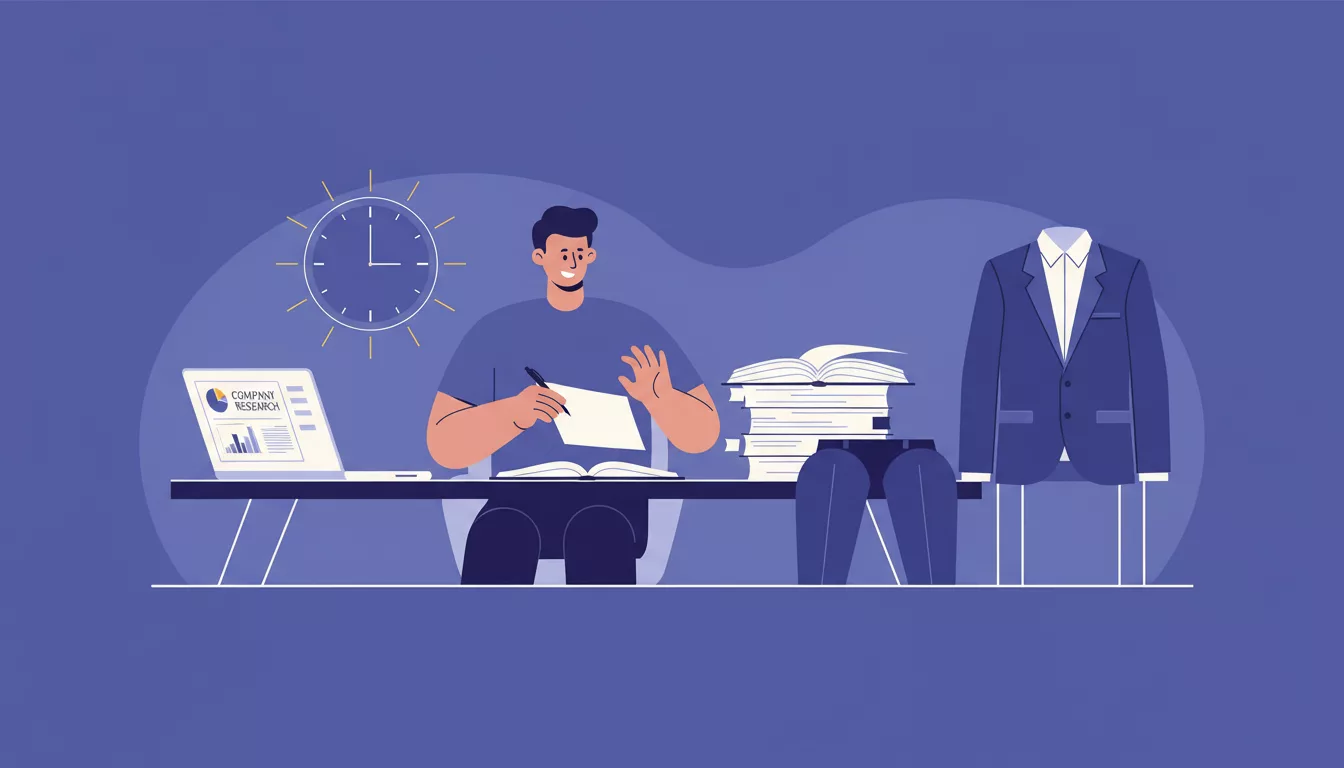
You've got an interview scheduled. Maybe it's tomorrow, maybe it's next week. Either way, that slight knot in your stomach is telling you to get ready.
Good news: interview preparation isn't complicated. Most candidates either don't prepare at all (which is obvious) or over-prepare to the point of sounding robotic (which is almost as bad). The sweet spot is doing focused, strategic prep that makes you sound confident and natural.
Here's your complete guide to walking into any interview ready to go.
The Night-Before Checklist
Let's start with the basics that trip people up way more often than they should:
- Confirm the details. Time, location (or video link), who you're meeting with, and how long the interview is expected to last. Check your email for the confirmation and screenshot the important details.
- Plan your route. For in-person interviews, do a test run on Google Maps at the same time of day. Add 20 minutes of buffer. Being late is essentially disqualifying.
- Test your tech. For virtual interviews, test your camera, microphone, and internet connection. Download whatever platform they're using (Zoom, Teams, Google Meet) ahead of time. Have a backup plan — your phone as a hotspot, their phone number to call if video fails.
- Prepare your outfit. Lay it out the night before. When in doubt, dress one level above what employees at the company typically wear. Wrinkled clothes send a message you don't want to send. Our interview outfit guide covers specifics for every industry.
- Print copies of your resume. Bring 3-5 copies on decent paper. Yes, they have your resume. But having it in front of you helps you reference specifics, and handing one to an interviewer who forgot theirs makes you look prepared.
- Charge everything. Phone, laptop, earbuds — whatever you might need. A dead phone on interview day adds stress you don't need.
Research the Company (30-60 Minutes)
This is where most preparation time should go. You need to know enough about the company to sound genuinely informed, not like you crammed Wikipedia five minutes before walking in.
What to Research
- What they actually do. This sounds obvious, but you'd be surprised how many candidates can't clearly explain the company's core business. Visit their website, read their "About" page, and look at their products or services.
- Recent news. Google the company name and check the past 3 months. Funding rounds, product launches, leadership changes, awards — any of these make great conversation starters or things to reference in your answers.
- Their competitors. Knowing who they compete with shows you understand their market position. You don't need a deep analysis — just know the top 2-3 competitors and how this company differentiates itself.
- The team you'd join. Look up the hiring manager and team members on LinkedIn. Understanding their backgrounds helps you tailor your answers to what matters to them.
- Company culture clues. Check their careers page, Glassdoor reviews (take with a grain of salt), social media, and any blog posts from employees. This helps you gauge formality, values, and what they prioritize in their people.
Where to Look
| Source | What You'll Find | Time Needed |
|---|---|---|
| Company website | Products, mission, team, recent blog posts | 10-15 min |
| LinkedIn company page | Employee count, growth trends, recent posts | 5-10 min |
| Google News | Recent press, funding, launches | 5-10 min |
| Glassdoor | Interview experiences, culture, salary range | 10-15 min |
| LinkedIn (interviewers) | Backgrounds of who you'll meet | 5-10 min |
Study the Job Description
The job posting is basically a cheat sheet for what they're going to ask you about. Read it three times — not skimming, actually reading.
What to Pull From It
- Required skills and qualifications: For each one listed, prepare a specific example of how you've demonstrated that skill. Not "I'm a good communicator" — more like "I presented quarterly results to our executive team and got buy-in for a $200K budget increase."
- Key responsibilities: These hint at what your first 90 days would look like. Think about how your experience maps to each responsibility.
- Preferred qualifications: If you have these, great — prepare to highlight them. If you don't, think about transferable skills that cover the gap.
- Repeated themes: If "collaboration" appears four times, they care about teamwork. If "data-driven" shows up repeatedly, prepare examples with metrics and numbers.
Prepare for the Most Common Questions
You can't predict every question, but certain ones come up in virtually every interview. Prepare solid answers for these and you'll be ready for 70% of what they throw at you.
The Core Questions to Practice
"Tell me about yourself." This is almost always the first question. Have a 60-90 second answer that traces your career arc and ends with why you're here, interviewing for this role.
"Why are you interested in this position?" Connect what excites you about the role to your skills and career direction. Be specific — "I love your product" is weak; "I'm excited about the challenge of scaling your mobile platform to handle enterprise clients" is strong.
"Why do you want to work here?" This is where your company research pays off. Reference something specific and genuine — their mission, their approach to a problem, or a recent initiative you admire.
"What are your strengths and weaknesses?" For strengths, pick ones directly relevant to the role and back them with evidence. For weaknesses, be honest about something real but show how you're actively improving.
"Where do you see yourself in 5 years?" Show ambition that aligns with the company's trajectory. They want to know you'll stick around and grow, not leave the moment something shinier comes along.
"Why did you leave your last job?" Keep it positive and forward-looking. Even if you left because your boss was terrible, frame it as seeking new growth opportunities.
Behavioral Questions — The STAR Method
Most interviews now include behavioral questions — the "Tell me about a time when..." variety. These are testing how you've actually handled real situations, not how you'd theoretically handle them.
Use the STAR framework:
- Situation: Set the scene briefly (1-2 sentences)
- Task: What was your specific responsibility?
- Action: What did you actually do? (This should be the longest part)
- Result: What happened? Use numbers whenever possible.
Prepare 5-7 STAR stories that cover common themes: leadership, conflict resolution, teamwork, failure/learning, going above and beyond, working under pressure, and problem-solving. Our behavioral interview guide has the full breakdown with example answers.
The same stories can be recycled across different questions. A story about showing leadership can also answer questions about initiative, problem-solving, or teamwork.
Prepare Your Questions for Them
When the interviewer asks "Do you have any questions for us?" — saying "No, I think you covered everything" is a missed opportunity. Thoughtful questions show genuine interest and help you evaluate whether you actually want this job.
Good questions to have ready:
- "What does success look like in this role during the first 90 days?"
- "What's the biggest challenge the team is facing right now?"
- "How would you describe the team's working style?"
- "What do you personally enjoy most about working here?"
- "Is there anything about my background that gives you hesitation?"
That last one takes courage, but it gives you a chance to address concerns directly. For a deeper list, check out our guide on questions to ask at the end of an interview.
Practice (But Don't Memorize)
There's a fine line between prepared and scripted. Cross it and you'll sound like you're reading from a teleprompter.
How to Practice Effectively
- Talk out loud. Thinking through an answer in your head is completely different from saying it. Practice your answers verbally — in the shower, in the car, wherever you won't feel weird.
- Record yourself. Use your phone to record a practice answer, then play it back. You'll catch filler words ("um," "like," "you know"), nervous habits, and spots where you ramble.
- Do a mock interview. Ask a friend, family member, or mentor to run through questions with you. Even an audience of one adds pressure that makes your practice more realistic.
- Know your key points, not scripts. For each question, know the 2-3 points you want to hit. But let the exact words be different each time you practice. This keeps you sounding natural.
Time Your Answers
Most answers should be 1-2 minutes. Shorter feels incomplete; longer and you're losing your audience. If you find yourself going past 2 minutes on a single answer, you're including too much detail. Edit down to the essentials.
Prepare for Different Interview Formats
Not all interviews are created equal. Your preparation should shift depending on the format:
Phone Screens
Usually 20-30 minutes with a recruiter. They're checking basic fit — do you meet the qualifications, are you in the right salary range, are you professional and articulate? Keep answers shorter than you would in person. Have your resume and the job posting in front of you (one of the perks of phone interviews). If you want more detailed strategies, we have a full guide on phone interview tips.
Video Interviews
Everything from phone screens applies, plus visual presentation matters. Good lighting (face a window), neutral background, camera at eye level, and look at the camera (not the screen) when speaking. Close unnecessary tabs and put your phone on silent. Check our virtual interview tips for the complete setup guide.
Panel Interviews
Multiple interviewers at once. Address your answer to the person who asked the question, but make brief eye contact with everyone. It helps to learn each person's role beforehand so you can tailor parts of your answers to their perspective — the engineering lead cares about different things than the HR director.
Technical Interviews
If you're in a technical field, you'll likely face coding challenges, case studies, or technical presentations. Practice on platforms like LeetCode, HackerRank, or with industry-specific case study collections. The key is practicing your thinking out loud — they want to see your problem-solving process, not just the answer.
Second Interviews
These go deeper. You'll meet more people, face tougher questions, and they may ask you to present or do a working session. Review your first interview notes and build on what you discussed. Our second interview guide covers what changes between rounds.
Day-Of Preparation
Interview morning. Here's your game plan:
Two Hours Before
- Review your notes on the company, role, and prepared answers
- Eat something substantial (your brain needs fuel — don't skip breakfast)
- Do something that calms you — a short walk, music, whatever works
30 Minutes Before
- Arrive at the location (or log into the video call) early. 10-15 minutes early for in-person; 5 minutes early for virtual.
- Use the restroom, check your appearance, silence your phone
- Take three slow, deep breaths. Sounds cheesy, actually works.
During the Interview
- Listen more than you talk. It's an interview, not a monologue. Answer the question they actually asked, not the one you wish they'd asked.
- Use the interviewer's name. Not excessively, but naturally. It builds rapport.
- Take notes. Jot down key points, especially names and details you want to reference in your thank-you email afterward.
- Be honest. If you don't know something, say so — then explain how you'd figure it out. Trying to bluff your way through technical questions never works.
- Watch for cues. If the interviewer seems to want a shorter answer, wrap up. If they lean in and ask follow-up questions, they're interested — give them more detail.
The Resume Connection
Your interview answers should reinforce what's on your resume, not contradict it. Before the interview, reread your own resume carefully and be prepared to elaborate on anything listed there.
If your resume mentions "increased sales by 35%," have the full story ready — what was the situation, what did you do differently, and why did it work? This is especially important if you need to talk about your work experience in detail.
Make sure your resume is polished before the interview too. A strong resume summary gives you a built-in answer for "Tell me about yourself," and knowing which skills to highlight helps you stay focused during the conversation.
Managing Interview Nerves
Nearly everyone gets nervous before interviews. The goal isn't to eliminate nerves — it's to keep them from running the show.
- Reframe the anxiety. Nervous and excited feel almost identical in your body. Tell yourself you're excited about this opportunity rather than scared of it. It sounds silly, but research shows it works.
- Remember: it's a two-way conversation. You're not begging for a job. You're evaluating whether this company and role are right for you. That mindset shift changes everything about how you show up.
- Prepare for the worst case. Even if this interview goes poorly, it's practice for the next one. No single interview determines your entire career trajectory.
- Power posing works (sort of). Standing tall with your shoulders back for two minutes before walking in does affect how confident you feel. The science is debated, but the practical effect is real — you carry yourself differently.
After the Interview
Your preparation doesn't end when you walk out the door. And while you wait, learn to recognize the signs you got the job.
- Send a thank-you email within 24 hours. Personalize it for each interviewer. Reference something specific from your conversation. Our follow-up email guide has templates you can customize.
- Debrief yourself. While it's fresh, write down what went well, what you'd improve, and any questions they asked that caught you off guard. This makes your preparation better for the next interview.
- Don't obsess. You did your best. Overthinking every response won't change the outcome. Move on to preparing for your next opportunity while you wait to hear back.
Interview Preparation Timeline
Here's how to structure your prep based on how much time you have:
One Week Out
- Deep company research (30-60 minutes)
- Study the job description and map your experience to it
- Prepare STAR stories for behavioral questions
- Practice common questions with a friend
- Plan your outfit and interview logistics
Two Days Out
- Review and refine your answers
- Research your interviewers on LinkedIn
- Prepare your questions for the interviewer
- Do a tech check for virtual interviews
Night Before
- Quick review of key talking points (not a full practice session)
- Lay out your outfit, charge devices, set alarms
- Get a normal amount of sleep — cramming doesn't work for interviews
Last Minute (1-2 Hours Notice)
- Read the job posting and company "About" page
- Prepare answers for "Tell me about yourself" and "Why this role?"
- Think of 2-3 questions to ask them
- Take a breath — even minimal preparation puts you ahead of most candidates
The Bottom Line
Interview preparation boils down to three things: know the company, know yourself, and practice connecting the two. You don't need to memorize perfect answers or spend days preparing. But walking in having done your homework — on the company, the role, and your own experience — is the single biggest differentiator between candidates who get offers and those who don't.
The candidates who get hired aren't always the most qualified. They're the ones who clearly prepared, communicated their value effectively, and showed genuine enthusiasm for the opportunity. That's all within your control.
Keep Reading
- How to Answer "Tell Me About Yourself" in an Interview
- The Complete Guide to Behavioral Interviews
- How to Answer "What Are Your Strengths and Weaknesses?"
- How to Answer "Where Do You See Yourself in 5 Years?"
- Questions to Ask at the End of an Interview
- Virtual Interview Tips
- Second Interview Tips: What to Expect
- How to Write a Thank-You Email After an Interview
- Signs You Got the Job After an Interview: 10 Signals to Watch For
Frequently Asked Questions
How many hours should I spend preparing for an interview?
For most interviews, 2-4 hours of focused preparation is plenty. Spend about an hour on company research, an hour preparing and practicing answers, and the rest on logistics and questions for the interviewer. More than 5-6 hours usually leads to diminishing returns and over-rehearsed answers.
Should I bring notes to the interview?
Yes, a small notepad with key points is perfectly acceptable — even expected. Just don't read directly from your notes. Use them as reference points for questions you want to ask or important details you want to mention. For virtual interviews, you can keep notes just below your camera's eye line.
What if I can't find much information about the company?
Smaller companies may have limited online presence. Focus on what you can find — their website, any press mentions, the LinkedIn profiles of employees. Then ask thoughtful questions during the interview that show curiosity about areas where public information was limited. This actually works in your favor because the questions sound organic.
How do I prepare for an interview in an industry I've never worked in?
Focus on transferable skills and do extra industry research. Read industry publications for a week before your interview, learn the basic terminology, and be upfront about your transition while emphasizing what you bring from your background. Career changers who can articulate why they're switching and what unique perspective they offer are often more compelling than candidates with obvious backgrounds.
Is it okay to ask what type of interview to expect?
Absolutely. Email the recruiter or HR contact and ask about the interview format, who you'll be meeting, and how long to expect. Most will happily tell you whether it's behavioral, technical, panel, or case-study based. This is smart preparation, not a sign of weakness.
What should I do if I'm preparing for multiple interviews at different companies?
Create a base set of answers that work across most interviews, then customize 20-30% for each specific company. Your STAR stories, career narrative, and general strengths stay the same. What changes is how you connect those stories to each company's specific needs, culture, and challenges.
How do I prepare if the job description is vague?
Look at similar roles at other companies to understand what the position typically involves. Check LinkedIn for people who hold that title at the company and see what they post about. You can also email the recruiter to ask for a more detailed breakdown of the role's responsibilities — this shows initiative and genuine interest.
Should I prepare differently for a startup versus a large corporation?
Yes. Startups tend to value versatility, scrappiness, and cultural fit — prepare stories about wearing multiple hats and thriving in ambiguity. Large corporations care more about process, specialization, and working within established systems. Tailor your examples to match the environment you're interviewing for.