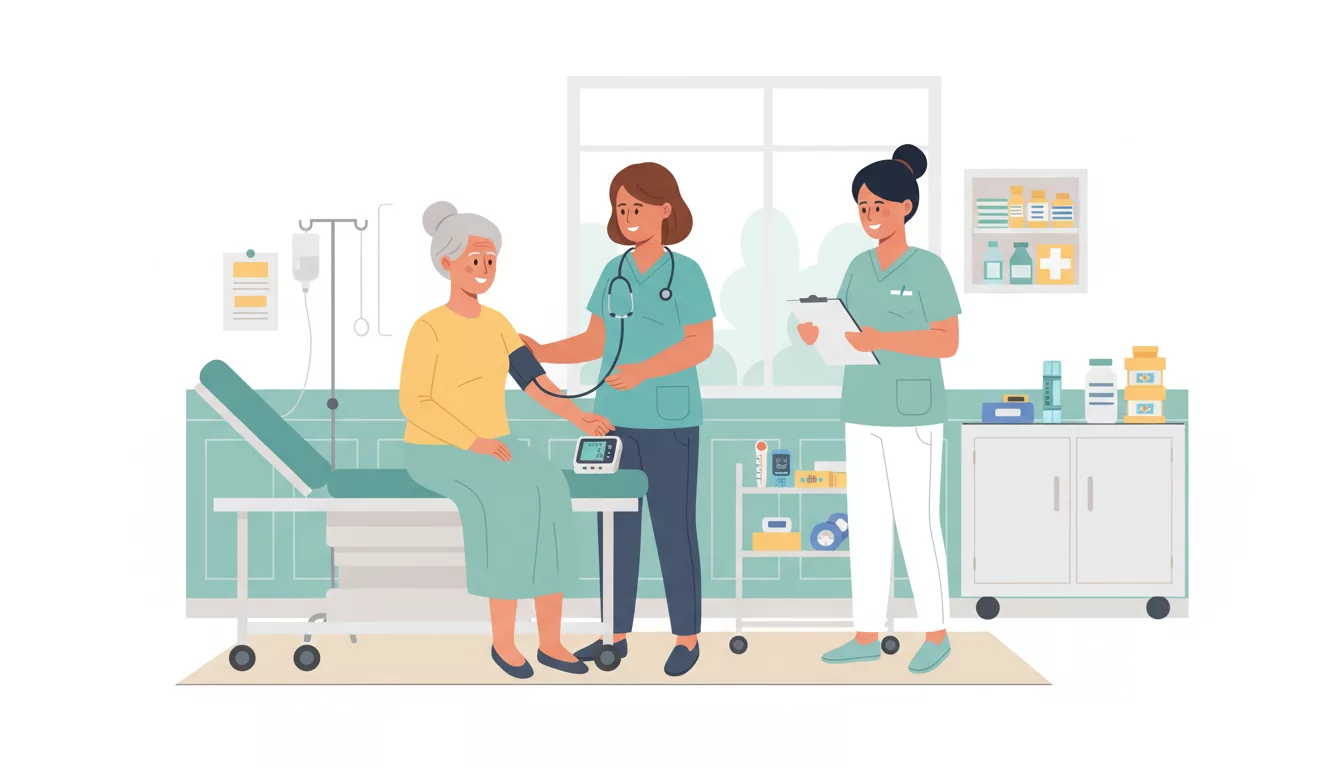
CNA and Medical Assistant interviews run differently from most job interviews. The nursing director or office manager sitting across from you isn't interested in clever corporate answers or leadership philosophy. They want to know three things: Can you handle patients safely? Will you show up reliably? Do you actually care about the people you'll be working with?
That's good news if you're the right kind of person for this work. Healthcare support roles reward genuine compassion and practical skill more than polished interview technique. If you're still exploring whether this career is right for you, our CNA and medical assistant career guide covers the full training and certification path. The hiring manager has seen hundreds of candidates, and they can tell within minutes whether you've actually done bedside care or just memorized textbook answers.
This guide covers the real questions asked in CNA and Medical Assistant interviews in 2026 - from new graduates walking into their first clinical job to experienced aides moving into hospitals or specialty clinics. If you're still exploring whether this career path is right for you, our healthcare careers overview breaks down the major roles, and our medical assistant salary guide shows what CMAs and RMAs actually earn across different settings. If you're considering dental hygiene instead, see our dental hygienist interview questions guide. For general interview strategy that applies to any field, start with our complete interview preparation guide.
How Healthcare Support Interviews Work (By Setting)
Where you're interviewing changes everything about what they'll ask and how the process works. A hospital system runs a very different hiring process than a two-doctor family practice.
Hospitals and Health Systems
Hospital interviews are the most structured. You'll typically go through an HR phone screen first, where they verify your certification, availability, and basic qualifications. If you pass that, you'll interview with the unit manager or charge nurse for the specific floor. Med-surg units, ICUs, emergency departments, and rehab floors all have different expectations. Some hospitals include a clinical skills assessment - they might ask you to demonstrate a blood pressure reading, a patient transfer, or hand hygiene technique right there in the interview. Large health systems like HCA, Ascension, or Kaiser may also require a behavioral interview panel. The whole process can take two to three weeks from application to offer.
Long-Term Care and Nursing Homes
This is where most CNAs start, and the interview reflects the reality of the work. The Director of Nursing (DON) or Assistant DON usually conducts the interview, and they're looking for patience above everything else. Long-term care residents need help with activities of daily living - bathing, dressing, eating, toileting, repositioning - day after day. The DON wants to know you won't burn out in three months. Turnover is the biggest problem in long-term care, so showing that you understand the work and still want to do it carries more weight than any certification. Many facilities will interview and hire the same day if they're short-staffed.
Outpatient Clinics and Physician Offices
Medical Assistants land here most often. The office manager or lead MA handles the interview, and multitasking is the theme. In a busy clinic, you might room a patient, take vitals, assist with a procedure, answer the phone, process a prior authorization, and draw blood - all before lunch. They want to see that you can handle volume without getting flustered. EHR proficiency matters a lot here because documentation happens in real time. Clinics also care about your front-office skills - can you check patients in, verify insurance, schedule follow-ups? The line between clinical and administrative work is blurry in most outpatient settings.
Urgent Care and Specialty Practices
Urgent care centers need MAs who can think fast. Patients walk in with everything from sprained ankles to chest pain, and you need to triage efficiently. The interview focuses on how you handle unpredictable situations and whether you can prioritize when multiple patients need attention simultaneously. Specialty practices - dermatology, orthopedics, cardiology, OB/GYN - ask about your familiarity with their specific procedures and equipment. A dermatology office wants to know if you can assist with biopsies. An orthopedic practice cares about casting and splinting experience. Research the specialty before your interview - our guide on how to research a company before your interview applies here.
Home Health and Hospice
Home health CNAs work independently in patients' homes, which changes the interview dynamic completely. The supervisor wants to know you can function without a team around you. Can you assess a situation, make good decisions, and know when to call the office? Hospice care adds an emotional dimension - you'll be caring for people at the end of life, supporting families through grief, and managing your own emotions. The interview often includes scenario questions about death and dying. This isn't the right setting for everyone, and good hospice agencies respect that. They'd rather you be honest about your comfort level than hire you and have you leave after two weeks.
Entry-Level and New Graduate Questions
If you're fresh out of a CNA program, an MA diploma or associate's program, or transitioning from another field into healthcare, these are the questions you'll face. The interviewer knows you're new. They're checking your foundation and your heart.
"Why do you want to work in healthcare?"
This is the healthcare version of "tell me about yourself." Have a genuine answer ready. Maybe you cared for a grandparent and realized you had a gift for it. Maybe you volunteered at a hospital and connected with patients in a way that surprised you. Maybe you're making a career change because your desk job left you feeling empty. Whatever your reason, make it real. What the interviewer is actually evaluating: Will this person still want to do this work six months from now when the novelty wears off and it's just hard, physical, emotional labor every shift?
"What clinical experience do you have?"
Be specific, even if your experience is limited to clinicals. "During my CNA program, I completed 120 hours of clinical rotations at Sunrise Senior Living. I was responsible for four to six residents each shift - I did morning care, assisted with meals, took vitals, documented intake and output, and helped with ambulation" is far better than "I did clinicals at a nursing home." If you've done any volunteer work, home care for a family member, or externships, include those too. Every hour of hands-on patient contact counts.
"Are you certified? Which credentials do you hold?"
For CNAs: State certification is typically required, and you should know your certification number and expiration date. Mention if you're on your state's nurse aide registry. For MAs: The main certifications are CMA (through AAMA), RMA (through AMT), CCMA (through NHA), and NCMA (through NCCT). If you hold any, state which one clearly. Additional credentials that impress: BLS/CPR certification (required almost everywhere), phlebotomy certification, EKG technician certification. If you're still working toward certification, say so with a specific timeline. "I'm sitting for the CMA exam next month - I've already scheduled my test date" shows initiative. Healthcare is one of the fastest growing career fields, and credentials help you stand out in a competitive market.
"How do you handle seeing patients in pain or distress?"
This question separates candidates who romanticize healthcare from those who can actually do the work. The right answer isn't "It doesn't bother me" - that sounds detached. And it's not "I cry every time" - that sounds like you can't function. A good answer acknowledges the emotional reality while showing you can still do your job: "It affects me. I'd be worried if it didn't. But I've learned to channel that into focused care. When a patient is in pain, my job is to make them as comfortable as possible - repositioning them, getting the nurse, holding their hand if that's what they need. I process the emotional side after my shift, not during it." Mention specific coping strategies: talking to coworkers, exercise, journaling, leaving work at work.
"What does patient dignity mean to you?"
This matters enormously in CNA work especially, where you're helping people with their most personal needs. Give practical examples, not abstract philosophy. "Patient dignity means closing the curtain before every single care task, even when I'm rushing. It means asking Mrs. Johnson which nightgown she wants to wear instead of just grabbing one. It means explaining what I'm doing before I do it, even with patients who have dementia and may not fully understand. It means never talking about a patient's care in the hallway where others can hear." Hiring managers have seen aides who treat residents like tasks on a checklist. They want someone who sees a person, not a room number.
"Can you work every other weekend and holidays?"
Healthcare doesn't stop for weekends or Christmas. Be honest about your availability, but understand that flexibility is almost always required. If you have genuine scheduling constraints - you're in school two evenings a week, for example - say so upfront. But if you're hoping for a Monday-through-Friday schedule, most inpatient settings can't offer that. Outpatient clinics and physician offices typically have more traditional hours, which is one reason many MAs prefer clinic work. Know what you're signing up for before the interview.
Experienced CNA and MA Questions
Once you've got a couple years of experience, the questions shift from "Can you do this work?" to "How well do you do it, and what have you learned?"
"Walk me through your healthcare experience."
Structure this as a career timeline focusing on what's relevant:
- Where have you worked? (Hospital, nursing home, clinic, home health, specialty practice)
- What patient populations have you served? (Geriatric, pediatric, surgical, behavioral health)
- What's your typical patient load or daily workflow?
- What clinical skills are you strongest in? (Vitals, phlebotomy, wound care, EKG, injections)
- What EHR systems have you used?
- What certifications do you hold?
- Why are you looking for a change?
"I've been a CNA for four years. I started at a 120-bed skilled nursing facility where I handled eight to ten residents on the day shift. After two years, I moved to a hospital med-surg floor at Regional Medical Center. I'm currently on a 36-bed unit, typically assigned six patients. I'm comfortable with vitals, blood glucose monitoring, wound care assistance, and I/O documentation. I use Epic daily" - that tells the interviewer exactly what they need to know.
"How do you handle a heavy patient assignment?"
Patient-to-CNA ratios are a real problem in healthcare, and the interviewer wants to know you can manage when you're stretched thin. The answer is prioritization. "I start every shift by doing a quick round to assess all my patients - who needs immediate care, who's stable, who has specific time-sensitive needs like pre-meal blood sugars or scheduled repositioning. I make a mental priority list and adjust it throughout the shift as things change. If I'm truly overwhelmed and patient safety is at risk, I communicate that to the charge nurse. I don't just struggle silently and hope for the best." Never badmouth a previous employer's staffing, but it's fine to acknowledge that staffing challenges exist.
"Tell me about a time you noticed a change in a patient's condition."
This question tests your observation skills and clinical judgment. CNAs and MAs are often the first to notice something is wrong because they spend the most face time with patients. Have a specific example ready: "I was taking vitals on a resident I'd cared for every day for months. Her blood pressure was slightly elevated, which wasn't unusual, but she also seemed more confused than normal and wasn't finishing her breakfast. Individually, none of those were alarming, but together they didn't feel right. I reported it to the charge nurse, who assessed her and found signs of a urinary tract infection. UTIs can cause sudden confusion in elderly patients. It got caught early because I knew what her baseline was." The key elements: you noticed something, you assessed it, you reported it to the appropriate person.
"How do you deal with difficult patients or families?"
Every healthcare worker encounters this. Patients can be angry, scared, confused, or in pain - and their families are often anxious and looking for someone to blame. "I try to understand what's driving the behavior. A patient who's yelling is usually scared or in pain, not actually angry at me. I stay calm, lower my voice, and acknowledge their feelings: 'I can see you're frustrated. Let me help.' With families, I listen to their concerns, validate them, and involve the nurse if it's beyond my scope. I never take it personally. If a situation is escalating beyond what I can manage safely, I step back and get help. De-escalation is a skill, and it's one I've gotten better at with experience."
"Why are you leaving your current position?"
Answer honestly but professionally. Good reasons that interviewers respect: seeking growth opportunities, wanting to work in a different specialty, looking for better staffing ratios, pursuing a higher acuity environment, relocating. Bad answers: trashing your current employer, complaining about specific coworkers, or anything that suggests you're running away rather than moving toward something. "I love bedside care, but I've gone as far as I can in long-term care. I'm ready to challenge myself in an acute care setting where I can expand my skills" works well.
"What EHR/EMR systems have you used?"
Electronic health records are central to every healthcare job now. Common systems you might have experience with: Epic (most common in hospitals), Cerner (now Oracle Health), eClinicalWorks (popular in clinics), Athenahealth, PointClickCare (dominant in long-term care), MatrixCare, MEDITECH. Don't just name the system - describe what you actually did in it. "I've used PointClickCare for three years. I document vitals, I/O, ADL completion, skin assessments, and behavioral observations. I'm comfortable with the CNA task flow and the charting by exception format." If you haven't used the specific system they have, emphasize that you learn quickly: "I haven't used Epic specifically, but I've been on PointClickCare and Cerner, and the documentation concepts transfer. Give me a couple shifts of orientation and I'll be up to speed."
Clinical and Technical Questions
These questions test whether you actually know your clinical fundamentals. Studying for these is important - review your CNA or MA program materials before the interview.
"What are normal vital sign ranges for an adult?"
You should know these cold. Here's a reference table:
| Vital Sign | Normal Adult Range | When to Report |
|---|---|---|
| Blood Pressure | 90/60 - 120/80 mmHg | Below 90/60 or above 140/90 |
| Heart Rate | 60-100 bpm | Below 60 or above 100 (or irregular) |
| Respiratory Rate | 12-20 breaths/min | Below 12 or above 24 |
| Temperature (oral) | 97.8-99.1°F (36.5-37.3°C) | Above 100.4°F (38°C) or below 96°F |
| Oxygen Saturation | 95-100% | Below 92% (or per facility threshold) |
| Blood Glucose (fasting) | 70-100 mg/dL | Below 70 or above 180 |
| Pain Scale | 0 (no pain) | Any score above 4 or sudden increase |
Don't just memorize the numbers - understand them. If the interviewer asks "What would you do if a patient's oxygen saturation is 88%?" you should know that's low and requires immediate action: notify the nurse, reposition the patient to promote breathing, and stay with them.
"Walk me through how you take a manual blood pressure."
This is a step-by-step knowledge check. Hit these points in order:
- Wash your hands and gather equipment (sphygmomanometer, stethoscope)
- Position the patient - seated comfortably, arm supported at heart level, palm up
- Make sure the patient has been resting for at least five minutes (no recent exertion or smoking)
- Select the correct cuff size - the bladder should wrap around 80% of the upper arm
- Find the brachial artery by palpation (inside of the elbow)
- Place the cuff snugly about one inch above the antecubital space, with the artery marker aligned over the brachial artery
- Palpate the radial pulse and inflate to find the estimated systolic (when the pulse disappears, add 30 mmHg)
- Deflate completely, wait 30 seconds
- Place the stethoscope over the brachial artery
- Inflate to your estimated systolic + 30 mmHg
- Deflate slowly at about 2-3 mmHg per second
- First Korotkoff sound = systolic. Last Korotkoff sound = diastolic
- Document the reading and which arm you used
Practice this on a friend or family member before the interview. Some facilities will ask you to demonstrate it live.
"What would you do if a patient's blood sugar reading is critically low?"
Hypoglycemia (blood sugar below 70 mg/dL) is a medical emergency. Your answer should show urgency and proper protocol: "If the patient is conscious and able to swallow, I'd follow the 15-15 rule - give 15 grams of fast-acting carbohydrates like four ounces of juice or glucose tablets, then recheck in 15 minutes. If they're unconscious or unable to swallow, I would NOT give anything by mouth - that's an aspiration risk. I'd call the nurse immediately and stay with the patient. I'd document the reading and my actions. The key is recognizing the symptoms early: shakiness, sweating, confusion, irritability. And I always check blood sugar before meals for diabetic patients so we catch lows before they become emergencies."
"How do you prevent the spread of infection?"
Infection control is fundamental. Cover these points: hand hygiene (the single most important measure - wash with soap and water or use alcohol-based sanitizer before and after every patient contact), proper use of PPE (gloves, gowns, masks, face shields as indicated), standard precautions with every patient regardless of diagnosis, transmission-based precautions (contact, droplet, airborne) when indicated, proper disposal of sharps and biohazardous waste, environmental cleaning between patients, and respiratory hygiene for yourself and patients. "I treat hand hygiene like it's non-negotiable because it is. I sanitize before entering a room, after removing gloves, after touching any surface, and before moving to the next patient. It's the habit that prevents the most harm."
"Describe proper body mechanics for patient transfers."
Back injuries are the number one occupational hazard for CNAs. Show that you take this seriously: "I assess the patient first - can they bear weight? What's their mobility level? Do I need a gait belt, a slide board, or a mechanical lift? I never try to lift alone if the patient is heavier than I can safely manage. For a basic bed-to-wheelchair transfer: lock the wheelchair brakes, lower the bed to wheelchair height, have the patient scoot to the edge of the bed, apply the gait belt, position my feet shoulder-width apart with knees bent, use my leg muscles to lift while keeping my back straight, and pivot - never twist. If a patient is a two-person assist or requires a Hoyer lift, I get the help. No shortcut is worth a herniated disc."
For Medical Assistants: "Walk me through a patient intake."
This is the core of MA work in clinics. A thorough intake includes:
- Greet the patient and verify their identity (two identifiers - name and date of birth)
- Escort them to the exam room
- Document the chief complaint - why are they here today?
- Take and record vital signs (BP, HR, temp, respiratory rate, O2 sat, weight, height if needed)
- Review and update their medication list
- Review and update allergies
- Ask about relevant medical history updates since their last visit
- Screen per office protocol (PHQ-2 for depression, fall risk assessment for elderly, etc.)
- Document everything in the EHR before the provider enters the room
- Inform the provider the patient is ready and give a brief summary
The goal is to have the chart fully updated and the patient comfortable before the doctor walks in. A good intake saves the provider time and makes the whole visit run smoother.
Quick-Fire Clinical Knowledge
Some interviewers rapid-fire basic clinical questions. Here's what you should know:
| Question | Answer |
|---|---|
| NPO means? | Nothing by mouth (nil per os) |
| PRN means? | As needed (pro re nata) |
| What position for someone who's feeling faint? | Supine with legs elevated (Trendelenburg-like) |
| What position for a patient having difficulty breathing? | High Fowler's (sitting upright at 60-90 degrees) |
| When do you perform hand hygiene? | Before and after every patient contact, after glove removal, after touching contaminated surfaces |
| What does STAT mean? | Immediately |
| Normal urine output for an adult? | At least 30 mL/hour (or about 1,500 mL/day) |
| What does DNR mean? | Do Not Resuscitate - no CPR if patient's heart stops |
| What does ambulate mean? | To walk or move around |
| Signs of dehydration? | Dry mucous membranes, decreased urine output, dark urine, poor skin turgor, confusion |
Safety and Compliance Questions
Healthcare facilities take safety and regulatory compliance seriously. These questions test whether you understand the rules and - more importantly - whether you'll follow them even when it's inconvenient.
"What would you do if you saw a coworker skip hand hygiene?"
This is a test of your integrity. The right answer is that you'd say something, even though it's uncomfortable. "I'd address it directly but privately. Something like, 'Hey, I noticed you forgot to sanitize before going into that room - just wanted to give you a heads up.' Most of the time it's genuinely a lapse, not intentional, and a quick reminder fixes it. If it's a pattern and direct conversation hasn't helped, I'd bring it to the charge nurse. Patient safety isn't something I can look the other way on, even if it makes things awkward." Never say you'd ignore it or that it's not your business.
"How do you handle a patient who refuses care?"
Patients have the right to refuse any treatment or care, even if you believe it's in their best interest. "First, I try to understand why they're refusing. Sometimes a patient refuses a bath because the water was too cold last time, or they refuse to eat because the food doesn't taste right. If I can address the underlying reason, I do. If they still refuse, I respect their decision, document it clearly, and notify the nurse. I never force care on a patient. That said, I also try again later - sometimes the timing just isn't right. A patient who refuses a shower at 7 AM might be happy to take one at 10 AM after breakfast."
"What is HIPAA and how does it affect your daily work?"
Don't give a textbook definition. Show how HIPAA plays out in real daily work. "HIPAA protects patient health information. In practice, that means I don't discuss patients in public areas like hallways, elevators, or the cafeteria. I don't look at charts for patients I'm not assigned to - even if I'm curious. I log out of the EHR when I step away from a computer. I don't take photos in patient care areas. I don't share patient information with family members unless the patient has given authorization. If someone calls asking about a patient, I direct them to the nurse. It's about treating every patient's information with the same privacy I'd want for my own."
"What would you do if you made a medication error?"
Note: CNAs generally don't administer medications (except in some states with additional training), but MAs commonly do. Regardless, the principle applies to any error. "I would report it immediately. I wouldn't try to hide it or fix it quietly. I'd tell the supervising nurse or physician right away, assess the patient for any adverse effects, document exactly what happened in an incident report, and cooperate fully with any review process. I know that sounds scary, but covering up an error can cause far more harm than the error itself. The patient's safety comes first, always. And honestly, most facilities appreciate honesty because it gives them a chance to catch problems before they escalate."
Behavioral Questions
Behavioral questions reveal how you actually perform under pressure, not how you think you'd perform in a hypothetical situation. Use the STAR method: Situation, Task, Action, Result.
"Tell me about a time you went above and beyond for a patient."
Have a specific story. Not "I always go above and beyond" but a particular moment: "I had a resident in the nursing home who hadn't had a family visit in over three months. She was withdrawn and stopped eating well. During my breaks, I started sitting with her and looking through her old photo albums. I learned she used to be a piano teacher. I mentioned it to the activity director, and they arranged for a volunteer pianist to come play for the residents. When she heard the music, she lit up. She started participating in activities again and her appetite improved. It wasn't a clinical intervention, but it reminded me that caring for the whole person - not just their physical needs - is what this work is about."
"Describe a conflict with a coworker and how you resolved it."
Healthcare teams are tight-knit, and conflict happens. "I had a coworker on nights who consistently left her patients' call lights unanswered, which meant I'd arrive for day shift with patients who'd been waiting for care. Instead of complaining to the charge nurse first, I talked to her directly. I asked if everything was okay and if she was feeling overwhelmed. Turns out she was picking up extra shifts to cover bills and was exhausted. We worked out a system where she'd focus on completing essential care by 5 AM so the transition would be smoother, and I started arriving ten minutes early to help with the handoff. The situation improved once we communicated instead of resenting each other." Show that your first instinct is direct communication, not going over someone's head.
"How do you handle stress during a 12-hour shift?"
Twelve-hour shifts are standard in hospitals and many nursing homes. Be realistic: "I'm not going to pretend 12-hour shifts aren't tiring. But I've developed strategies that work for me. I eat a real meal before my shift and pack healthy snacks - nothing tanks your energy faster than skipping food. I wear compression socks and good shoes because my feet matter. During the shift, I try to take my breaks even when it's busy, because I'm better for my patients when I'm rested. After a particularly hard shift, I have a decompression routine - I might go for a walk, call a friend, or just sit in my car for ten minutes before driving home. Burnout in healthcare is real, and I take prevention seriously."
"Tell me about a time you had to adapt to a sudden change."
Healthcare is inherently unpredictable. "I was halfway through morning care when a code blue was called on my floor. Suddenly the whole routine changed. I helped clear the hallway, assisted with moving the crash cart, and kept other patients calm while the code team worked. After the code, my morning care schedule was blown, but I reprioritized based on who needed the most urgent attention. A patient with a 9 AM surgery prep came first, then diabetic patients who needed pre-meal blood sugars, then everyone else. I communicated with the charge nurse about where I was in my assignments so she could send help if needed. It wasn't an ideal morning, but everyone got safe care."
Specialty Setting Questions
Depending on where you're applying, you might face questions specific to a patient population or clinical specialty.
Pediatric Settings
Working with children requires a different approach. Common questions include: "How would you take vitals on a scared three-year-old?" (Make it a game. Let them listen to their own heartbeat first. Use age-appropriate language - "I'm going to give your arm a little hug" for blood pressure.) "How do you communicate medical information to parents who are anxious?" (Be clear, honest, and calm. Validate their concern without making promises about outcomes. Direct clinical questions to the provider.) Pediatric offices also ask about developmental milestones, immunization schedules (for MAs), and how you handle working with children who have chronic illnesses.
Geriatric and Memory Care
If you're applying to a memory care unit or working with dementia patients, expect questions about: "How do you communicate with a patient who has Alzheimer's?" (Short, simple sentences. One instruction at a time. Use a calm tone. Don't argue or correct - redirect instead. Approach from the front so you don't startle them.) "What do you do when a resident with dementia becomes aggressive?" (Stay calm, don't raise your voice, give them space, try to identify the trigger - pain, hunger, fear, overstimulation. Remove the trigger if possible. Never restrain unless there's an immediate safety risk, and always document and report.) "How do you handle sundowning?" (Increased confusion and agitation in late afternoon/evening. Keep the environment calm, reduce stimulation, maintain a consistent routine, provide reassurance.) Patience isn't just preferred in memory care - it's required.
Surgical and Procedural Settings
Medical Assistants in surgical or procedural settings face additional questions about: "What's the difference between sterile and clean technique?" (Sterile technique eliminates all microorganisms and is used for invasive procedures. Clean technique reduces microorganisms and is used for non-invasive care.) "How do you set up a sterile field?" (Open the sterile pack away from you, don't reach over the field, keep sterile items within the field, if contamination is suspected, start over.) "What pre-op preparations do you handle?" (Identity verification, consent form verification, surgical site marking confirmation, allergy band, NPO status, vitals, IV access if within your scope.) Knowledge of surgical instrument names and autoclave operation may also come up. Certifications like surgical tech or sterile processing credentials can boost your prospects in these settings.
Questions to Ask Your Interviewer
Always have questions ready. Asking nothing suggests you don't care. These are smart, thoughtful questions that healthcare interviewers respect:
- "What's the typical patient-to-CNA (or MA-to-provider) ratio?" - This tells you about workload and staffing. If a nursing home says 1:15 and you were hoping for 1:8, you know what you're signing up for.
- "What does orientation look like for new hires?" - Good facilities invest in training. If the answer is "You'll shadow someone for a day and then you're on your own," that's a red flag.
- "What EHR system do you use, and will I receive training on it?" - Shows you're thinking practically about day-one readiness.
- "What's the culture like on this unit/in this office?" - Listen carefully. "We're like a family" can mean close-knit support or it can mean dysfunctional boundaries. Ask follow-up questions.
- "Is there opportunity for growth or additional training?" - Maybe they support CNA-to-LPN bridge programs or MA certification advancement. This shows you're thinking long-term. Healthcare offers many career advancement paths from entry-level roles.
- "Why is this position open?" - Growth is a good sign. High turnover is a warning sign. Listen to how they answer this one.
After the Interview
Healthcare facilities often move fast - you might get an offer within days or even the same day. But that doesn't mean you should skip the follow-up. Send a thank-you email within 24 hours. Keep it brief: thank them for their time, mention something specific from the conversation that reinforced your interest, and restate your enthusiasm for the role. If your interview was virtual, our virtual interview guide covers the specific follow-up etiquette for remote interviews.
If you're interviewing at multiple facilities (which you should be - never put all your hopes on one application), be prepared for second interviews at hospital systems. Some may ask you back for a unit-specific interview or a peer interview with the team you'd be working with.
CNA and Medical Assistant roles are the backbone of healthcare. The work is demanding - physically, emotionally, and sometimes mentally exhausting. But every nurse, doctor, and administrator in that building knows it. The best facilities don't just want warm bodies to fill shifts. They want people who show up with compassion, clinical skill, and the kind of quiet toughness that gets patients through their worst days. If that sounds like you, you'll do fine in the interview. If you're also considering pharmacy as a healthcare career path, our pharmacy technician interview guide covers what pharmacy directors look for. Because the truth is, the people who genuinely care about this work are exactly the ones healthcare needs most.