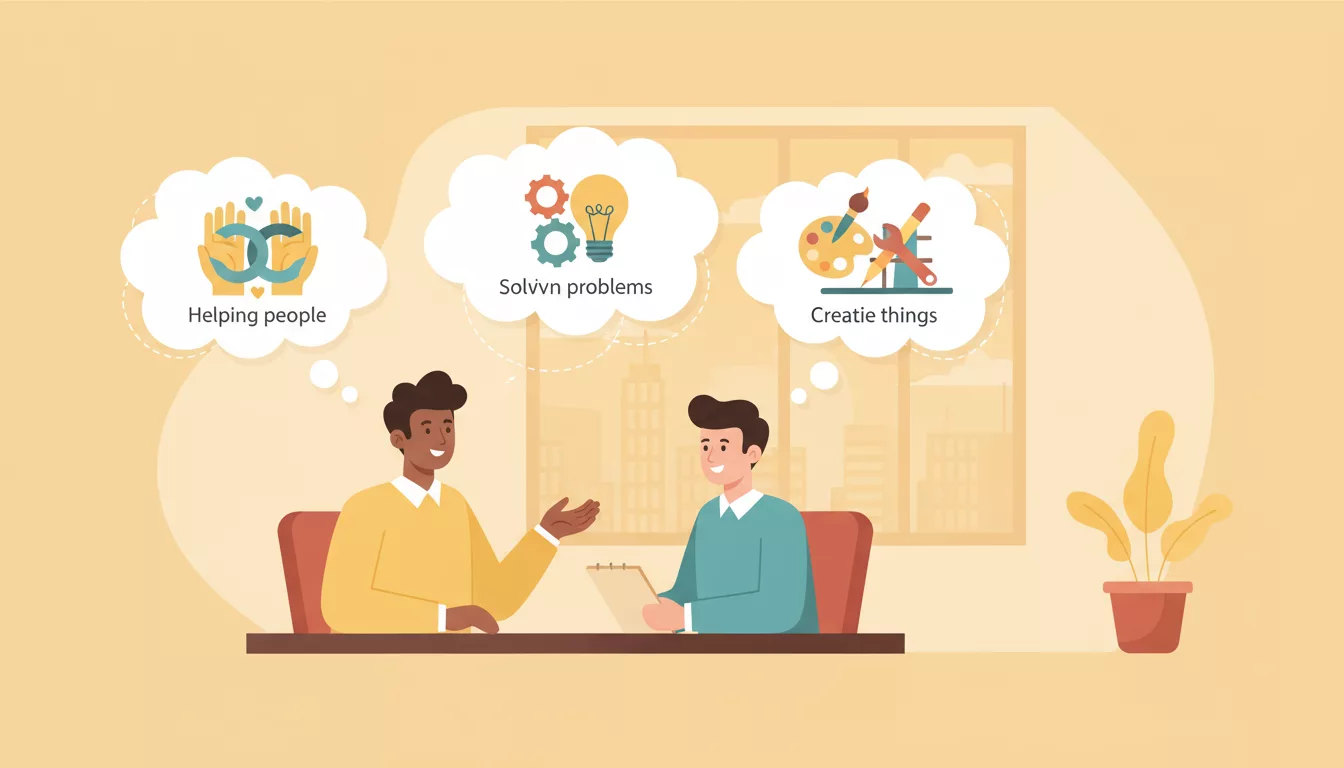
"What motivates you?" sounds like a straightforward question. But most candidates fumble it because they treat it like a personality quiz instead of what it actually is — a way for interviewers to figure out whether you'll stick around and actually care about the work.
The hiring manager isn't looking for a philosophical answer about your deepest passions. They want to know if your internal drivers match the day-to-day reality of this job. Someone motivated by independent problem-solving will be miserable in a role that's 90% meetings. A person who thrives on team collaboration won't last long in a fully remote, asynchronous position.
This guide breaks down exactly what interviewers are testing for, how to build your answer, and gives you sample responses for different industries and experience levels.
Why Interviewers Ask "What Motivates You?"
This question — right up there with "tell me about yourself" — serves three purposes simultaneously:
Culture fit assessment. Your motivators reveal whether you'll mesh with the team and work environment. A startup that moves fast needs self-starters who get energized by ambiguity. A large corporation with structured processes needs people who find satisfaction in optimizing systems.
Retention prediction. Employees who are intrinsically motivated by the actual work stay longer than people chasing a paycheck. Interviewers have seen enough turnover to know that misaligned motivation leads to a 6-month resignation letter.
Performance indicator. What motivates you usually correlates with what you're best at. People motivated by solving complex problems tend to be strong analytical thinkers. Those driven by helping others are typically great at client-facing roles. Interviewers are listening for evidence that your motivation translates into results.
How to Identify Your Real Motivators
Before you can answer this question well, you need to actually know what drives you. Not what sounds impressive — what's genuinely true.
Think about the last time you were so absorbed in work that you lost track of time. What were you doing? That's a motivator.
Consider the projects you've volunteered for or gone above and beyond on without being asked. What did they have in common? Another motivator.
Here are common workplace motivators — most people have two or three primary ones:
- Problem-solving: You get a rush from untangling complex issues and finding solutions that work
- Impact: Seeing tangible results from your work — revenue generated, people helped, products shipped
- Learning: Constantly building new skills and understanding new domains
- Collaboration: Working alongside smart people, bouncing ideas off each other, building something together
- Autonomy: Having the freedom to own your work and make decisions
- Recognition: Being acknowledged for your contributions and expertise
- Helping others: Making someone's life easier, mentoring, supporting
- Creative expression: Designing, building, or creating something that didn't exist before
- Competition: Hitting targets, exceeding benchmarks, being the best at what you do
- Stability and mastery: Becoming deeply excellent at a specific skill or domain
How to Structure Your Answer
The best answers follow a simple three-part framework:
1. Name your motivator clearly. Don't hedge or give a vague non-answer. State what drives you in one direct sentence.
2. Back it up with a specific example. Anyone can claim they're motivated by "making a difference." The proof is in the story. Describe a real situation where this motivation drove your actions and produced results.
3. Connect it to the role. Show the interviewer you've thought about how your motivation aligns with what they need. This is the part most people skip, and it's the most important.
Keep your answer under 90 seconds. Long, rambling responses about your motivational philosophy make interviewers zone out.
What NOT to Say
A few responses that will hurt you, even if they're technically honest:
"Money." Yes, everyone works for money. But leading with compensation tells the interviewer you'll leave the moment someone offers $5K more. If salary is genuinely your biggest motivator, frame it differently — talk about being driven by hitting performance targets or earning advancement through results. (When they do ask about compensation directly, here's how to answer salary expectations questions.)
"I just don't want to be bored." This sounds passive and suggests you need constant entertainment. If variety motivates you, say you're energized by tackling different types of challenges.
"Making my parents proud" or any external validation that has nothing to do with the actual work. It's endearing but doesn't tell the interviewer anything about how you'll perform.
Generic platitudes. "I'm motivated by success" or "I want to make a positive impact" say nothing. These are filler words dressed up as an answer. Get specific or don't bother.
Motivators that conflict with the role. If you're applying for a repetitive data entry position and say you're motivated by constant novelty, the interviewer will flag you as a flight risk. Read the job description carefully and align accordingly — without lying.
10 Sample Answers for Different Situations
1. For a Problem-Solving Role (Engineering, Analytics, IT)
"I'm motivated by digging into complex problems that don't have obvious solutions. In my last role, our data pipeline was failing silently about twice a week, and nobody could figure out why. I spent two weekends building a monitoring system and traced it to a race condition in our batch processing. Fixing that one issue saved the team about 8 hours a week in manual data reconciliation. That feeling of cracking a tough problem and seeing it make everyone's work easier — that's what keeps me going. From what I've read about this role, you're dealing with similar scale challenges with your real-time processing systems, and that's exactly the kind of work I want to be doing."
2. For a Customer-Facing Role (Sales, Account Management, Support)
"What motivates me most is turning frustrated customers into advocates. At my current company, I took over a portfolio of accounts that had a 40% churn rate. I scheduled calls with every at-risk client, listened to their actual pain points — not just the tickets they'd filed — and worked with our product team to address the three most common issues. Within six months, retention in my portfolio hit 94%. Hearing a client say 'you actually fixed the thing I've been complaining about for a year' is genuinely the best part of my day. Your role involves managing enterprise accounts, and I'd love to bring that same approach to your client relationships."
3. For a Creative Role (Marketing, Design, Content)
"I'm driven by the process of taking a blank page and turning it into something that actually changes how people think or act. Last year, I pitched a completely different approach to our quarterly campaign — instead of the typical product-focused ads, we ran a series of customer story videos. My manager was skeptical, but the campaign outperformed our best quarter by 35% and two of those videos got picked up organically by industry blogs. Building something from scratch and watching it connect with real people — that never gets old for me."
4. For a Leadership or Management Role
"What motivates me is watching people on my team grow into roles they didn't think they were ready for. I managed a team of six at my previous company, and one of my junior developers was hesitant about taking on a client-facing project. I paired her with a senior engineer for the first sprint and gradually gave her more ownership. By the end of the project, she was leading client demos on her own and got promoted to mid-level six months later. Building a team where people are doing the best work of their careers — that's what I find most rewarding about management. I see this role involves growing a new team from four to twelve people, and that kind of team-building is exactly what energizes me."
5. For an Entry-Level Position
"Honestly, I'm motivated by learning. I know that sounds generic, but here's what I mean — during my internship, I asked my manager if I could sit in on the product strategy meetings even though it wasn't part of my role. I took notes, asked questions afterward, and ended up contributing a competitive analysis that the team actually used in their next planning cycle. I want to be in an environment where I'm constantly absorbing new things and contributing more each month. (If you're new to the workforce, make sure your entry-level resume reflects this growth mindset too.) From your job posting, it sounds like this role touches multiple departments, and that cross-functional exposure is really appealing to me."
6. For a Healthcare Role
"I'm motivated by the moments when you can see the direct impact of your care on a patient's recovery. Last month, I worked with an elderly patient who came in completely withdrawn after a fall — wouldn't engage with physical therapy, barely spoke during rounds. I started spending an extra five minutes during my checks just talking with him about his garden, which his family mentioned he loved. Within a week, he was more engaged in his PT sessions and was discharged ahead of schedule. His daughter sent our unit a thank-you card. Those moments remind me why I chose this field (here are more nursing interview tips), and they keep me showing up ready to give my best every shift."
7. For a Teaching or Education Role
"What motivates me is the moment when a concept clicks for a student who's been struggling. I had a student last year who was convinced she was 'bad at math' — her words. I restructured my approach with her, using real-world budgeting scenarios instead of abstract problems. By the end of the semester, she was helping other students with their assignments. That transformation — from 'I can't do this' to 'I actually get it' — is why I teach. Your school's focus on differentiated instruction aligns perfectly with how I approach student learning." (See more teacher interview questions and answers.)"
8. For a Remote Role
"I'm motivated by autonomy and ownership. I do my best work when I can structure my day around deep focus time and deliver results without someone checking in every hour. In my current remote role, I redesigned our onboarding documentation on my own initiative because I noticed new hires kept asking the same questions. I spent two weeks on it between my regular assignments, and it cut our onboarding questions by about 60%. I thrive when I'm trusted to identify what needs doing and execute on it. Your posting mentioned this role is fully remote with quarterly in-person meetups, and that structure is exactly where I'm most productive." (More on thriving remotely: remote work tips that actually help.)"
9. For a Career Changer
"What motivates me is solving real operational problems — which is actually what pushed me to make this career change. In my previous role as a restaurant manager, the part I loved most wasn't the food or the front-of-house management. It was figuring out staffing algorithms, analyzing our busiest hours, and building scheduling systems that reduced overtime by 20%. I realized I was essentially doing data analysis with a spatula in my hand. That same drive to find patterns in messy data and turn them into actionable systems is why I'm pursuing this analyst role. I've spent the last year completing a data analytics certification and building projects that scratch that same itch."
10. For a Nonprofit or Mission-Driven Role
"I'm motivated by work where I can draw a straight line between what I do every day and someone's life getting better. At my current organization, I managed a program that connected first-generation college students with mentors. When I started, we had 45 mentor-mentee pairs. I rebuilt our matching algorithm and outreach strategy, and we scaled to 180 pairs in two years. But the real motivation isn't the numbers — it's getting a text from a mentee who says they got into their dream school. That direct human impact is what I want to keep building my career around, and your organization's work in workforce development connects directly to that."
Variations of This Question
Interviewers don't always use the exact words "what motivates you." Watch for these variations — they're testing the same thing:
- "What gets you out of bed in the morning?"
- "What are you passionate about?"
- "What drives you professionally?"
- "What do you find most rewarding about your work?"
- "What keeps you engaged at work?"
- "What kind of work environment brings out your best?"
Your core answer stays the same for all of these. Adjust the framing slightly — "what keeps you engaged" invites you to focus more on day-to-day activities, while "what are you passionate about" gives you room to talk bigger picture. But the motivator-example-connection framework works for every variation. Similarly, "what is your greatest strength?" tests for overlapping territory — your strength often connects to what motivates you.
How to Research What Motivators the Company Values
The smartest thing you can do before answering this question is figure out what the company wants to hear — and then be honest about whether your real motivators match.
Read the job description carefully. Words like "fast-paced," "self-starter," and "entrepreneurial" signal they want someone motivated by autonomy and challenge. "Collaborative," "team-oriented," and "supportive" mean they value people driven by working with others.
Check the company's careers page and About section. Their stated values often reveal what they reward. If they emphasize innovation, they want people motivated by creativity. If they highlight client success, they want people driven by impact.
Look at employee reviews on Glassdoor. The positive reviews will tell you what actually motivates people who stay. The negative reviews will show you which motivators go unfulfilled.
Review their LinkedIn posts. What do they celebrate? Product launches, team milestones, individual achievements, community impact? That tells you what they value.
Once you've done this research, you can also use it to ask smarter questions during the interview. The goal isn't to fake your motivators. It's to find the genuine overlap between what drives you and what the role actually offers. If there's no overlap, that's useful information too — maybe this isn't the right fit.
Tailoring Your Answer to the Interview Stage
Your answer should evolve as you move through the interview process:
Phone screen: Keep it brief and clear. One motivator, one quick example, done. The recruiter is screening for basic alignment, not depth. Thirty seconds max.
First interview: Give your full three-part answer with a solid example. This is where you prove your motivators are real and relevant.
Final interview: Connect your motivation directly to what you've learned about the team and role through earlier conversations. "After talking with Sarah about the product roadmap, I'm even more excited because [specific thing] connects directly to what drives me." This shows you've been listening and your interest is deepening, not just rehearsed.
Common Mistakes to Avoid
Being too broad. "I'm motivated by doing good work" tells the interviewer nothing. What kind of good work? Writing clean code? Closing deals? Helping patients? Get specific enough that someone could picture you actually doing it. (Same principle applies when answering "why should we hire you?")
Listing too many motivators. Pick one or two. When you say "I'm motivated by learning, teamwork, problem-solving, impact, creativity, and growth," you sound like you're reading a corporate values poster. (Compare this to "what makes you unique?" where specificity also wins.) One strong motivator with evidence beats five vague ones every time.
Not connecting to the role. You can give the most authentic, compelling answer about your motivation, but if you don't link it to this specific job, the interviewer is left doing the work themselves. Make it obvious.
Sounding rehearsed. Practice your answer enough to hit the key points naturally, but don't memorize it word-for-word. If it sounds like you're reciting a speech, the authenticity — which is the whole point — disappears.
Confusing motivation with goals. "I'm motivated to become a VP in five years" is a goal, not a motivator. The interviewer wants to know what drives your daily behavior, not your career roadmap. Save the career goals discussion for when they ask about it directly.
Quick-Reference Cheat Sheet
Use this to build your answer before the interview:
- My primary motivator: [One clear thing — problem-solving, impact, learning, etc.]
- My proof story: [Specific situation where this motivation drove action and results]
- The connection: [How this motivator aligns with THIS specific role]
- Time check: [Can I say this in under 90 seconds? If not, cut it down]
That's it. Don't overcomplicate this. Know what genuinely drives you, prove it with evidence, and show the interviewer why it matters for their role. When your real motivation matches the work they need done, you won't just get the offer — you'll actually enjoy the job. And after you nail the interview, don't forget to send a follow-up email.
Frequently Asked Questions
Can I say money is a motivator?
Not as your primary answer, but you can reference it indirectly. Saying "I'm motivated by hitting performance targets and being rewarded for results" covers the financial angle without sounding purely mercenary. Pair it with a non-financial motivator to show you're not a flight risk the moment a competitor waves a higher number.
What if I genuinely don't know what motivates me?
Start with elimination. Think about the tasks you actively avoid or dread at work — your motivators are usually the opposite. If you hate repetitive work, you're probably motivated by variety and challenge. If you dread solo projects, collaboration might be your driver. You can also ask colleagues or managers what they notice energizes you most.
Should my answer be different for every interview?
Your core motivator stays the same — it's genuinely who you are. But the example you choose and the connection to the role should change for every interview. Use a story that's relevant to the position, and research the company enough to make the "connection" step specific.
How long should my answer be?
Aim for 60 to 90 seconds. Under 30 seconds feels underdeveloped, and over two minutes means you're rambling. Practice with a timer if you tend to go long.
What if my motivation changed after a career transition?
That's actually a strength. Saying "earlier in my career I was motivated by X, but after [experience], I realized what really drives me is Y" shows self-awareness and intentionality. Interviewers respect people who've thought deeply about what they want from their work. Just make sure your current motivator aligns with the role you're applying for.
Keep Reading
- How to Answer "Tell Me About Yourself"
- How to Answer "Why Should We Hire You?"
- How to Answer "What Is Your Greatest Strength?"
- How to Answer "What Makes You Unique?"
- How to Answer "What Are Your Career Goals?"
- How to Answer "Where Do You See Yourself in 5 Years?"
- How to Answer "Why Do You Want to Work Here?"
- How to Answer "What Is Your Greatest Weakness?"
- How to Answer "Tell Me About a Time You Failed"
- How to Answer "Why Did You Leave Your Last Job?"
- How to Prepare for a Job Interview: The Complete Guide