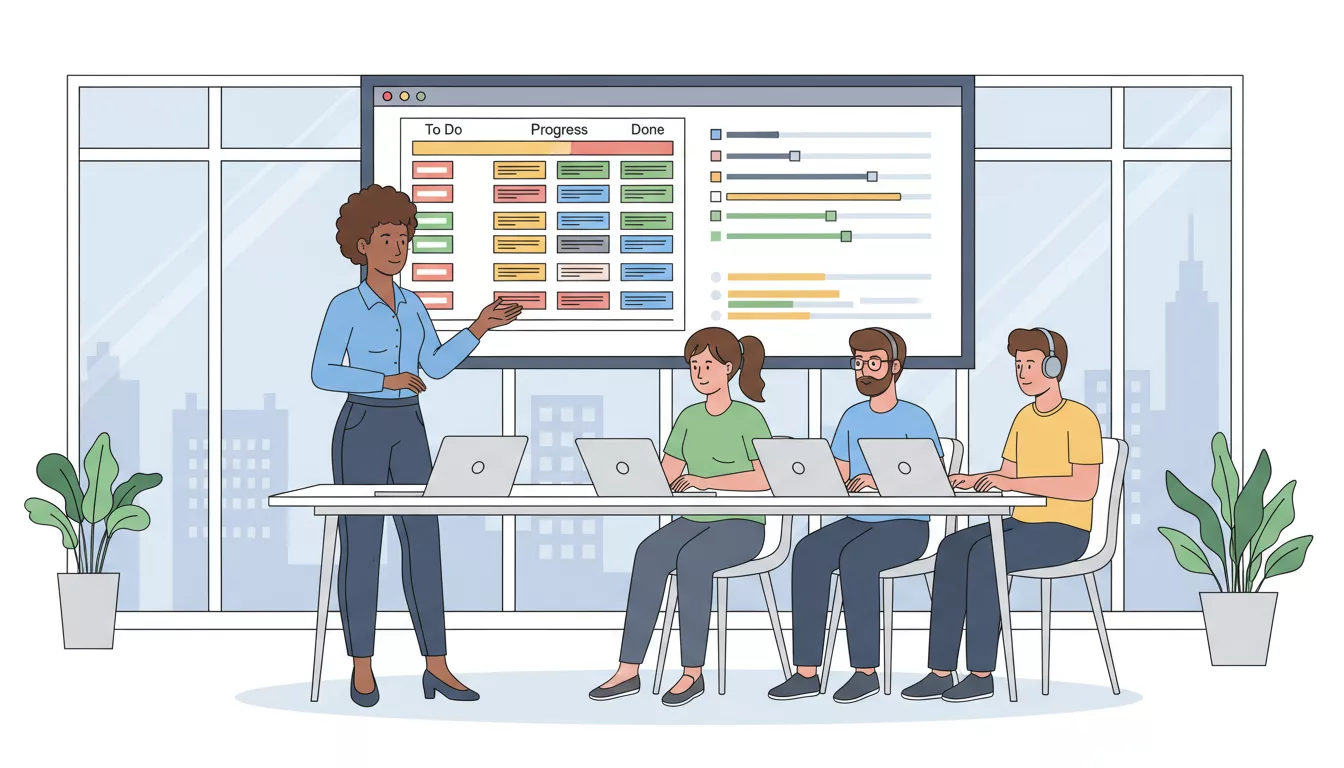
Project manager interviews have a reputation for being tough, and honestly, they've earned it. You're not just proving you can manage timelines and budgets — and you should know what the role actually pays. You're proving you can handle people - difficult stakeholders, team members who disagree with each other, executives who change priorities every other week, and clients who want everything yesterday.
The questions in PM interviews are designed to surface how you actually operate under pressure. Not how you talk about it in theory, but what you've actually done when a project went sideways. And projects always go sideways.
This guide covers the questions you'll face in project manager interviews in 2026, across industries. Whether you're interviewing for your first PM role (with a strong resume in hand) or moving into a senior position, these are the questions that keep coming up - and the answer strategies that get offers.
How PM Interviews Are Structured
Most project manager interviews follow a predictable pattern, though the specifics vary by company size and industry.
Round 1: Recruiter screen (15-20 minutes). They'll verify your experience, check salary alignment, and ask about your PM methodology experience. This is surface-level. Don't overthink it.
Round 2: Hiring manager deep-dive (45-60 minutes). Heavy on behavioral questions. This is where they dig into your actual experience managing projects. Expect lots of "tell me about a time when..." questions. This round makes or breaks most candidates.
Round 3: Case study or scenario round (30-45 minutes). Some companies give you a hypothetical project scenario and ask you to create a plan on the spot. Others present a troubled project and ask how you'd get it back on track. A few companies - especially in tech - ask you to present a past project as a case study.
Round 4: Cross-functional panel (45-60 minutes). You'll meet engineers, designers, or business stakeholders who would work with you. They're evaluating whether you'd be someone they want to collaborate with daily.
Some companies also assess specific methodology knowledge (Agile, Scrum, Waterfall, SAFe) through targeted questions. If any rounds are remote, review our virtual interview tips ahead of time. If the job posting mentions a specific framework, you need to know it cold.
Behavioral Questions: The Core of Every PM Interview
Behavioral questions dominate PM interviews. Hiring managers have learned that the best predictor of future performance is past behavior. If you want a deep dive on this format, check out our complete STAR method guide. So they'll ask about specific situations from your experience. Vague answers kill you here - you need concrete examples with real details.
"Tell me about a project that failed or significantly missed its goals. What happened?"
This is the question most candidates dread — and it's closely related to tell me about a time you failed. But it's also your biggest opportunity to stand out, because most people either dodge it with a minor example or refuse to take accountability.
Here's what good looks like: Pick a real failure. Own your part in it. Explain what you learned and what you changed.
Example answer: "We were building a new customer portal and I underestimated the complexity of the legacy system integration. I had scoped it at 6 weeks based on the API documentation, but the actual API behaved differently from what was documented. We ended up 4 weeks behind schedule. My mistake was trusting the documentation without running a technical spike first. After that project, I started building technical discovery sprints into every project plan before committing to timelines. It's added about a week to the planning phase but has prevented that kind of surprise from happening again."
Notice how that answer doesn't blame anyone. It identifies a specific mistake, explains the impact, and shows a concrete change in behavior. That's what interviewers want.
"How do you handle a team member who isn't pulling their weight?"
This tests your people management skills. The wrong answer is "I'd escalate to their manager." That's a last resort, not a first step.
Walk through your approach: Start with a private 1:1 conversation. Be specific about what you're observing - "I noticed the last two deliverables were late" rather than "you're not performing well." Ask if there's something going on. Sometimes people are struggling with unclear requirements, personal issues, or are stuck technically and too embarrassed to ask for help.
If the conversation doesn't help, set clear expectations with specific deadlines and check in more frequently. Document everything. If performance still doesn't improve after you've given direct feedback and support, then you involve their manager.
The key point to emphasize: your first assumption should be that the person wants to do good work, and something is getting in the way. Approaching it with curiosity rather than frustration almost always gets better results.
"Describe a time when you had to manage conflicting priorities from different stakeholders."
Every PM deals with this constantly. Marketing wants Feature A. Engineering wants to pay down tech debt. The CEO wants Feature B by next quarter. And you have one team.
Strong answer framework:
- Describe the specific conflict
- Explain how you gathered input from all sides
- Show how you used data or a framework to make the decision (impact vs. effort matrix, revenue impact analysis, strategic alignment scoring)
- Describe how you communicated the decision to the stakeholder whose request didn't get prioritized
- Explain the outcome
The communication part is critical. How you tell someone "your thing isn't happening this quarter" matters enormously. Good PMs make people feel heard even when the answer is no.
"Tell me about a time you had to push back on a deadline or scope request."
PMs who say yes to everything are dangerous. Interviewers want to see that you can push back professionally.
A strong answer shows that you (a) understood the business reason behind the request, (b) evaluated whether it was feasible, (c) came back with data showing why it wasn't, and (d) proposed alternatives.
"We can do the full scope by Q3, or we can deliver a reduced version with the three highest-impact features by the end of this quarter. Here's the trade-off." That's how good PMs push back - with options, not just "no."
"How do you handle scope creep?"
Scope creep is the #1 project killer. Your answer should show a proactive approach rather than just reacting to it.
Talk about how you define scope clearly upfront with a documented project charter or scope statement. Explain your change management process - when someone wants to add something, you evaluate the impact on timeline and resources before agreeing. And mention how you communicate the trade-offs: "Sure, we can add that feature, but it'll push the launch by two weeks. Is that acceptable?"
The best PMs treat scope creep as a negotiation, not a battle. Sometimes the scope change is genuinely more valuable than the original plan. The skill is evaluating that clearly and adjusting accordingly.
Methodology Questions
You'll get asked about your methodology experience, especially if the job description mentions Agile, Scrum, Waterfall, or hybrid approaches.
"What's your preferred project management methodology, and why?"
Trick question alert. The best answer isn't "I always use Agile" or "I prefer Waterfall." It's "I choose the methodology based on the project and team."
Give examples: "For a software development project with evolving requirements, I'd use Agile with two-week sprints because we need the flexibility to adjust direction based on user feedback. For a compliance implementation with a hard regulatory deadline and well-defined requirements, I'd use a Waterfall approach because the scope is fixed and we need a clear timeline stakeholders can plan around."
Companies in 2026 increasingly use hybrid approaches - Agile for execution but with Waterfall-style milestone planning for executive reporting. If you have experience with this, mention it.
"Walk me through how you run a sprint planning session."
If you're interviewing for an Agile PM or Scrum Master role, you need to know this cold.
Cover these elements: review the product backlog, identify the sprint goal, break stories into tasks with the team (not for the team - this is a common mistake), estimate effort collaboratively, check capacity (accounting for PTO, meetings, other commitments), and commit to what's realistic.
Emphasize that sprint planning is a team activity, not a PM dictating tasks. Your role is facilitation, not direction. If you've had situations where sprint planning went well because of something specific you did, share that example.
"How do you estimate project timelines?"
This is a question where experienced PMs separate themselves from beginners. Beginners estimate based on how long tasks should take. Experienced PMs build in buffers, account for dependencies, and use historical data.
Good techniques to mention:
- Three-point estimation (optimistic, most likely, pessimistic)
- Reference class forecasting - looking at how long similar past projects took
- Breaking work into small, estimable chunks rather than estimating big blocks
- Adding buffer for unknowns (the "known unknown" buffer and the "unknown unknown" buffer)
- Getting estimates from the people doing the work, not just estimating yourself
If you have a specific example where your estimation approach saved a project from disaster, use it.
Scenario and Case Study Questions
These questions test your ability to think on your feet and apply PM principles to new situations.
"You take over a project that's 3 months behind schedule and over budget. What do you do in your first week?"
This is one of the most common PM scenario questions. And the answer is NOT to immediately start cutting scope or adding resources.
First week priorities:
- Understand the situation. Meet with the team individually. Read the project documentation. Look at the actual data - burn rate, velocity, milestone history. Don't rely on secondhand summaries.
- Identify root causes. Is it a resource problem? A scope problem? A technical problem? A communication problem? Usually it's a combination, but there's typically one primary cause.
- Talk to stakeholders. Understand their expectations and what flexibility exists on timeline, scope, and budget. You might discover there's more room to adjust than the previous PM thought.
- Create a realistic recovery plan. Now that you understand the situation, propose a path forward with trade-offs clearly laid out. "We can deliver the full scope by pushing the deadline 6 weeks, or we can hit the original deadline by reducing scope to these core features."
The key insight to share: you can't fix a problem you don't understand. Rushing to solutions before you have a complete picture usually makes things worse.
"How would you manage a project where the key stakeholder is in a different timezone and unavailable for regular sync meetings?"
This tests your communication adaptability. Good answers include:
- Establish async communication norms - detailed written updates at a set cadence (daily or weekly depending on project pace)
- Record short Loom-style video updates for complex topics that don't translate well to text
- Find the one overlapping hour and use it wisely - don't fill it with status updates they could read, use it for decisions and blockers
- Create clear decision-making frameworks so the team doesn't get blocked waiting for stakeholder input on every choice
- Set up a shared document or board where the stakeholder can review and comment at their convenience
"You have a fixed deadline that can't move. Your team tells you they need two more weeks. What do you do?"
This is a trade-off question. The real answer depends on the specifics, and that's what you should say first: "I'd need to understand what's driving the delay."
Then walk through the levers: Can we reduce scope while still delivering value? Can we bring in additional resources (and would that actually help or just create coordination overhead)? Is there a phased approach - deliver the core by the deadline and the rest in a fast follow? Can we work overtime for a short period (while being honest about the burnout risk)?
End with: "I'd present these options to the stakeholders with a recommendation and let them make the call. My job is to give them the information to make a good decision."
Leadership and Communication Questions
"How do you keep your team motivated during a difficult project?"
Be specific. Generic answers like "I celebrate wins" or "I make sure they feel valued" are too vague.
Real things that work: breaking the work into visible milestones so progress feels tangible, shielding the team from political noise they don't need to worry about, being transparent about challenges without creating panic, recognizing specific contributions publicly ("Sarah's work on the data migration saved us two weeks"), and checking in individually to catch burnout early.
Mention that motivation drops when people feel like their work doesn't matter or that decisions are being made without their input. Good PMs make sure the team understands the "why" behind what they're building.
"How do you communicate bad news to executives?"
This is a critical PM skill. Bad news doesn't get better with age, and executives hate surprises.
Structure: Lead with the impact ("The Q2 launch date is at risk"). Then explain why, briefly. Then immediately present options and your recommendation. Don't bury the lead with a long setup, and don't present problems without solutions.
The timing also matters. Flag risks early, when there are still options, rather than waiting until it's a crisis and the only option is a delayed launch.
"What project management tools do you use and why?"
This varies by company, but in 2026 the common PM tools include Jira, Asana, Monday.com, Linear, and Notion. Know at least 2-3 well.
More important than naming tools is explaining your philosophy: "I use the tool that the team is most comfortable with, because a tool nobody uses is worthless regardless of its features. My goal is minimum viable process - enough structure to keep the project organized without so much overhead that the team spends more time updating Jira than doing actual work."
Questions to Ask Your Interviewer
Strong questions show you're evaluating them as much as they're evaluating you. (Need more inspiration? See our full list of smart questions to ask your interviewer.) Here are PM-specific questions that always land well:
"What does the handoff between product and project management look like here?" - This reveals how much authority you'll have and whether product managers define the work or PMs have input on scope and direction.
"What's the biggest project management challenge your team faces right now?" - Shows you're thinking practically about how you'd contribute. Their answer also tells you a lot about the organization.
"How are project success metrics defined?" - This reveals whether the company measures PM success by on-time delivery, stakeholder satisfaction, team health, or some combination. Important for understanding expectations.
"What happened with the last project that went off track?" - Shows you understand that things go wrong and you're interested in how the organization handles it. A company with a blame culture will answer very differently from one with a learning culture.
"Is there an established PMO, or would I be defining processes?" - Critical question. Building processes from scratch is very different from working within established frameworks. Both are valid, but you want to know which you're signing up for.
Certifications: Do They Matter?
Short answer: it depends on the industry and company.
PMP certification still carries weight in construction, government, consulting, and large enterprises. For a broader view, see our guide to the best certifications to boost your career in 2026. If you're interviewing at a Fortune 500, having your PMP opens doors. CSM (Certified ScrumMaster) is useful for tech PM roles, especially if Agile experience is required.
For startups and mid-size tech companies in 2026, certifications are less important than demonstrated experience. A candidate with no certification but three years of shipping products will beat a freshly certified PMP with no real experience every time.
If the job posting lists a certification as "required," get it. If it says "preferred," it's a tiebreaker, not a dealbreaker.
One-Week Prep Plan
Day 1: Write out 8-10 STAR stories covering common PM scenarios. Our complete interview prep guide walks you through this process step by step. Include at least one failure, one conflict resolution, one scope management example, and one stakeholder management win.
Day 2: Study the company. Understand their product, industry, competitors, and recent news. Map their business to potential project challenges you can reference in your answers.
Day 3: Brush up on methodology. Review Agile ceremonies, Waterfall phases, and hybrid approaches. If the job mentions a specific framework like SAFe, spend time on that specifically.
Day 4: Practice scenario questions out loud. Have someone give you a situation ("Your project is behind schedule because...") and talk through your approach in real time. Practice being structured and concise.
Day 5: Tool review. Make sure you can speak fluently about the PM tools mentioned in the job description. If they use Jira, review Jira workflows. If they use Asana, be ready to discuss how you'd set up a project there.
Day 6: Full mock interview. Behavioral questions plus a case study. Get feedback from someone who's been in PM interviews before.
Day 7: Rest and light review. Scan your STAR stories, review the company notes, and get sleep.
Final Thoughts
PM interviews test a combination of hard skills and soft skills that's hard to fake. You either have experience managing real projects or you don't. But even with solid experience, many PMs struggle in interviews because they don't prepare their stories in advance and end up rambling through vague, unfocused answers.
The candidates who get offers do three things consistently: they use specific examples with concrete details, they show structured thinking even in ambiguous situations, and they demonstrate self-awareness about their strengths and areas for growth. And don't forget to send a follow-up email within 24 hours of your interview. If you can do those three things across a full interview day, you'll stand out from the majority of candidates.
Keep Reading
- How to answer tell me about yourself
- What a day in the life of a PM looks like
- Explore remote project management opportunities
- Templates for negotiating your PM offer
- Browse project manager jobs
- Write the perfect post-interview thank you email
- How to Answer "Why Should We Hire You?"
- How to Answer "Where Do You See Yourself in 5 Years?"
- How to Answer "Why Do You Want to Work Here?"