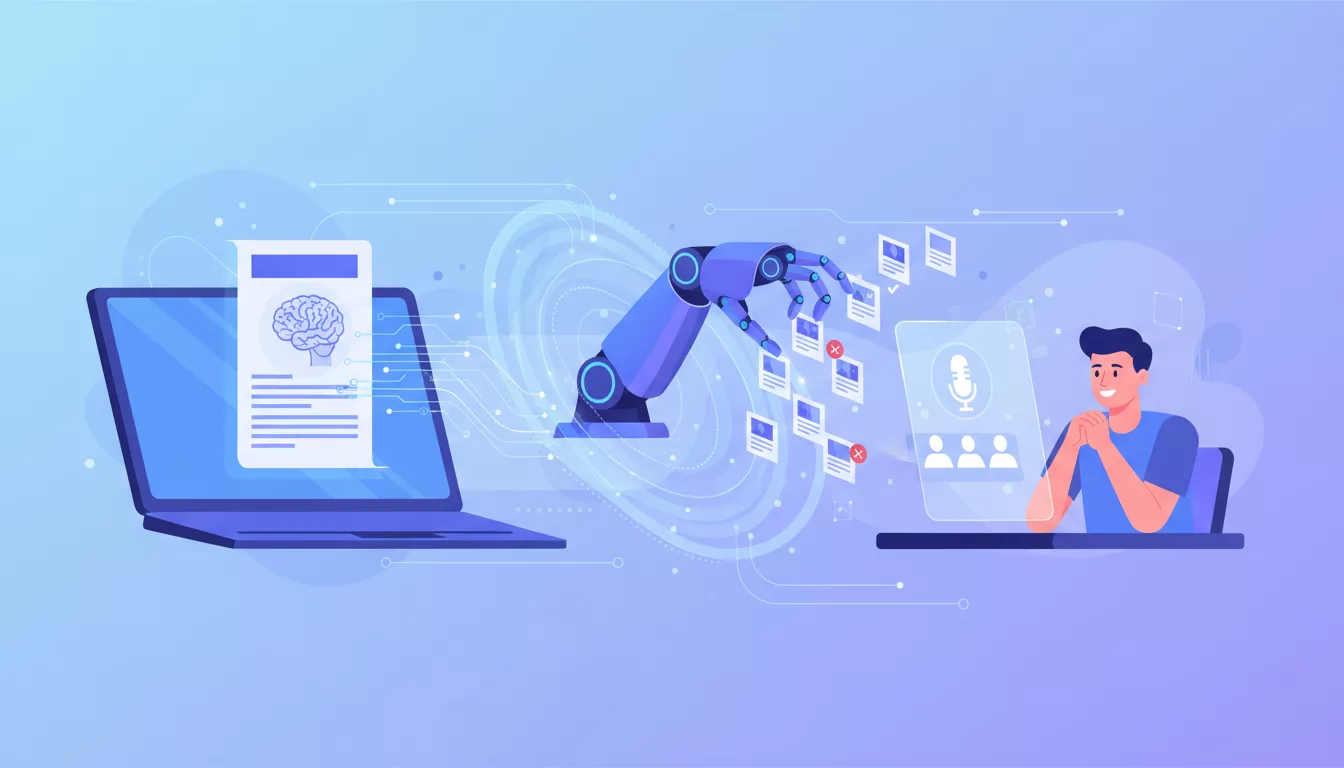
Five years ago, you could send the same resume to fifty jobs and expect a handful of callbacks. That world is gone. AI has reshaped how companies find candidates, how candidates find companies, and what happens in between. If you're job hunting in 2026 and you're not thinking about AI - both as a tool and as a gatekeeper - you're already behind.
But here's what most career advice gets wrong about this topic: they either tell you AI is a magic wand that'll land you a dream job, or they panic about robots replacing human connection. The truth is messier and more interesting than either extreme. AI is a powerful set of tools that can save you enormous time and effort - but only if you understand how it actually works on both sides of the hiring table.
How AI Changed Recruiting (And Why You Should Care)
The biggest shift happened quietly. Most mid-to-large companies now use some form of Applicant Tracking System with AI-powered screening built in. These aren't the keyword-matching dinosaurs from 2020. Modern ATS platforms use natural language processing to understand context, evaluate experience relevance, and rank candidates before a human recruiter ever sees your application. A 2025 study from Harvard Business School found that over 90% of Fortune 500 companies use automated screening, and roughly 75% of resumes are rejected before reaching a person.
That statistic should wake you up. It means your resume format and content aren't just competing with other candidates - they're competing with an algorithm's idea of what a good candidate looks like. And those algorithms have gotten surprisingly sophisticated. They can parse project descriptions, weigh the relevance of different job titles, and even assess career trajectory patterns.
Then there are AI screening interviews. Companies like HireVue, Spark Hire, and newer platforms have rolled out video interviews where an AI evaluates your responses in real-time. Some analyze word choice and structure. Others assess how clearly you communicate ideas. If you've done a virtual interview recently, there's a decent chance AI was scoring your performance alongside - or instead of - a human reviewer.
Chatbot-based first-round screening has also exploded. You apply for a role, and within minutes a chatbot pings you with qualifying questions. How many years of experience with Python? Are you open to relocation? What's your salary range? These feel casual, but your answers are being parsed and scored. Companies use them to filter high-volume roles fast - retail, customer service, sales, and increasingly mid-level positions in tech and healthcare.
The uncomfortable truth is that AI recruiting tools are imperfect. They can carry biases from their training data. They sometimes penalize non-traditional career paths. And they definitely struggle with career changers who have transferable skills but unconventional titles. If you're switching into tech from a non-technical background, this matters a lot. You need to understand what these systems are looking for so you can present your experience in a way that translates.
AI Tools That Can Actually Help Your Job Search
Now for the useful part. There's a growing ecosystem of AI tools designed specifically for job seekers, and some of them are genuinely good. Not miracle workers - but real time-savers that can sharpen your approach.
Resume optimization tools like Jobscan, Teal, and Kickresume can analyze a job posting and compare it against your resume, highlighting gaps in keywords and skills. This isn't about gaming the system. It's about making sure you're not accidentally hiding relevant experience behind vague language. When you're writing your resume summary, these tools can show you exactly which phrases the employer's ATS is likely scanning for. Pair that with strong action words and you've got a resume that speaks the machine's language without reading like it was written by one.
Job matching platforms have gotten smarter too. LinkedIn's AI-powered job suggestions are more accurate than they were even a year ago. But there are also newer platforms that go deeper - analyzing not just your listed skills but your career trajectory, industry preferences, and even salary patterns to surface roles you might not have considered. Some of the fastest-growing fields in 2026 are ones many candidates don't even know exist yet, and AI matching can bridge that awareness gap.
Interview prep is where AI tools really shine. ChatGPT, Claude, and purpose-built interview coaches can run you through behavioral interview questions specific to your target role, critique your answers, and help you develop the STAR-format stories that interviewers love. I've seen candidates go from rambling two-minute answers to tight, compelling responses in just a few practice sessions with AI coaching. It won't replace practicing with a real human, but it's available at 11 PM on a Sunday when your interview is Monday morning - and that accessibility matters.
LinkedIn optimization deserves its own mention. Your LinkedIn profile is essentially a second resume, and AI tools can help you rewrite your headline, about section, and experience descriptions for maximum visibility. Good LinkedIn profile optimization means showing up in recruiter searches, and AI can analyze which keywords are trending for your target roles. Some tools even suggest connection strategies and content topics that can boost your visibility in the algorithm.
Cover letter generators are a mixed bag, honestly. They can produce a serviceable first draft, but the best cover letters still need a human voice. Use AI to handle the structure and hit the right talking points, then rewrite it so it sounds like you. A strong cover letter should feel like a conversation, not a form response - and that's the one thing AI still struggles with.
The Risks Nobody Wants to Talk About
AI in job search has a dark side, and pretending it doesn't helps nobody.
The biggest risk is over-optimization. When everyone uses the same AI tools to tailor their resumes to the same job posting, you get a stack of applications that all look eerily similar. Recruiters have started noticing. I spoke with a hiring manager at a mid-size SaaS company last month who told me she can spot an AI-optimized resume within seconds - not because it's bad, but because they all hit the same beats in the same order. When every candidate's resume summary starts with "Results-driven professional with X years of experience in..." you've got a problem. You need the right skills on your resume, absolutely. But you also need to sound like a specific person, not a template.
Fake job listings are another growing issue. Scammers use AI to generate convincing job posts at scale, complete with fake company profiles and automated follow-up emails. Some estimates suggest that up to 20% of listings on major job boards in 2025 were either fraudulent or "ghost jobs" - positions companies post with no real intention of filling. AI makes these schemes cheaper and easier to run. If you receive a job offer that seems too good to be true after minimal interaction, it probably is. Always verify through official company channels and check platforms like Glassdoor for company legitimacy.
There's also the cookie-cutter problem. When you let AI write everything - your resume, your cover letter, your LinkedIn posts, your follow-up emails - you risk sounding generic across every touchpoint. Hiring managers talk to each other. If your application materials are polished but your actual conversation style is completely different, that disconnect raises red flags. Use AI as a starting point and an editor, not as a ghostwriter for your entire professional identity.
And let's talk about the equity issue. Not everyone has equal access to premium AI tools. Free tiers are limited. The best features cost money. Candidates who can afford $30-50/month subscriptions to multiple AI platforms have a real advantage over those who can't. This doesn't mean free tools are useless - they're not - but it does mean the playing field isn't as level as the marketing suggests.
Why Human Connection Still Wins
For all the hype around AI, the data on how people actually get hired hasn't changed as much as you'd think. Referrals still account for a disproportionate number of hires. A LinkedIn study from late 2025 found that referred candidates are 4x more likely to be hired than applicants who come through a job board. Four times. No AI tool can replicate that advantage.
This is why networking still matters enormously. And not the awkward "let me connect with 500 strangers" kind. Real networking means building genuine relationships with people in your industry, sharing useful insights, and being someone others actually want to help. AI can help you identify the right people to connect with and even draft initial outreach messages. But the relationship itself - the trust, the mutual respect, the willingness to vouch for someone - that's purely human.
Personal branding is the other piece that AI can support but never replace. Your brand is the story people tell about you when you're not in the room. It's built through consistent, authentic communication - the kind that shows up in how you write emails, how you engage on LinkedIn, and how you carry yourself in conversations. AI can help you refine your messaging, but the underlying substance has to be real.
Here's a practical example. Say you're preparing for a final-round interview. You've used AI to research the company, practice your "tell me about yourself" answer, and draft thoughtful questions to ask. Great. But what AI can't do is read the room when you're sitting across from a hiring manager who seems distracted. It can't help you make a joke that lands perfectly and breaks the tension. It can't tell you when to stop talking about your qualifications and just listen. Those instincts come from practice, self-awareness, and experience - the same things that make someone good at their actual job.
The candidates who do best in 2026 are using AI for preparation and humans for connection. They prepare thoroughly with AI tools, then show up as themselves. They use AI to get through the algorithmic gates, then rely on interpersonal skills to close the deal. And they know that a solid job search strategy combines both elements deliberately, not randomly.
Where This Is All Heading
Predictions are tricky, but a few trends seem nearly certain.
First, AI screening is going to get harder to game. Companies are already building detection layers that flag resumes showing obvious signs of AI optimization. The arms race between AI resume writers and AI resume screeners will push both sides toward more nuanced analysis. This actually benefits candidates with genuine experience and clear communication skills. If you've done the work and can articulate what you've accomplished, you'll stand out more - not less - as AI gets better at spotting filler.
Second, skills-based hiring will accelerate. AI makes it easier for companies to assess specific competencies rather than relying on proxies like degree pedigree or years of experience. This is good news for career changers, self-taught professionals, and anyone whose resume doesn't follow the traditional mold. Industry certifications are becoming more valuable precisely because they give AI systems concrete, verifiable data points to evaluate.
Third, the interview process will continue to evolve. We'll see more AI-assisted interviews in early rounds, with human interviews reserved for final stages. This means your ability to communicate clearly and concisely with AI systems becomes a real skill - one that's distinct from but related to traditional interview skills. The signals that you've made a good impression will still be recognizably human, but getting to that final conversation will increasingly require navigating AI gatekeepers.
Fourth, salary transparency and AI negotiation tools will change the offer stage. We're already seeing platforms that analyze compensation data and suggest negotiation strategies. By late 2026, it's realistic to expect AI tools that can help you negotiate a job offer by benchmarking your situation against thousands of similar negotiations. This levels the playing field for candidates who've historically been uncomfortable asking for more.
And fifth - this one's speculative but worth watching - we'll start seeing AI agents that manage entire job searches semi-autonomously. You define your criteria, the AI applies to matching roles, handles initial screening conversations, and only brings you in when there's a real opportunity worth your time. Early versions of this exist now. By 2027, it could be mainstream. The candidates who thrive will be the ones who know how to direct these tools effectively while maintaining the personal touch that ultimately seals the deal.
Practical Tips for Using AI Without Losing Yourself
So how do you actually put all of this together? Here's what I'd tell anyone starting a job search today.
Start by using AI to audit your current materials. Feed your resume into an AI tool along with three or four job postings you're interested in. Look at the gap analysis. Are there skills you have but haven't mentioned? Are you using language that matches what hiring managers are actually searching for? This initial audit alone can dramatically improve your callback rate without changing who you are or what you've done.
Next, use AI for first drafts but never final drafts. Let it generate a starting point for your resume bullets, cover letter, and LinkedIn sections. Then rewrite every line in your own voice. Read it out loud. If it doesn't sound like something you'd actually say in a conversation, change it. The goal is a document that's both optimized and authentic - and that combination is something only you can create.
Practice interviewing with AI at least three times before any real interview. Feed it the job description and ask it to run you through likely questions - both behavioral and technical. Record yourself answering. Listen back. You'll catch filler words, rambling, and unclear points that you'd never notice in the moment. Then do at least one practice round with a real person, because the dynamic is different and you need to be ready for both.
Build your remote work and digital communication skills deliberately. As more hiring processes happen virtually and AI tools become standard in the workplace, employers want candidates who are comfortable with technology. But they also want people who can communicate warmly through a screen - something that takes practice and intention.
Don't abandon traditional job search tactics. AI should augment your strategy, not replace it. Still attend industry events. Still reach out to former colleagues. Still send thoughtful, personalized messages to people whose work you admire. These human touchpoints generate the referrals and insider knowledge that no algorithm can replicate.
Finally, stay informed but don't panic. The AI hiring tools available today will look primitive in two years. The specific platforms don't matter as much as your ability to adapt, learn quickly, and present yourself clearly. Those are the same skills that have always mattered in a job search. AI just raises the stakes - and the rewards - for getting them right.
The job seekers who will come out ahead aren't the ones using the most AI tools. They're the ones using the right tools at the right moments, and knowing exactly when to put the technology aside and be a real person. That balance is the real competitive edge in 2026 - and honestly, it probably always will be.