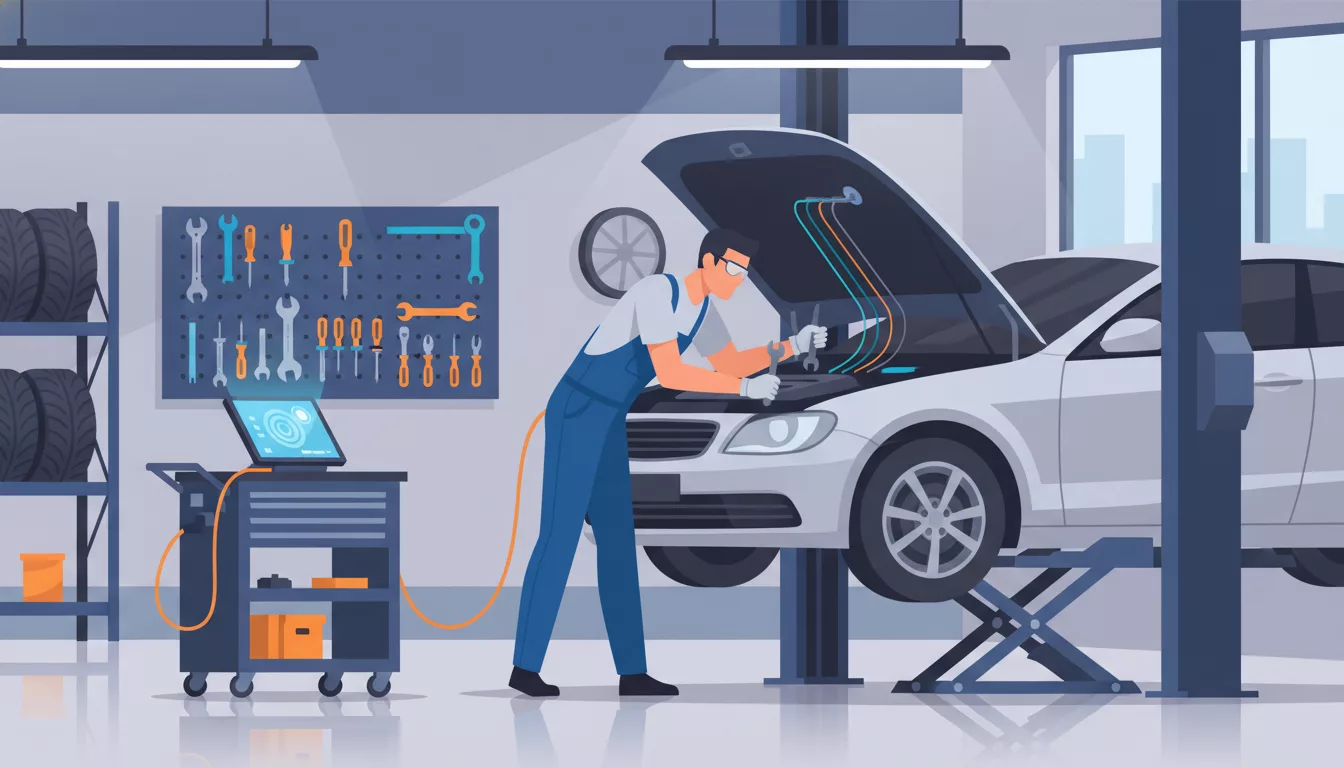
5:45 AM: Coffee and the Cold Concrete Floor
Most auto mechanics don't work banker's hours. The shop opens at 7, but if you're serious about the job, you're there by 6:15 to get your bay organized. The morning routine starts at home around 5:45 - shower, coffee, and boots that already smell like brake cleaner no matter how many times you wash them.
The drive to the shop is short for most techs. You pick a job close to home because commuting 45 minutes each way when you're already physically spent by 4 PM is a recipe for burnout. By the time you pull into the lot, two or three other techs are already there. The early birds get first pick on the day's jobs from the service board, and the good-paying ones go fast.
Walking into the shop in the morning has a specific feeling. Cold concrete, fluorescent lights, the faint smell of motor oil and cleaning solvent that never fully goes away. Your toolbox is right where you left it - a $15,000 rolling cabinet that you'll spend a decade paying off if you financed it as an apprentice. (Curious about what those paychecks look like? Check our auto mechanic salary guide for a realistic breakdown.)
6:30 AM: Pulling the Day's First Ticket
The service advisor has already loaded the day's appointments into the shop management system. You scan the board and grab a brake job on a 2019 Honda CR-V. Brakes are bread-and-butter work - predictable flat-rate hours, parts are common, and you can knock it out before most customers have finished their first cup of coffee.
Flat rate is the pay system that defines most mechanics' lives. You don't get paid by the hour you spend. You get paid by the hour the job is supposed to take according to a labor guide. If the guide says brake pads and rotors on a CR-V pays 1.8 hours and you finish in 1.2, you just earned 1.8 hours of pay in 1.2 hours of work. But if a seized caliper bracket bolt turns what should be 1.2 hours into 2.5 hours, you still only get paid 1.8.
This is why speed matters - but not at the expense of quality. The techs who cut corners to beat flat rate are the ones who generate comebacks, lose customer trust, and eventually get fired or pushed into a lower-paying position. The best mechanics are fast because they're experienced and organized, not because they're skipping steps.
7:15 AM: Brakes Done, Next Up - The Diagnostic Puzzle
You finished the brake job in just over an hour. Both rotors resurfaced, new pads, caliper slides cleaned and lubed, brake fluid condition checked. Quick test drive around the block to confirm - no pulsation, pedal feels solid, no pulling. Done.
Next ticket is where things get interesting: a 2021 Ford F-150 with a check engine light and a rough idle. The customer says it "started running funny last week." That description could mean a hundred different things. This is the diagnostic work that separates a parts swapper from a real technician.
You hook up the scan tool - not the $30 code reader from the auto parts store, but a professional-grade unit that reads live data, freeze frame information, and manufacturer-specific codes. The truck throws a P0301 (cylinder 1 misfire) and P0316 (misfire detected on startup). You pull up the misfire count data and cylinder 1 is showing 847 misfires while every other cylinder is under 10.
Could be a coil pack. Could be a spark plug. Could be a fuel injector. Could be a compression issue. The amateur move is to throw a coil at it and hope. The professional move is to test. You swap the coil from cylinder 1 with cylinder 3 and clear the codes. After a short run, the misfire followed the coil. That's your answer - bad coil pack. You quote the customer, get approval, install the new coil, clear codes, verify with a test drive. Misfire count stays at zero. Done right.
9:30 AM: The Oil Change Assembly Line
Between the bigger jobs, there are always oil changes. Some shops have dedicated lube techs for these, but in smaller independent shops, everyone does their share. An oil change pays maybe 0.3 to 0.5 flat-rate hours depending on the vehicle. You're not getting rich on oil changes, but they keep the bays turning and they're how you build relationships with customers who eventually come back for bigger work.
The thing about oil changes is they're also your chance to inspect the entire underside of the vehicle. You're looking for fluid leaks, worn bushings, torn CV boots, brake pad thickness, tire condition, exhaust damage. A good multi-point inspection during an oil change catches problems early - better for the customer and better for the shop's revenue.
Today's oil change is on a 2017 Subaru Outback. While you're under it, you notice the rear differential is seeping fluid from the pinion seal. Not catastrophic yet, but it'll get worse. You note it on the inspection sheet, take a photo, and the service advisor will call the customer with a quote. Maybe they fix it now, maybe they wait six months. Either way, you documented it.
10:30 AM: The Job That Makes You Question Your Career Choices
Every mechanic has one of these per week minimum. Today it's a 2015 Chevy Cruze that needs a water pump. On paper, the labor guide says 3.2 hours. In reality, GM designed this engine with the water pump driven internally by the timing chain, which means you're essentially doing a timing job to replace a $45 water pump.
You're pulling the front bumper cover, draining coolant, removing the serpentine belt, timing cover, timing chain tensioner, chain guides, and the chain itself - just to access the water pump bolts. Then you reverse the whole process, refill coolant, bleed the system, run it up to temperature, check for leaks, verify the timing is correct, and test drive.
The engineering decision that put this water pump inside the timing cover was made by someone who never had to work on the engine. Mechanics talk about stuff like this constantly. Every brand has its horror stories - BMW's plastic cooling systems, Ford's cam phasers, Chrysler's 3.6L rocker arm failures. You develop strong opinions about vehicle engineering based on what you've had to tear apart.
Three hours in, you're knuckle-deep in this Cruze, your back hurts from leaning over the fender, and you've already dropped two bolts into the abyss behind the engine. A telescoping magnet retrieves one. The other required removing the intake manifold. This is the job that eats your flat-rate efficiency for the day.
12:15 PM: Lunch - If You Can Call It That
Lunch for most mechanics is 30 minutes eaten in the break room, at your toolbox, or in your car. Some shops are strict about the 30-minute window. Others let you take a full hour if the schedule allows. Today you eat a sandwich while scrolling through a forum thread about a TSB (Technical Service Bulletin) related to that F-150 coil issue from earlier. Turns out Ford updated the coil pack design in 2022. Good to know for next time.
The break room in an auto shop is a specific kind of place. There's always a mini fridge that needs cleaning, a microwave that's seen better decades, a table with automotive trade magazines from 2019, and a TV that's either showing sports or nothing. The conversation is about cars, trucks, terrible engineering decisions, and which tech just bought what tool.
Speaking of tools - mechanics in most shops supply their own hand tools, and often their own diagnostic equipment. Your toolbox represents tens of thousands of dollars in investment. Snap-on, Matco, Mac, and Cornwell truck drivers show up weekly like traveling salesmen, and it's alarmingly easy to put $200 worth of new sockets on a weekly payment plan. The tool debt trap is real, and every experienced mechanic warns apprentices about it.
12:45 PM: Back at It - Alignment and Suspension
The afternoon starts with an alignment on a 2020 Toyota Tacoma. The customer says it pulls right and the steering wheel is off-center. You put it on the alignment rack and immediately see the problem - the left front toe is way out of spec, probably from hitting a pothole. Camber and caster are fine, so it's not a bent component - just needs adjustment.
Alignments are satisfying work when everything cooperates. You adjust toe, center the steering wheel, verify all four corners are within spec, and print the before-and-after alignment report. The green numbers on the screen feel like a small victory every time. Test drive confirms - tracks straight, steering wheel centered, no pull. Clean job.
But then the next vehicle on the alignment rack is a 2012 Chevy Silverado with 180,000 miles. The alignment angles are all over the place because the ball joints, tie rod ends, and idler arm are completely worn out. You can't align a truck that has play in every steering and suspension joint. The alignment gets rejected and converted into a suspension repair estimate. That's a $1,500-2,000 job that'll take most of tomorrow.
2:00 PM: The Comeback
Every mechanic dreads the word "comeback." It means a customer returned because something you fixed didn't hold, or a new problem appeared after your work. Today, a customer from last week is back. You replaced an alternator, and now the battery light is on again.
Your stomach drops a little. You pull the car in, check the alternator output - it's charging at 14.2 volts, which is perfect. The belt is tight. All connections are clean. So why is the battery light on? You dig deeper and find that the body control module is throwing a communication error with the instrument cluster. The alternator replacement required disconnecting the battery, and the BCM lost its learned parameters during the reset.
A quick relearn procedure with the scan tool fixes it. The battery light goes off. Crisis averted - it wasn't actually your fault, but the customer doesn't know that and doesn't care. What they know is they came back, and that's a negative experience regardless. You shake their hand, apologize for the inconvenience, and make sure they leave happy. Customer retention is everything in this business.
3:15 PM: Teaching the New Guy
Most shops have at least one apprentice or junior tech. Today, the new guy is struggling with a tire pressure monitoring system reset on a Nissan. He's been at it for 20 minutes and the TPMS light won't go off. You walk over, show him the specific relearn procedure for that generation of Nissan (hold the hazard button, turn ignition on, wait for the horn chirp, then drive in a specific pattern), and it takes about three minutes.
Teaching is part of the job whether you signed up for it or not. The senior techs who refuse to help new guys create a toxic shop culture. The ones who share knowledge freely build loyalty and eventually get some of that work taken off their plate when the apprentice becomes competent. It's a long game, but it pays off. (Thinking about getting into the trade? Our guide to becoming an auto mechanic covers the full path from zero experience to certified tech.)
4:00 PM: The Late Add-On
It's 4 PM and you were planning to start wrapping up. Then the service advisor walks over with an apologetic smile. A regular customer just pulled in with a no-start condition and they're stuck in the parking lot. Can you squeeze one more in?
You walk out to the car - a 2018 Hyundai Elantra. It cranks but won't fire. Quick check: the fuel pump primes (you can hear it cycle when you turn the key to ON), spark plugs are firing (you pulled one and grounded it), but the injectors aren't pulsing. You check for injector pulse with a noid light - nothing. That points to a crank sensor or cam sensor issue since the PCM needs those signals to trigger the injectors.
You check the crank sensor signal with your scope. Flat line. Unplug the connector, inspect it - corrosion on two of the three pins. Clean the connector, apply dielectric grease, plug it back in. The engine fires immediately. You write it up as a corroded connector, recommend monitoring it, and suggest replacement if the issue returns. The customer drives away before closing time.
That right there is what makes this job interesting. A no-start condition could be fifty different things, and you narrowed it down to a corroded connector pin in twenty minutes. That kind of diagnostic skill takes years to build and it's worth real money.
4:45 PM: Closing Out the Day
The shop closes at 5, but your day isn't done at 5. You spend the last 15-20 minutes cleaning your bay, putting tools away, logging your hours in the shop management system, and reviewing tomorrow's schedule. If you have a job in progress (like that Cruze water pump), you make sure everything is organized so you can pick up exactly where you left off in the morning.
You also restock anything you used from your consumables drawer - brake cleaner, shop towels, nitrile gloves, electrical tape. Running out of brake cleaner mid-job is a productivity killer, and those small details add up over a week.
Today's flat-rate tally: about 9.2 hours billed in an 8-hour day. That's a solid day. Some days you only flag 6 hours because a diagnostic nightmare ate your afternoon. Other days you hit 12+ hours because every job went smooth and the schedule was stacked. Over a pay period, it averages out - but the inconsistency is something you either learn to manage or it drives you out of the trade.
What Nobody Tells You About Being a Mechanic
The money can be surprisingly good - if you're skilled. Entry-level lube techs might start at $14-18/hour, but experienced diagnostic technicians with ASE certifications routinely earn $60,000-$80,000. Master techs at dealerships or busy independent shops can push past $90,000 with overtime and efficiency bonuses. The pay gap between a parts swapper and a real diagnostician is enormous.
Your body keeps score. Mechanics develop specific physical problems over time - lower back pain from leaning over fenders, knee problems from kneeling on concrete, hand and wrist issues from repetitive wrench work, chemical exposure from solvents and fluids. The techs who last long-term are the ones who use creepers instead of lying on bare concrete, wear gloves consistently, and don't try to muscle through every stuck bolt.
The tool investment is serious. A working mechanic's toolbox and specialty tools can easily represent $30,000-$50,000 in investment. Tool trucks offer financing, but the interest rates aren't great and the weekly payments add up. New techs should start with quality basics and add specialty tools as they need them, not before.
Technology is changing everything. Modern cars are rolling computers. You'll spend as much time with a scan tool and wiring diagrams as you do with wrenches. Electric and hybrid vehicles are adding high-voltage systems that require specific certifications and safety equipment. The techs who embrace the technology earn more. The ones who refuse to learn past carburetors are finding fewer and fewer jobs.
Shop culture matters more than pay rate. A shop that pays $2 more per flat-rate hour but has toxic management, broken equipment, and no parts support will cost you money in the long run. The best mechanics are selective about where they work. They look for clean shops with good equipment, fair dispatching, a reasonable parts markup policy, and a service team that sells work honestly. A bad shop will burn you out in a year.
Comebacks are inevitable - it's how you handle them. Every mechanic, no matter how good, will have a repair come back at some point. A part fails prematurely, a connector you didn't touch develops an issue, or you simply miss something. How you respond to comebacks defines your reputation. Own it, fix it, and learn from it.
Is Being an Auto Mechanic Right for You?
This career works for people who genuinely enjoy solving mechanical and electrical problems, don't mind getting dirty, and can handle the physical demands. It's not a fallback career for people who "aren't good at school" - modern automotive repair requires continuous learning, electrical theory, computer skills, and the ability to read and interpret technical data.
The entry path is straightforward. Many community colleges and trade schools offer automotive technology programs that take 1-2 years. Some dealerships and shops hire entry-level helpers and train from scratch. ASE certifications (there are over 40 specialty areas) are the industry standard for proving competence, and most employers either require them or pay more if you have them.
The job market is strong and getting stronger. The average age of an auto technician keeps climbing, retirements are accelerating, and not enough new techs are entering the field. Shops are competing for talent in ways they never did 15 years ago - signing bonuses, tool allowances, relocation packages. If you're good, you'll have options.
Ready to start? Review our complete guide to becoming an auto mechanic, prepare with real mechanic interview questions, or check the latest auto mechanic salary data to see what technicians earn in your area.